Beat Elbow Pain: Simple Daily Habits & Quick Fixes for Lasting Relief
With Memorial Day weekend rapidly approaching, many of us are eagerly shifting into summer mode. We are dragging heavy coolers out of the garage, aggressively pulling weeds to get the garden BBQ-ready, and dusting off our racquets for that first long weekend tennis match of the season.
But as the seasonal excitement ramps up, so does an unwelcome guest: a sharp, nagging pain on the outside or back of your elbow.
When elbow pain strikes, our first instinct is usually to blame a single, dramatic event. We assume we swung a racquet too hard or lifted something far too heavy. However, the reality of elbow inflammation is much stealthier. More often than not, the culprit isn't a sudden injury, but the cumulative effect of innocent-looking daily activities. The way you type, the way you carry your groceries, and even how you lean on your desk while reading emails can create micro-traumas that eventually boil over into serious inflammation.
Let's pull back the curtain on the secret triggers of elbow pain and, more importantly, discover the simple, actionable modifications you can make today to reclaim your active lifestyle.

Understanding Your Elbow: The Mechanics of Inflammation
Before we can modify your activities, we need to understand what's actually happening beneath the skin. When we talk about elbow inflammation, we are generally dealing with overuse conditions.
Think of your elbow joint as a busy intersection where bones, muscles, and tendons meet. The two most common "traffic jams" at this intersection are:
- Tendinitis (e.g., Tennis Elbow): This involves the inflammation of the tendons that attach your forearm muscles to the bony bumps on the outside (lateral) or inside (medial) of your elbow. Every time you grip, twist, or lift, these tendons bear the load. When overworked without adequate rest, they develop microscopic tears.
- Bursitis: Your elbow has a small, fluid-filled sac called a bursa that acts as a cushion between the bone and the skin. When subjected to prolonged pressure (like leaning on a hard surface for hours), this sac can become irritated and swell up.
Both conditions thrive on repetitive strain. The good news? Because they are fueled by your daily habits, they can also be resolved by tweaking those same habits.
Your Daily Pain Triggers: Deconstructing Common Activities
Let's break down the most common daily triggers and look at the exact points of stress, alongside easy "micro-modifications" to reduce that strain.
1. The Memorial Day Yard Work & Household Chores
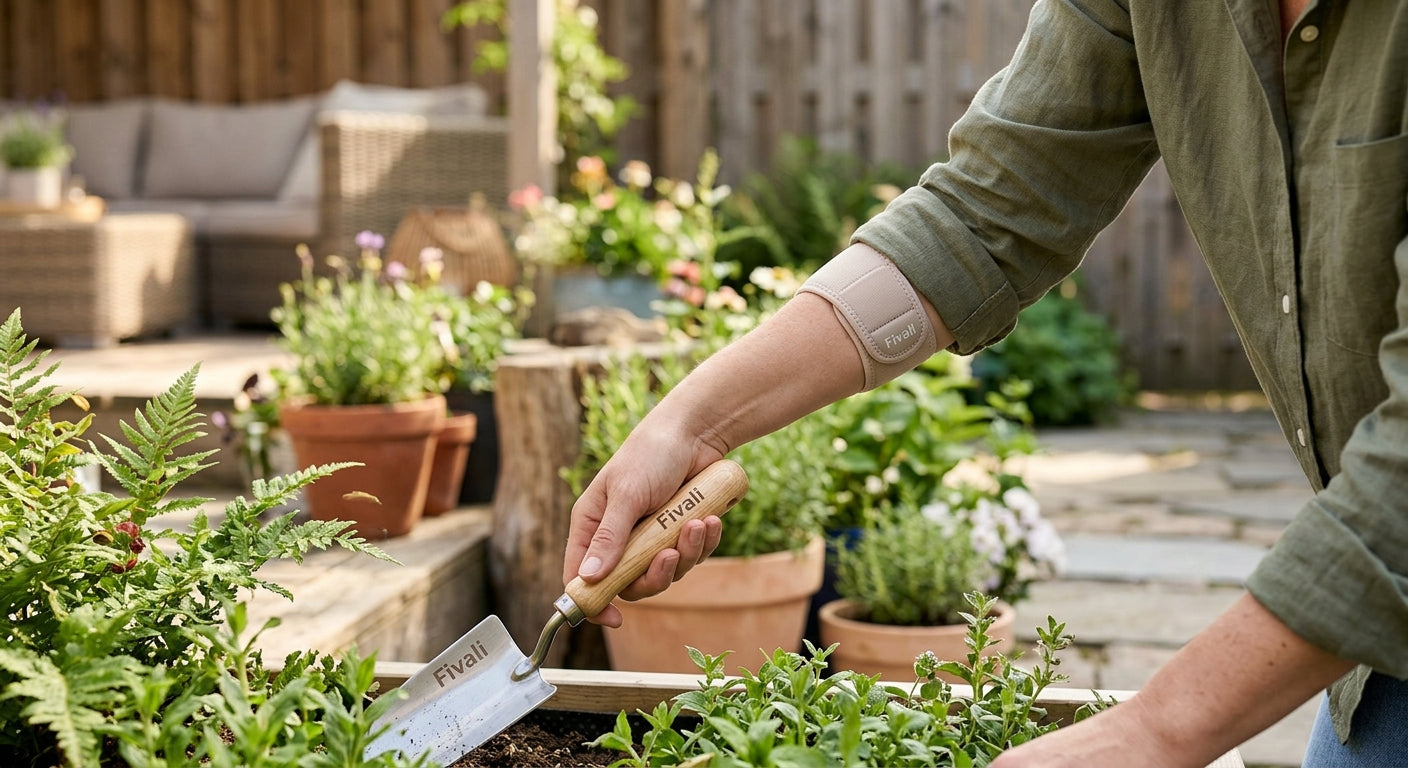
Whether you are planting new flower beds or aggressively scrubbing the patio furniture for the holiday weekend, chores require repetitive gripping and twisting.
- The Biomechanics: When you grab a trowel or a heavy sponge with your palm facing down (pronation) and squeeze tightly, you place maximum tension directly on the lateral epicondyle—the exact spot where tennis elbow originates.
- The Modification: Change your grip and your leverage. When lifting watering cans or bags of mulch, use an underhand grip (palms facing up) to shift the load onto your stronger bicep muscles rather than your forearm tendons. When scrubbing or gardening, consciously loosen your grip by 20%. Let the tool do the work, not your tendons.
2. The Desk Warrior Routine
You might not consider typing a high-impact sport, but your tendons disagree.
- The Biomechanics: Sitting with your keyboard pushed far back forces you to extend your arms and float your wrists in an upward, cocked position. Holding this "wrist extension" for eight hours a day keeps your forearm muscles in a state of constant, low-grade contraction. Furthermore, resting your elbows directly on hard desk edges to support your posture places direct mechanical pressure on the bursa sac.
- The Modification: Bring your keyboard closer to the edge of the desk so your elbows rest naturally by your sides at a 90-degree angle. Invest in a soft gel wrist rest to keep your hands neutral, eliminating the constant upward tension on your forearms.
3. Weightlifting & Fitness
Staying active is vital, but the gym is a minefield for elbow strain if your form is off. Many fitness enthusiasts find themselves asking, can i workout with tennis elbow? The answer is yes, provided you aren't aggravating the affected tendons.
- The Biomechanics: Exercises like reverse curls, upright rows, or gripping a barbell with a "death grip" overload the extensor muscles.
- The Modification: If you're wondering what weight lifting exercises can i do with tennis elbow, the key is moving to a neutral grip. Switch from straight barbells to dumbbells, and hold them with your palms facing each other (a "hammer grip"). This simple rotation of the wrist completely bypasses the inflamed outer tendon.
4. Racquet Sports
As summer leagues kick off, tennis and pickleball injuries spike.
- The Biomechanics: Hitting a late backhand forces you to rely entirely on your forearm and wrist to flick the ball over the net, rather than using your core and shoulder rotation. Additionally, a racquet grip that is too small forces your hand to over-squeeze to prevent the racquet from twisting on impact.
- The Modification: Have a professional check your racquet grip size. Over-wrapping your handle by even a fraction of an inch can dramatically reduce the muscular effort required to hold it. Focus on footwork to ensure you hit the ball in front of your body, engaging your whole arm and torso.

The "Supportive Device Bridge": When Modifications Need Backup
Behavioral modifications are incredibly powerful, but life doesn't always allow us to completely stop moving. Sometimes, your job requires eight hours of typing, or your tendons need an extra layer of protection while healing from previous damage. This is the exact moment when supportive devices transition from being "just accessories" to being necessary bridges back to a pain-free life.
Supportive devices aren't magic—they are biomechanical tools designed to offload stress or provide therapeutic compression. Understanding how they work helps you determine exactly what you need.
Dispersing the Tension
If you suffer from tendon pain (like tennis or golfer’s elbow), your goal is to prevent the muscle contractions in your forearm from pulling forcefully on your inflamed elbow joint. A counterforce brace works by applying targeted pressure to the muscle belly of your forearm, just below the elbow. This essentially creates a "new" anchor point. When you grip or lift, the tension stops at the strap instead of traveling all the way up to your injured tendon.
When searching for the best brace for tennis elbow or the best elbow brace for tendonitis, you are looking for this specific tension-blocking capability. You may also hear people refer to a counter force strap, which is simply another name for this targeted offloading tool.
Compression and Cushioning
If your issue is general joint achiness, swelling, or bursa sac irritation, your strategy changes. Rather than a thin strap, you want something that encompasses the joint. An elbow compression sleeve for bursitis works by keeping the joint warm, promoting blood flow, and gently squeezing the tissue to limit swelling.
For those who are notorious desk-leaners or who perform groundwork where elbows touch hard surfaces, adding an elbow pad for bursitis provides a crucial layer of physical foam cushioning to protect that sensitive fluid sac from further trauma.
When beginners weigh a tennis elbow brace vs compression sleeve, the decision always comes down to the source of the pain: pinpoint tendon pain usually calls for a strap, while generalized swelling or bursa irritation calls for a sleeve.

Frequently Asked Questions (FAQ)
Q: What's the difference between tendinitis (like Tennis Elbow) and bursitis in the elbow?
A: Tendinitis involves the inflammation of tendons connecting forearm muscles to the elbow, often due to repetitive strain causing microscopic tears. Bursitis is the inflammation of the bursa, a fluid-filled sac that cushions the elbow, typically caused by prolonged pressure or irritation.
Q: How do everyday activities lead to elbow inflammation?
A: Many daily actions, such as gripping tools with palms down, maintaining cocked wrists while typing, using a "death grip" in weightlifting, or hitting racquet sports with poor form, create repetitive micro-traumas. These cumulative strains overload tendons and irritate bursae, leading to inflammation.
Q: When should I consider using an elbow support device?
A: Supportive devices become beneficial when behavioral modifications alone aren't enough, or when your activities make it impossible to avoid strain completely. They act as a "bridge" to support healing and prevent further injury while you continue with necessary movements.
Q: Which type of elbow support is right for me: a counterforce strap or a compression sleeve/pad?
A: For pinpoint tendon pain (like tennis elbow), a counterforce strap applies targeted pressure below the elbow to offload stress from the inflamed tendon. For general joint achiness, swelling, or bursitis, a compression sleeve or an elbow pad for bursitis provides warmth, promotes blood flow, limits swelling, and offers cushioning against impact.
Q: How long does it take for elbow pain to improve with lifestyle changes?
A: Minor flare-ups may subside in a few weeks with consistent activity modification and proper support. However, chronic tendinitis can take several months to fully heal due to the lower blood supply to tendons.
Q: Should I use ice or heat for my inflamed elbow?
A: In the first 48-72 hours after a sharp flare-up, ice is recommended to reduce acute swelling. For chronic, stiff, and lingering pain, gentle heat can help loosen tissues and promote blood flow before activity.
Your Personalized Elbow Health Checklist
Managing elbow inflammation isn't about giving up the activities you love; it's about getting smarter about how you perform them. As you gear up for the summer season, use this mental checklist to stay injury-free:
- Check your grip: Are you white-knuckling your steering wheel, gardening tools, or weights? Loosen up by 20%.
- Flip your palms: Whenever possible, carry objects (like grocery bags or coolers) with your palms facing forward or up, utilizing your biceps rather than straining your forearms.
- Optimize your desk: Keep your keyboard close and stop using your elbows as kickstands on hard surfaces.
- Listen to early warnings: Ache is a request for change; sharp pain is a demand to stop.
- Utilize smart support: If you know an activity triggers you, bridge the gap with an appropriate compression sleeve or offloading strap before the pain becomes unmanageable.
By making these subtle, biomechanical adjustments to your daily routine, you can extinguish the slow burn of elbow inflammation and confidently get back into the swing of things.