How Back Brace Materials Impact Heat Moisture and Skin Comfort

As the weather warms up and we gear up for summer activities—whether that means hauling out the grill for Memorial Day, tackling ambitious yard work, or finally getting back to your favorite outdoor sports—staying active is top of mind. But if you rely on a back support, this active season brings a familiar, uncomfortable dread.
You strap your support on, head outside, and within thirty minutes, your midsection feels like it's trapped in a sauna. It’s sweaty, itchy, and wildly uncomfortable.
Most people assume this discomfort is just the inevitable price you pay for spinal support. But what if the problem isn’t the brace itself, but the microscopic science of the fabric it's made from?
Understanding the relationship between fabric properties, heat retention, and your skin is the secret to transforming your daily comfort.

The Hidden World Under Your Gear
To understand why some materials feel terrible after an hour while others feel virtually weightless, we have to look at the "microclimate"—the tiny layer of space directly between your skin and the fabric.
When you exert yourself, your body generates heat. Your body's brilliant, natural cooling mechanism kicks in: sweating. As sweat evaporates off your skin into the air, it pulls heat away, cooling you down.
However, when you wrap a dense, non-porous material around your torso, you completely disrupt this process. The sweat has nowhere to go. It pools on your skin, the heat is reflected back into your body, and that microclimate quickly becomes a humid, irritating swamp. When you are distracted by this intense discomfort, it's almost impossible to focus on proper body mechanics, like how to fix an arched lower back during your exercises.
Material Science 101: Decoding the Fabric
To beat the heat, textile engineers look at three fundamental properties. Understanding these will give you a massive "aha" moment the next time you compare different supports.
1. Breathability and MVTR
Breathability isn't just about poking holes in fabric. In material science, we measure it using the Moisture Vapor Transmission Rate (MVTR). It measures how easily water vapor (sweat that has turned into gas) passes through the fabric. High MVTR means the fabric lets your skin "breathe" at a microscopic level, preventing the initial buildup of liquid sweat.
2. Moisture-Wicking (Capillary Action)
Here is a common misconception: absorbing sweat is a good thing. It's actually not. Cotton absorbs sweat, but it holds onto it like a sponge, becoming heavy and soggy.
True moisture-wicking materials utilize a scientific principle called capillary action. The fibers are engineered with microscopic channels that pull liquid sweat away from your skin and push it to the garment's outer surface, where it spreads out and evaporates quickly.
3. Thermal Insulation vs. Dissipation
Some materials are natural insulators (think rubber and dense foams). They have low thermal conductivity, meaning they trap body heat. This is great for a wetsuit in freezing water, but terrible for a summer hike. Conductive or highly ventilated materials, by contrast, allow heat to dissipate outward.

Comparing Common Support Materials
Let's look at how the most common materials stack up for comfort.
- Traditional Neoprene: Neoprene is a synthetic rubber. It offers fantastic compression and firm support, but it is notoriously non-breathable. It traps heat and moisture almost completely. While great for short, specific therapeutic sessions, it is the leading culprit for overheating during prolonged wear.
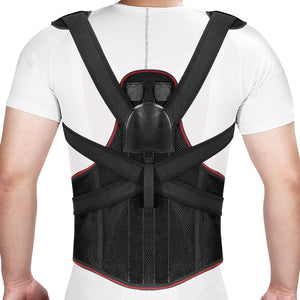
- Polyester Mesh and Nylon Blends: These synthetics are the gold standard for a breathable back brace. Woven into a mesh pattern, they offer high MVTR. More importantly, nylon and treated polyesters excel at capillary action, actively wicking sweat away from your skin to keep you dry.
- Cotton and Natural Blends: Soft to the touch and initially very comfortable. However, because cotton lacks moisture-wicking properties, it will quickly saturate with sweat. Once wet, it causes friction and takes a long time to dry.

The Domino Effect: Heat, Friction, and Skin Breakdown
Why does all this material science matter to the average person? Because wearing the wrong fabric sets off an uncomfortable domino effect.
When sweat is trapped by a non-breathable material, it softens the outer layer of your skin (a process called maceration). Soft, wet skin is highly vulnerable to friction. Every time you bend, twist, or walk, the fabric rubs against this weakened skin.
This rapidly leads to a painful condition commonly known as brace rash—a highly irritating red friction burn that can sideline you from your activities. Many people mistakenly believe they are allergic to their gear when, in reality, they are simply suffering the physical effects of a poor microclimate.
Furthermore, trapped sweat and body oils act as an acid over time, slowly degrading the elastic fibers and structural integrity of the support itself. Choosing superior materials doesn't just protect your skin; it extends your gear's life.
Frequently Asked Questions
Why do I sweat so much exactly where the support sits?
Because the material is physically blocking your body's natural evaporative cooling process. Without airflow, your body keeps pumping out sweat in a desperate attempt to cool that specific patch of skin, creating a vicious cycle of overheating.
Is there a connection between how snug my gear is and how much I sweat?
People frequently wonder: should a back brace be tight? Yes, it needs to be snug to provide structural support. However, tightness amplifies friction. If you have a very tight fit combined with a non-breathable material, you are practically guaranteeing skin irritation. Pair a snug fit with high-quality wicking fabrics.
Are there hypoallergenic options?
Yes! If you have highly sensitive skin, look for latex-free synthetic mesh blends. Avoid thick rubber and choose advanced 3D-knit fabrics to drastically reduce the risk of both contact dermatitis (allergies) and friction rashes.
Empowering Your Next Step
You don't have to choose between protecting your spine and feeling comfortable in your own skin. The technology exists to give you the best of both worlds.
By understanding how moisture-wicking and breathability function at a structural level, you are now equipped to look past basic marketing claims. As you continue your journey to find the perfect support system for your active lifestyle, you know exactly which fabric properties to prioritize to stay cool, dry, and fully focused on the activities you love.