Unlock Unstoppable Movement: How Your Ankle Masters Multi-Directional Stability

Picture this: You are at a Fourth of July backyard barbecue. A casual game of flag football breaks out on the grass. You sprint forward, plant your foot hard to dodge a defender, and instantly change direction. In that split second, your body absorbs a massive amount of force—yet you seamlessly push off and keep running.
We rarely think about our ankles until they hurt, but that effortless pivot is a biomechanical miracle. As we head into peak summer for outdoor sports, hiking, and holiday activities, our ankles are put to the ultimate test. They must constantly adapt to forward sprints, sudden stops, sideways shuffles, and unexpected rotations, all while carrying our entire body weight.
But how exactly does this relatively small joint manage to stabilize such intense, multi-directional movement? The answer lies in a beautifully orchestrated system of tendons, ligaments, muscles, and nerves. Let’s dive into the fascinating mechanics of your ankle and uncover why it is so much more than just a simple hinge.
The Ankle's Core Team: Anatomy 101
To understand how the ankle handles complex movements, we first need to meet the players on the field. The ankle isn't just one bone; it’s a complex intersection where the leg meets the foot, relying on three main active and passive structures to keep you upright.
- The Bones (The Foundation): The tibia (shinbone) and fibula (the thinner bone on the outside of the leg) meet the talus (a foot bone) to create the primary ankle joint. Just below that is the subtalar joint, which allows your foot to rock side to side.
- The Ligaments (The Seatbelts): Ligaments are strong, fibrous bands of tissue that connect bone to bone. Their primary job is passive stability. Like a seatbelt in a car, they engage and pull tight only when the joint is pushed to its limit, preventing the bones from separating.
- The Muscles and Tendons (The Engine and Cables): Muscles are the active stabilizers. They generate the force needed to move. Tendons are the thick, durable cables that attach these muscles to your bones. When a muscle contracts, it pulls the tendon, which then pulls the bone to create movement or act as a brake to slow movement down.

Deconstructing Multi-Directional Movement: Managing the Forces
If the ankle only moved up and down, stabilizing it would be simple. But life—and sports—happens in 3D. Your ankle must manage "force vectors" from multiple planes simultaneously. Here is how your anatomy responds to different directions of movement:
1. Forward and Backward (Sagittal Plane)
When you run forward or brake to a stop, your ankle moves through plantarflexion (pointing the toes down) and dorsiflexion (pulling the toes up).
- The Mechanism: As you push off the ground, your massive calf muscles contract, pulling on the Achilles tendon to generate explosive forward power. When you land, muscles on the front of your shin actively brake your momentum, controlling your foot's descent so it doesn't just slap the ground.
2. Side-to-Side (Frontal Plane)
Imagine shuffling sideways on a tennis court or navigating a rocky hiking trail. Your foot must invert (roll inward) and evert (roll outward) to maintain a flat connection with the ground.
- The Mechanism: The muscles on the outside of your calf (the peroneals) are your primary defense against rolling your ankle outward. If you step on an uneven rock and your foot abruptly rolls inward, these muscles instantly fire to pull it back. If the force is too fast or too heavy, your lateral ligaments (the "seatbelts" on the outside of the ankle) snap tight to physically stop the joint from giving way.
3. Rotational Forces (Transverse Plane)
This is the most complex movement. Think of planting your foot and twisting your entire body to look behind you or swinging a golf club.
- The Mechanism: Rotational forces require the highest level of coordination. The ligaments connecting your two leg bones (the syndesmosis) must hold firm to prevent the bones from splaying apart under twisting pressure, while a symphony of deep lower leg muscles fire in sequence to control the rotation.

The Control Center: Neuromuscular Integration & Proprioception
Strong muscles and tough ligaments aren't enough to prevent injury. They need a conductor to tell them when to work. This brings us to the secret weapon of ankle stability: Proprioception.
Proprioception is your body's subconscious ability to sense its position in space. Inside your ankle’s ligaments, tendons, and joint capsules are microscopic sensors called mechanoreceptors.
When you accidentally step in a hidden pothole, your ankle starts to roll. Instantly, these sensors detect the rapid stretch of the ligament and fire a warning signal up your spinal cord to your brain. Your nervous system processes this threat in milliseconds and sends a command back down to the peroneal muscles on the outside of your leg, yelling, "Contract now!"
The muscles fire, acting as a dynamic brake to catch your ankle before the ligament tears. This entire conversation between your ankle and your brain happens faster than you can blink. When people talk about having "good balance," they are actually talking about having a highly tuned proprioceptive and neuromuscular system.

When the System Fails: The Mechanics of a Sprain
So, if our ankles are so perfectly designed, why are sprains so common?
Injuries happen when the physical forces placed on the ankle exceed the capacity of the muscles to brake and the ligaments to hold. The most common vulnerability point is during a combination of plantarflexion and inversion—essentially, landing with your toes pointed down and your foot rolling inward.
In this vulnerable position, your bony architecture offers the least amount of lock-in support, leaving the lateral ligaments on the outside of the ankle to do all the heavy lifting. If your neuromuscular reaction time is just a fraction of a second too slow, the ligament overstretches or tears.
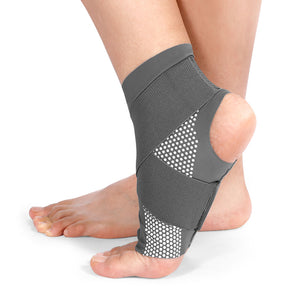
Once a ligament is stretched, those microscopic proprioceptive sensors are damaged. This creates a vicious cycle known as chronic ankle instability. The brain no longer receives fast, accurate feedback about the ankle's position, making recurrent rolls far more likely. This is precisely why exploring a dedicated ankle instability brace becomes a critical consideration for many individuals looking to regain confidence after an injury.
Building a Better Foundation: Prevention and Support
Understanding how your ankle stabilizes in multiple directions changes how you view joint care. It’s not just about doing calf raises for strength; it’s about training the entire system to react to unpredictable forces.
Incorporating multi-directional lunges, single-leg balance exercises on uneven surfaces, and agility drills can help retrain your nervous system. If you feel your foundation is already compromised, finding the right ankle support for weak ankles is an excellent way to bridge the gap between vulnerability and active confidence.
External supports can also play a fascinating role in your proprioceptive system. Wearing a snug compression ankle brace does more than physically restrict bad movements; the gentle pressure against your skin stimulates surface nerve receptors, giving your brain heightened feedback about where your joint is in space. Naturally, understanding how to wear ankle support optimally helps you get this sensory benefit without restricting natural muscle engagement.
Frequently Asked Questions About Ankle Stability
Why is my ankle prone to repeated sprains or instability?
After an initial sprain, the ligaments can stretch, and the tiny sensory receptors (mechanoreceptors) within them can be damaged. This impairs your ankle's proprioception, delaying the crucial signals to your muscles to react and stabilize the joint, making it more susceptible to future rolls and chronic instability, as explained in the "When the System Fails" section.
How do muscles and ligaments contribute differently to ankle stability?
Both are vital and play distinct roles. Muscles and their tendons provide active stability by contracting to control movement and absorb forces, acting as the primary engine and brakes. Ligaments offer passive stability; they are like the "seatbelts" that only tighten at the extreme limits of motion to prevent bones from separating, as detailed in "The Ankle's Core Team."
Can I improve my ankle's proprioception and balance?
Absolutely! Proprioception is highly trainable. Exercises such as single-leg stands (even with eyes closed), wobble board training, and multi-directional agility drills help retrain your nervous system. These activities enhance the speed and accuracy of communication between your ankle's sensors and your brain, improving your dynamic balance and reaction time.
Should I use an ankle support proactively, even if my ankle isn't currently injured?
Many individuals choose to use lightweight compression or flexible supports as a preventative measure, particularly during sports or activities that involve high-risk, multi-directional movements. These supports can enhance your joint awareness (proprioception) through gentle pressure, providing additional feedback to your brain and mild reinforcement against sudden, awkward motions, as discussed in "Building a Better Foundation."
Taking the Next Step in Your Active Journey
Your ankles are the foundation of your active lifestyle. From a casual summer stroll to an intense holiday sports tournament, they silently manage an incredible array of physical forces to keep you moving forward, backward, sideways, and everywhere in between.
By understanding the delicate balance of tendons, ligaments, and muscles—and the critical role of your nervous system—you are better equipped to protect these complex joints. Whether you are actively rehabilitating an old injury, looking to optimize your balance, or seeking the right gear to step onto the court with confidence, recognizing your body's multi-directional demands is the first step toward a lifetime of pain-free, vital movement.