How hip instability changes walking mechanics, balance, and everyday confidence
As we gear up for Memorial Day weekend—complete with neighborhood parades, family barbecues, and the unofficial start of summer—most people are looking forward to spending more time outdoors. But if you find yourself quietly scanning the park for uneven ground, dreading the long walk from the parking lot, or hesitating before stepping off a curb, you might be dealing with something more profound than just "getting aging joints."
You might be experiencing hip instability.
Unlike an acute injury where a single moment of impact causes pain, hip instability often creeps up quietly. It starts as a vague ache, a subtle click when you stand, or a fleeting sensation that your leg might just give out. Over time, this invisible weight changes not only your physical walking mechanics but also your everyday confidence. Let's break down exactly why this happens, how your body compensates, and what you can do to reclaim your stride and trust your body again.

Your Hip's Blueprint: A Guide to Healthy Biomechanics
To understand why walking becomes difficult, it helps to understand the incredible engineering of a healthy hip. Your hip is a ball-and-socket joint. Imagine a baseball perfectly nestled into a catcher’s mitt. The "baseball" is the top of your thigh bone (femur), and the "mitt" is the socket in your pelvis.
Surrounding this joint is a fibrous ring of cartilage called the labrum, which acts like a suction cup to keep the ball securely in place. Wrapping around the entire structure is a complex network of ligaments and hip stabilizer muscles. These muscles are the "guy wires" that keep the joint centered and absorb the shock of every step you take.
When you walk, this system undergoes massive force—often supporting up to three times your body weight. In a stable hip, this force is distributed evenly, allowing for a smooth, symmetrical gait. But when that stability is compromised, a ripple effect begins.
The Instability Cascade: Weakness, Tears, and Arthritis
Hip instability happens when the ball isn't sitting securely in the socket during movement. This can be caused by several factors:
- Muscle Weakness: If your glute muscles (the primary stabilizers) are weak, they can't properly hold the pelvis level when you lift your other foot off the ground.
- Labral Tears: A tear in the suction-cup cartilage reduces the joint's seal, leading to a feeling of catching, clicking, or the joint "giving way."
- Early Arthritis: As cartilage wears down, the joint loses its smooth gliding surface, prompting the body to alter its mechanics to avoid pain. People often search for the best hip brace for arthritis when they notice this stiffness setting in, seeking external compression to soothe the aching joint.
When the hip joint loses its structural integrity, your brain receives a warning signal: Warning, unstable ground. To protect you from falling or experiencing sharp pain, your brain subconsciously alters your walking mechanics.

How Your Walk Changes: The Predictable Compensations
If you’ve been dealing with a hip issue, you might have noticed friends or family pointing out that you’re walking differently. These changes aren't random; they are predictable biomechanical compensations.
1. The Shortened Stride
One of the most common signs of hip instability is taking shorter steps. Why? Because the longer your foot is off the ground, the more weight and balance must be supported by the unstable hip. By taking shorter, choppier steps, you minimize the amount of time you spend relying on the weakened joint.
2. The Trendelenburg Gait (Waddling)
When the stabilizing muscles on the side of your hip become weak, your pelvis drops on the opposite side every time you lift your leg to take a step. To stop yourself from falling over, you instinctively throw your torso over the weakened hip. This creates a side-to-side waddling motion known as a Trendelenburg gait.
3. The Antalgic Gait (Limping)
This is simply a pain-avoidance walk. You might land heavily on your "good" leg and only briefly touch down on your painful side, causing an uneven, lopsided rhythm. Over time, this uneven weight distribution puts immense pressure on your lower back, knees, and ankles. It's incredibly common for people to wonder if they need a back brace for walking because their hip compensation has triggered secondary lower back pain.
The Balance Breakdown: The Erosion of Self-Trust
The physical changes in your gait are observable, but the psychological toll of hip instability is often invisible.
Balance is an intricate dance between your vision, your inner ear, and the proprioceptors (sensory nerves) in your joints. When your hip is unstable, the sensory feedback to your brain becomes garbled. You start to feel "wobbly," even on flat ground.
This physical wobbliness directly attacks your everyday confidence. You might begin to experience:
- Activity Avoidance: Turning down invitations to summer festivals or hikes because you don't trust your hip on uneven terrain.
- Hyper-Vigilance: Constantly looking down at your feet while walking, mentally mapping out places to rest or things to grab onto.
- The Fear of Falling: A very real, pervasive anxiety that a sudden shift in weight will send you to the ground.
This loss of self-trust is the true tragedy of joint instability. It shrinks your world. But it doesn't have to be permanent.
Reclaiming Your Stride: Strategies for Stability
When everyday movements become a source of anxiety, it’s a clear sign that your body needs external help to reset its mechanics. The goal is to provide enough support so that your brain feels safe enough to stop compensating, allowing you to engage in structured rehabilitation to rebuild strength.
The Role of External Support
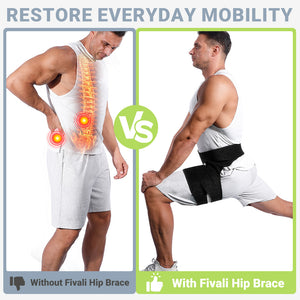
If you find yourself holding onto furniture while walking through the house, your body is begging for stability. This is where mobility-focused supports come into play. But how does a hip brace work?
Quality sports braces apply targeted compression around the pelvis and thigh. This does two critical things:
- Improves Proprioception: The snug compression sends sensory feedback to your brain, essentially reminding your nervous system where your joint is in space. This immediately improves balance.
- Reduces Joint Load: By mimicking the function of the body's natural ligaments, a good support helps stabilize the ball securely within the socket, reducing the clicking, catching, and sudden giving-way sensations.
For those experiencing weakness on both sides of the body, a double hip support brace can provide bilateral stability, ensuring that your pelvis stays level and aligned. Furthermore, individuals often wonder, does a hip brace help sciatica? While sciatica stems from the lower back, stabilizing the hips can prevent the lopsided walking mechanics that often aggravate nerve compression, indirectly offering relief.

Committing to Structured Rehab
External support is a bridge, not a permanent destination. By utilizing a high-quality hip brace to manage pain and restore balance, you create a window of opportunity to engage in physical therapy. A physical therapist will help you safely rebuild your glutes, core, and hip rotators without the fear of your joint failing you mid-exercise.
Frequently Asked Questions
Is it better to rest or walk when my hip feels unstable?
Motion is lotion for joints, but proper motion is key. Complete rest can cause the stabilizing muscles to atrophy (shrink), making the instability worse over time. However, pushing through a painful, limping walk will only reinforce bad habits and damage other joints. The goal is supported, pain-free movement.
Why does my hip only give out occasionally?
Instability is often position-dependent. You might have a small labral tear or localized weakness that only becomes a problem when your leg is at a specific angle—like twisting to get out of a car or pivoting on grass.
Will a support brace make my muscles weaker?
This is a common myth. When used as an active recovery tool, braces actually help your muscles. When you are in pain, your brain "turns off" certain muscles to prevent further injury. By reducing pain and providing stability, a brace gives your brain permission to turn those stabilizing muscles back on, allowing you to walk and exercise with proper form.
Moving Forward With Confidence
Hip instability is a mechanical problem that creates a psychological burden. Understanding the biomechanics behind your shortened stride or occasional waddle is the first step in taking your life back. You don't have to accept a shrinking world or sit out during this season's holiday festivities.
By acknowledging the compensations your body is making, utilizing the right external supports to bridge the gap, and engaging in targeted strengthening, you can rebuild the foundation of your movement. You can replace hesitation with self-trust, and reclaim the joy of an active, pain-free life.