Everyday triggers that worsen thumb pain: ergonomics, tools, and movement patterns to watch
As we gear up for Memorial Day weekend and the official kickoff to summer, our hands are about to go into overdrive. Between prepping the backyard grill, aggressively pulling weeds in the garden, gripping the steering wheel for a weekend road trip, or endlessly texting friends to coordinate plans, we demand a lot from our hands.
But then it happens: you go to open a jar of BBQ sauce or swipe on your phone, and a sharp, aching twinge shoots through the base of your thumb.
If you are experiencing thumb or wrist pain, you aren’t alone. In our modern, active world, the thumb is highly susceptible to strain. But what if the secret to relief isn't just about resting—but rather understanding the tiny, everyday triggers that are causing the damage in the first place?
Let’s decode the everyday habits worsening your thumb pain and explore practical, ergonomic adjustments to get you back to your pain-free, active lifestyle.
Understanding Your Thumb’s Anatomy and Common Pain Points
Before we can fix the problem, it helps to understand the machinery. Your thumb is a biomechanical marvel that provides 50% of your hand's overall function. This incredible mobility comes primarily from the CMC (carpometacarpal) joint at the base of the thumb.
Because this joint is so flexible, it undergoes immense stress. When things go wrong, it usually manifests in a few specific ways:
- Thumb Arthritis (CMC Arthritis): Wear and tear of the cartilage at the base of the thumb, often causing a deep, aching pain when gripping or pinching.
- De Quervain’s Tenosynovitis: Inflammation of the tendons on the thumb side of the wrist, usually causing sharp pain when you turn your wrist, grasp something, or make a fist.
- Trigger Thumb: Inflammation of the tendon sheath that causes the thumb to catch or lock in a bent position.
Decoding Everyday Triggers: Are You Straining Your Thumb?
Most people assume their thumb pain comes from a single injury, but more often than not, it is the result of cumulative daily stress. When a joint is subjected to the same awkward forces day in and day out, you can develop a repetitive strain injury thumb. Let’s look at the most common culprits.
The Digital Life: "Texting Thumb" and Typing
Smartphones have completely changed how we use our hands. "Texting thumb" is a very real, modern overuse issue. When you hold your phone in one hand and stretch your thumb across the screen to type or swipe, you are forcing the tendons into unnatural, hyperextended angles. Over time, this repetitive micro-movement inflames the tendons, leading directly to symptoms of De Quervain’s.
Tools and Hobbies: The Memorial Day Weekend Prep
Think about your weekend activities. Gardening tools, heavy cooking utensils (like those long grill tongs), and even musical instruments force your hand into sustained, forceful grips. When you squeeze a pair of pruning shears, your thumb base bears a force many times greater than the actual effort you're applying. If your wrist is bent awkwardly while doing this, you are exponentially increasing the mechanical stress on the joint.
Household Chores: The Pinch-and-Twist
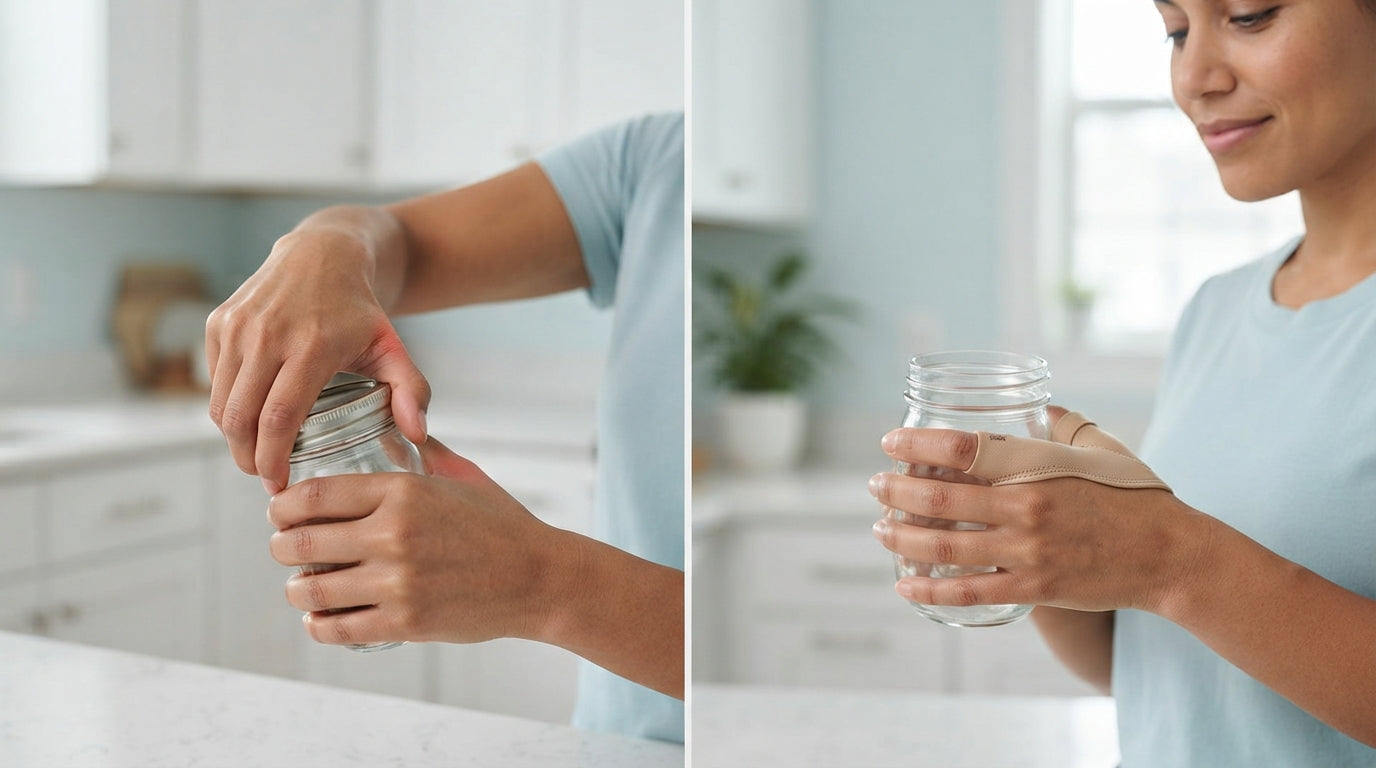
Opening stubborn jars, turning keys, or even carrying heavy grocery bags by the handles all require a specific movement pattern.
Here is an "aha moment" for your thumb health: pay attention to your pinch. A "side pinch" (pressing your thumb pad against the side of your index finger, like turning a key) puts intense, uneven pressure on the CMC joint. Conversely, a "pulp-to-pulp grip" (making an 'O' shape with your thumb and index finger tips) distributes the force much more evenly.

Proactive Solutions: Ergonomics and Behavioral Adjustments
You don't have to give up your favorite summer activities or stop using your smartphone. By making small behavioral adjustments, you can drastically reduce the strain on your thumbs.
1. Optimize Your Digital Grip
Instead of resting the entire weight of your phone on your pinky and typing with one thumb, switch to two-handed texting using your index fingers, or rely more on voice-to-text features. When scrolling, lay the phone flat on a table or use a phone stand rather than gripping it constantly.
2. Thicken Your Grips
For gardening tools, kitchen utensils, or pens, look for items with thicker, cushioned handles. A wider grip requires significantly less force from your thumb and fingers. You can even use foam tubing to adapt the handles of tools you already own.
3. Change Your Hand Mechanics
When opening jars, stop relying on your thumb and fingers to do all the twisting. Instead, place a silicone grip pad on the lid, press down with the palm of your hand, and use your shoulder to generate the twisting motion. This protects the delicate joints of the hand by transferring the work to larger muscle groups.
4. Know How to Respond to Acute Tweaks
Sometimes, despite our best efforts, we tweak a thumb during an active weekend of volleyball or yard work. Knowing how to wrap a sprained thumb can provide immediate stabilization for minor, acute injuries before they become nagging problems.
The Trigger-to-Support Rationale: Choosing the Right Brace
Understanding exactly why your thumb hurts is crucial when choosing a physical support. Many people blindly buy general wrist supports, expecting relief for thumb arthritis or De Quervain's, only to find the pain persists.
If you are looking for the best brace for wrist and thumb pain, you need to match the support to the biomechanical trigger:
- Thumb Spica Splints: If your pain is at the very base of the thumb (CMC joint) from gripping jars, or along the thumb-side wrist tendons (De Quervain's) from texting, a general wrist brace won't help. You need a "thumb spica" brace. This specific design immobilizes the thumb while leaving your other fingers free, interrupting the painful movement patterns so the inflammation can subside.
- General Wrist Braces: If your pain is primarily in the center of the wrist, or if you are experiencing numbness and tingling in your fingers (especially at night or while typing), this may be nerve-related. In this scenario, evaluating a wrist brace for carpal tunnel is more appropriate, as these braces are designed to keep the wrist in a neutral position to relieve pressure on the median nerve.

Frequently Asked Questions About Thumb Pain
Can excessive phone use actually cause thumb arthritis?
Excessive phone use does not cause osteoarthritis (which is wear and tear of the cartilage), but it does cause tendonitis (like De Quervain's), which can feel very similar. However, if you already have underlying, mild arthritis, the awkward angles of "texting thumb" can certainly cause a painful flare-up.
Should I ice or apply heat to an aching thumb?
If you've just finished a weekend of intense gardening and your thumb is sharply painful and swollen, use ice to reduce acute inflammation. If you have chronic, stiff thumb pain (like osteoarthritis) that feels worse in the morning, heat is generally better to loosen the joint and improve blood flow before you start your day.
When should I see a doctor for thumb pain?
You should consult a healthcare professional if your thumb is visibly deformed, if the pain prevents you from completing basic daily tasks, if you experience numbness or tingling, or if the pain does not improve after a few weeks of rest, ergonomic adjustments, and bracing.
Reclaiming Your Active Lifestyle
Don't let preventable hand strain sideline you from the activities you love this season. By identifying the hidden triggers in your daily routine, improving the ergonomics of your tools, and utilizing the correct targeted support when needed, you can protect your joints and keep moving comfortably. Take a moment today to observe how you hold your phone, grip your steering wheel, or open that next jar—your thumbs will thank you for it!