How to Identify Hip Joint Pain Sciatic Pain or Muscle Strain

Whether it's a long hike, a return to the Peak Stadium, or simply tending to the garden, our bodies often face sudden increases in activity intensity. And often, it’s our hips that protest the loudest.
You wake up with a sharp ache, a sudden twinge, or a nagging tightness in your hip area. You might immediately find yourself searching for compression for hip pain to find some relief. But before you can properly support your body, you need to solve a fundamental mystery: What exactly is hurting?
The hip area is a complex intersection of heavy-duty bones, thick bands of muscle, and major nerve pathways. Because everything is packed so tightly together, telling the difference between a hip joint problem, a sciatic nerve issue, and a simple muscle strain can feel like a guessing game.
Let's demystify your discomfort. By learning a few clear clinical clues, you can start to self-classify your pain, understand your body better, and be fully prepared to evaluate targeted support or treatment options.

The Golden Rule of Hip Pain: Location, Location, Location
The most surprising fact about hip pain is that true "hip joint" pain rarely hurts on the outside of your hip. The location of your pain is the first major clue in your diagnostic journey.
1. Groin Pain = Think "Joint"
If you point to the crease where your thigh meets your pelvis (the groin), you are likely dealing with true hip joint pain. Conditions like osteoarthritis, labral tears, or hip impingement almost always manifest here. The joint itself is deep, and the pain refers forward.
2. Side (Lateral) Pain = Think "Muscle or Tendon"
If it hurts on the outside of your hip—the part you sleep on—you are likely dealing with a soft tissue issue. This is often trochanteric bursitis or a strain in the gluteal tendons that attach to the bone.
3. Back/Buttock Pain = The Tricky Zone
If your pain is located entirely in your buttocks or the back of your thigh, you have entered the "grey zone." This is the most common area of confusion because it could be a referred joint issue, a muscle strain (like the hamstring or piriformis), or sciatic nerve pain originating from your spine.
The Symptom Decoder: Sensation, Timing, and Triggers
Beyond just where it hurts, how it hurts and when it happens are massive clues. Let's break down the classic profiles of our three main suspects.
Profile A: True Hip Joint Pain
- The Sensation: A deep, dull ache that can occasionally feature sharp "catching" or "clicking" feelings deep inside the joint.
- The Timing: It often feels worst first thing in the morning (morning stiffness) but loosens up after 30 minutes of moving around. It will ache again after vigorous, weight-bearing activity.
- The Movement Trigger (The Sock Test): Try putting on your socks and shoes. If bringing your knee up and rotating it outward to reach your foot causes intense groin pain or stiffness, this is a classic sign of a hip joint issue.
- The Simplest Rule: Hip joint pain usually stays localized; it rarely travels past the knee.
Profile B: Sciatic (Nerve) Pain
- The Sensation: Electric, burning, or sharp shooting pain. It may be accompanied by a "pins and needles" sensation, numbness, or weakness in the leg.
- The Timing: Pain is often provoked by prolonged sitting, bending forward, or coughing/sneezing, which increases pressure on the spinal nerves.
- The Movement Trigger (The Travel Rule): Sciatica travels. If your pain starts in your lower back or buttock and shoots down the back of your leg, especially extending below the knee into the calf or foot, it is almost certainly a nerve issue.
- The Simplest Rule: Sciatica rarely causes true groin pain.
Profile C: Muscle Strain
- The Sensation: A soreness, tenderness, or a sudden, localized sharp pull. The muscle will feel tight and may spasm.
- The Timing: It usually has a clear onset. You lunged for a tennis ball, lifted something heavy, or dramatically increased your running mileage, and felt an immediate or next-day soreness.
- The Movement Trigger: It only hurts when you actively use that specific muscle or stretch it. If you strain your hip flexor, lifting your knee against resistance will hurt. If you strain your glute, standing up from a deep squat will trigger it.

The Buttock Pain Breakdown: The Ultimate Grey Zone
Let's address the most common frustration: "My buttock hurts, and I don't know why."
When you experience posterior (back) hip pain, several systems overlap.
- Spinal Sciatica: A bulging disc in your back is pinching the sciatic nerve. The pain shoots through the buttock and down the leg.
- Deep Gluteal Syndrome (Piriformis Syndrome): The piriformis muscle in your buttock spasms and squeezes the sciatic nerve underneath it. This mimics sciatica perfectly, but the root cause is a tight muscle, not your spine.
- Gluteal Tendinopathy: The tendons of your deep hip stabilizer muscles become inflamed from overuse. It hurts directly over the "sit bone" when you press on it or sit on hard surfaces.
To tell the difference, look at your lower back. If moving your lower back (leaning backward or forward) triggers the leg pain, it's likely a spinal nerve issue. If deep stretching of the glutes triggers it, but your back feels fine, it points toward a localized muscle or tendon problem.

Why Scans Don't Always Tell the Whole Story
A common beginner trap is rushing out for an MRI, expecting a magical answer. While imaging is an incredible tool, it has major limitations for self-diagnosis.
Why? Because human bodies age like cars. If you take an MRI of 100 pain-free adults over the age of 40, a large percentage will show bulging discs, minor labral tears, and early signs of arthritis—yet they have absolutely zero pain.
If you get a scan without understanding your symptoms, the doctor might find a bulging disc and blame your hip pain on it, completely missing the fact that you actually have a strained hip flexor muscle. This is why knowing your specific symptoms, movement triggers, and the nature of your pain is crucial. You and your medical provider must match the picture on the scan to the physical symptoms you are actually experiencing.
Frequently Asked Questions (FAQ)
Can I have sciatica and a hip joint problem at the same time?
Absolutely. Because everything is connected, altering your gait (how you walk) due to hip joint arthritis can easily strain the muscles in your lower back or pelvis, which can subsequently irritate the sciatic nerve. This is why addressing the root cause early is vital before the body creates a domino effect of compensation pain.
What are the warning signs that I need a doctor immediately?
While most hip pain is mechanical and non-urgent, there are specific symptoms you should never ignore. If you experience a sudden loss of bowel or bladder control, severe pain following a traumatic fall, an inability to bear any weight on the leg, or fever accompanied by joint swelling, you need to know what is a red flag for hip pain? Seek professional medical evaluation immediately.
Will stretching make a muscle strain worse?
If the muscle is acutely strained or torn, aggressive stretching will pull on the damaged fibers and delay healing. In the first 48 hours of a sharp muscle strain, resting the muscle and applying ice is preferred over deep stretching.
Taking Action: Next Steps for Your Hip Health
Now that you have a clearer picture of whether your hip pain is stemming from the joint, a nerve, or a muscle, you are empowered to make smarter recovery choices.
- Modify Your Movement: If it's a joint issue, avoid high-impact activities like running and switch to swimming or cycling. If it's a nerve issue, avoid prolonged sitting and repetitive bending.
- Focus on Stability: Regardless of the source, building strength in the muscles that surround your pelvis acts like an internal shock absorber, taking pressure off both the nerves and the joint capsule.
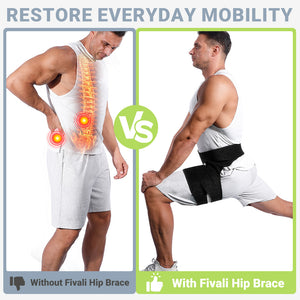
- Evaluate Targeted Support: A high-quality hip brace can provide the gentle, stabilizing compression necessary to remind your body of proper alignment, keep the joint warm, and help prevent the overextension that aggravates both muscle strains and joint inflammation.
Understanding your body is the first step toward a pain-free, active life. By listening to the clues your hip is giving you, you're already on the road to recovery—ready to reclaim your summer, your workouts, and your well-being.