How repetitive strain leads to chronic thumb pain
As we gear up for the early summer season and long Memorial Day weekends, many of us dive headfirst into activities we haven’t done in months. Whether it’s marathon gardening sessions, painting the deck, DIY home improvements, or even just logging extra hours on a video game console, our hands are put to the test.
Then, it happens: a dull ache at the base of your thumb.
Most of us brush it off. We think, "It's just a little sore, it'll pass." But what if that minor discomfort isn't just a temporary ache? What if it's the first domino in a biological chain reaction that leads to permanent joint wear?
Understanding how a simple repetitive strain transforms into chronic, debilitating thumb pain is the key to stopping it in its tracks. Today, we are going to look under the skin and break down the "Inflammation → Scarring Pathway." By the time you finish reading, you'll have a profound "aha moment" about why early intervention isn't just a good idea—it's biologically essential.
The Foundation: What Is Repetitive Strain?
To understand the problem, we have to look at the anatomy of your thumb. Your thumb is a mechanical marvel, relying on a complex network of tendons (which act like ropes pulling the bones), ligaments, and a highly mobile joint at the base (the CMC joint).
When you perform the same motion over and over again—like gripping a trowel, swiping a screen, or twisting a screwdriver—you place mechanical stress on these tissues. A repetitive strain injury (RSI) occurs when this repetitive stress creates microscopic tears in the tendons and ligaments faster than your body can repair them.
If you don't recognize the early signs of rsi and continue the aggravating activity, you unknowingly trigger a progressive biological pathway that can permanently alter the structure of your hand.
The Inflammation → Scarring Pathway: A Step-by-Step Breakdown
The journey from a weekend DIY project to chronic thumb pain doesn't happen overnight. It follows a specific, biological roadmap.
Phase 1: Microinjury and Initial Inflammation
When you create micro-tears in your thumb tissues, your body's alarm bells go off. The immune system responds by sending blood and healing factors to the area. This is acute inflammation. Even if you can't see the swelling on the outside, your tendon sheaths (the protective tunnels your tendons glide through) are swelling on the inside. At this stage, your thumb might feel slightly stiff or ache after use.
Phase 2: Persistent Inflammation and the Cellular Response
If you ignore the pain and keep performing the repetitive motion, the micro-tears multiply. Your body thinks it's under constant attack, so the inflammation never shuts off.
This sustained inflammation acts like a siren, calling in specific cells called fibroblasts. Think of fibroblasts as your body's emergency construction workers. Their job is to patch up tissue damage as quickly as possible. In a healthy scenario, they do their job and leave. But under persistent inflammation, these workers go into overdrive.
Phase 3: Fibrosis and Scar Tissue Formation
Because the fibroblasts are rushing to stabilize the constantly tearing tissue, they start producing excessive amounts of collagen. Instead of laying down neat, elastic fibers, they hastily dump thick, rigid scar tissue (a process called fibrosis).
Unlike healthy tendon tissue, which stretches and glides smoothly, scar tissue is stiff, bulky, and restrictive. The delicate sheath surrounding your thumb tendons becomes noticeably thickened.
Phase 4: Tendon Sheath Thickening and Joint Wear
Now, the physical architecture of your thumb has changed. The "rope" (your tendon) has to force its way through a thickened, narrowed "pulley" (the scarred sheath). Every time you move your thumb, the tendon grinds against this scar tissue, causing intense friction and sharp pain. This is exactly what happens in conditions like De Quervain's tenosynovitis.
Worse still, because the tendons are no longer gliding properly, the mechanical balance of your thumb is thrown off. This abnormal pulling puts uneven pressure on the cartilage at the base of your thumb. Over time, this loss of cushioning leads to cartilage wear, bone-on-bone friction, and eventually, irreversible basal joint arthritis.
Why Early Intervention Matters: Stopping the Scarring Cycle
Here is the most critical takeaway: Pain is not the start of the injury; it is often a late warning sign of an ongoing biological process.
Many people believe that if they can tolerate the pain, they are fine. But biologically, if you are feeling pain, the inflammation-scarring cycle is already spinning. To prevent permanent thickening and joint degeneration, you must interrupt this pathway before the fibroblasts lay down mature scar tissue.
How to Disrupt the Pathway
The most effective way to halt this progression is by removing the mechanical stress that is keeping the alarm bells ringing. This is where strategic support becomes your best friend.
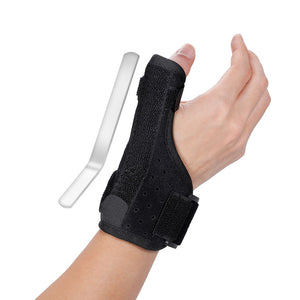
- Limit Harmful Motion: You don't necessarily have to stop using your hands entirely, but you must prevent the specific micro-movements causing the tears. Wearing a dedicated wrist thumb support physically restricts the thumb base, acting as an external "stop sign" that gives your tissues the breathing room they need to heal without triggering the emergency fibroblasts.
- Support the Surrounding Structures: Sometimes, thumb strain is exacerbated by poor wrist stability. Utilizing an rsi wrist brace or a high-quality wrist brace can help stabilize the entire forearm-to-hand mechanical chain, taking the pressure off the thumb tendons.
- Targeted Relief for Specific Conditions: If you are already experiencing the sharp, catching pain of tendon sheath thickening, understanding the mechanics of your support is crucial. For instance, learning how to wrap wrist for de quervain's tenosynovitis or choosing a specialized wrist brace for tendonitis can help immobilize the exact tendons that are inflamed.
Frequently Asked Questions (FAQ)
Is it normal for my thumb to hurt after typing or texting all day?
While common, it is not "normal" or healthy. It is a sign of acute inflammation. If you consistently experience pain after these activities, you are actively initiating the early stages of the repetitive strain pathway.
Can scar tissue in the thumb be reversed?
Once mature scar tissue (fibrosis) has heavily settled into the joint capsule or tendon sheath, it is very difficult to reverse naturally. This is why early intervention is so critical. Early-stage inflammation can be resolved completely; late-stage scarring often requires medical management or surgery to restore mobility.
How do I handle a sudden, sharp injury compared to repetitive strain?
If you suffer a sudden acute injury—like bending your thumb backward while catching a baseball—the immediate goal is stability to prevent ligament tearing. Knowing how to wrap a sprained thumb properly in the immediate aftermath can help control acute swelling, but chronic, slow-building pain requires long-term motion management.
When should I see a doctor?
If your thumb pain persists for more than a few weeks despite rest and using supportive braces, or if you experience numbness, tingling, or a visible deformity, it is time to consult an orthopedic specialist or a physical therapist.
Empowering Your Active Lifestyle
At Fivali, we believe that an active lifestyle shouldn't come with an expiration date dictated by joint pain. Whether you're planning a massive garden overhaul this weekend, training for a new sport, or just trying to get through the workday without wincing, understanding your body is your greatest advantage.
By recognizing how repetitive micro-injuries evolve into chronic scarring, you can shift from being reactive to being proactive. Listen to those early warning signs, support your joints intelligently, and give your body the environment it needs to heal properly.
Your future self—and your thumbs—will thank you.