Why Knee Pain Increases with Higher Body Weight
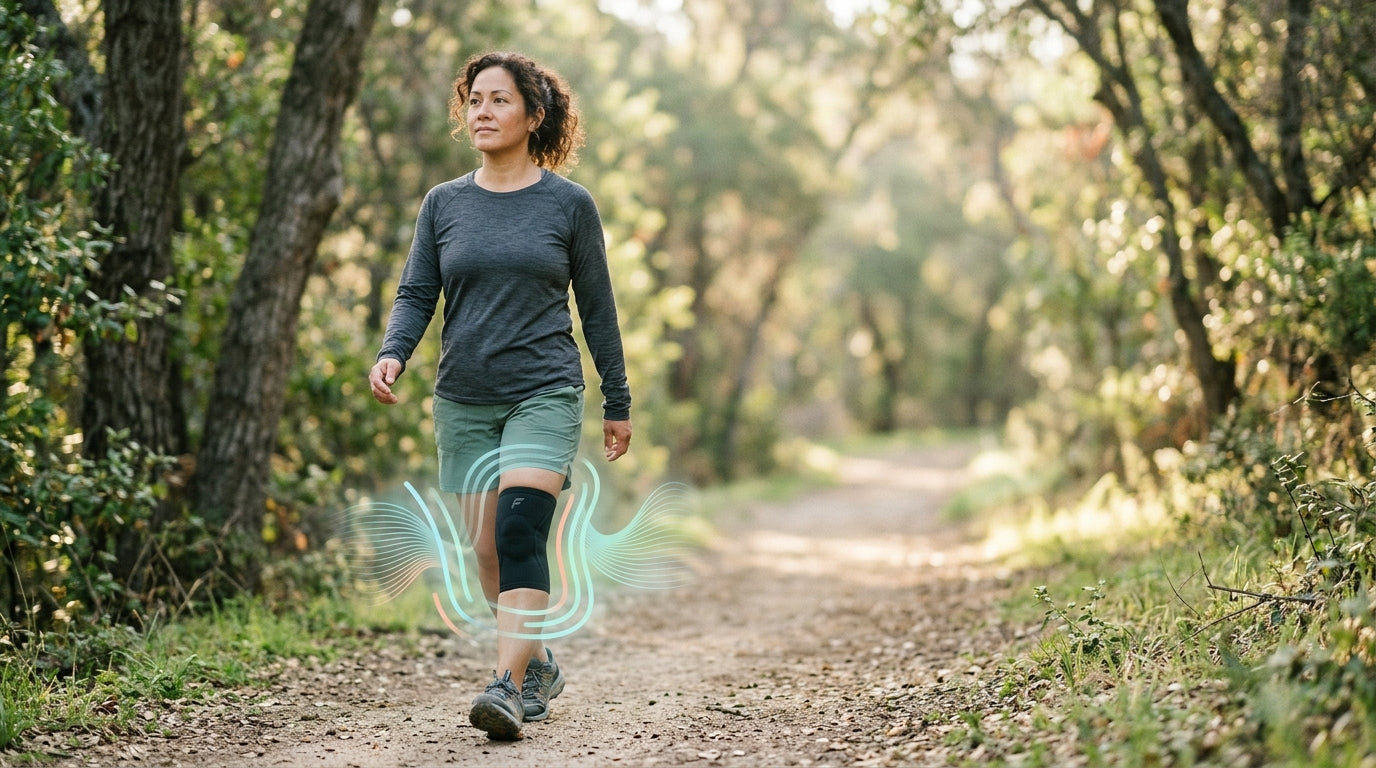
As the Memorial Day weekend approaches and signals the unofficial kickoff to summer, millions of Americans are dusting off their walking shoes, hitting local trails, or starting a light jogging routine. But if you carry a higher body weight, this seasonal burst of activity might come with an unwelcome side effect: a deep, aching pain or a frustrating sense of instability in your knees.
Have you ever wondered why your knees might feel perfectly fine when you’re standing still, start to ache during a brisk neighborhood walk, but completely flare up after a light jog?
It’s easy to write it off generally as "having bad knees" or simply blame it on the number on the scale. However, the true answer lies in a fascinating world of biomechanics. Understanding how your body mass changes joint loads, cartilage stress, and muscle demands during everyday activities is the crucial first step toward managing pain, taking control of your mobility, and understanding exactly what kind of external support your knees actually need.

This visual explains how increased body weight impacts knee joint load, cartilage stress, and muscle demand specifically during walking, setting the foundation for understanding knee pain mechanics.
The Foundation: Demystifying Knee Joint Mechanics
To understand knee pain, it helps to view the knee not just as a hinge, but as a complex biological shock absorption system. Your knee is the junction where your thigh bone (femur) meets your shin bone (tibia). At the front sits your kneecap, and if you’ve ever wondered what holds the patella in place, it is secured by a robust network of tendons and ligaments connecting it to your surrounding leg muscles.
Between these bones lies your cartilage—a smooth, rubbery tissue that acts like a highly pressurized sponge. When you take a step, the cartilage compresses, squeezing out joint fluid, and then expands again to soak it back up.
When you carry extra body weight, the foundational math of your knee mechanics changes dramatically due to a concept called the "force multiplier." When you move, the Earth pushes back against your foot (ground reaction force). Because of momentum and gravity, the force hitting your knee is always greater than your actual body weight.
The Biomechanics of Walking: More Than Just a Stroll
Walking is often recommended as the perfect low-impact summer activity. Yet, for someone with a higher body weight, walking is a significant mechanical undertaking.
During a typical walking stride, the force exerted on your knees is roughly 1.5 times your body weight. That means if you weigh 200 pounds, your knees absorb about 300 pounds of force with every single step. If you gain 10 pounds over the winter, that’s not just 10 extra pounds on the joint—it's 15 extra pounds of force per step. Multiply that by 10,000 steps during a Memorial Day parade, and you can see why the cartilage’s "sponge" mechanism gets overworked.
Many people starting a summer weight loss walking routine ask themselves, "will my knees stop cracking if i lose weight?" The answer is often tied to these exact mechanical loads. Excess weight forces the muscles—particularly the quadriceps—to work overtime just to keep your leg stable during the "stance phase" of your stride. When these muscles fatigue, they stop absorbing shock, passing the brunt of the impact directly onto the cartilage, leading to that aching, grinding sensation.
The Uphill Battle: The Complexities of Hiking Terrain
If walking is a basic math equation for your knees, hiking is advanced calculus. Hiking introduces uneven terrain, inclines, and, most punishingly, declines.
When you walk uphill, your knee stays bent longer under load, dramatically increasing the pressure behind the kneecap (patellofemoral joint stress). But the real damage often occurs on the way back down.

This process flow breaks down the biomechanical challenges hiking presents to the knee joint, highlighting how increased weight amplifies joint load, cartilage shear, and muscle demands.
When hiking downhill, your knees face "eccentric loading." This means your thigh muscles have to lengthen while contracting to act as brakes, fighting both gravity and your body mass. This braking motion pushes the shin bone forward against the thigh bone, creating immense "shear force" across the cartilage. For individuals with higher body mass, this shear force can quickly break down the smooth surface of the joint. It is common for hikers to seek out an Fivali ankle support brace for hiking to secure their lower leg, but they often overlook the massive mechanical load happening just a few inches higher at the knee.
The Impact Shift: The Shock of Light Jogging
You might feel motivated to push your pace from a fast walk to a light jog. Biomechanically, transitioning from walking to jogging is like flipping a switch from a rolling wheel to a bouncing ball.
During walking, one foot is always on the ground. During jogging, there is a "flight phase" where both feet are in the air. This means when your foot lands, it’s catching the full weight of your falling body. The force multiplier jumps from 1.5x up to 3x or even 4x your body weight.
For a 200-pound person, a light jog can mean up to 800 pounds of force per step on a single knee.

A data-driven visualization quantifying how knee joint loads increase dramatically from walking to jogging with higher body weight, illustrating why pain and stress escalate.
With increased weight, the joint's shock absorbers simply don't have the micro-seconds they need between strides to recover their shape and fluid. Finding the best knee brace for athletes or runners isn't just a concern for professionals; it's heavily researched by everyday joggers who realize their natural biological suspension system needs external help to manage this massive spike in force.
When Cartilage and Muscles Can't Keep Up
Pain is your body's alarm system signaling that mechanical limits have been reached. When higher body weight constantly over-stresses the knee across all these activities, two main things happen:
- Cartilage Degradation: The "sponge" starts to fray. Instead of gliding, bones start rubbing. Inflammation sets in, bringing heat, swelling, and a throbbing ache that persists long after your walk is over.
- Muscle Compensation and Instability: As the primary muscles fatigue from fighting the extra load, the body alters your gait (how you walk) to try and protect the knee. This compensation shifts pressure onto ligaments and the meniscus, increasing the risk of acute injury. It’s exactly why someone might suddenly find themselves needing a knee brace for meniscus tear after what felt like a normal step during a weekend hike.
Bridging the Gap: The Mechanical Rationale for Support
Understanding these biomechanics provides a massive "aha" moment: your knee pain isn't a character flaw; it’s a physics equation. When the load outpaces the joint's capacity, you feel pain.
This is the exact rationale for utilizing external knee support. Many people search for the best knee support for overweight individuals because they instinctively know they need help balancing the physics. High-quality support garments work by providing enhanced proprioception (your brain's awareness of your joint in space), mild compression to manage inflammatory fluid, and structural help to distribute the force vectors more evenly across the knee.
Furthermore, relying on anatomically correct plus size knee braces ensures that the support system doesn't just squeeze the leg uncomfortably, but actually aligns with the unique biomechanical angles and tissue distribution of a larger leg, allowing you to walk, hike, and enjoy your summer holidays without the looming dread of joint pain.
Frequently Asked Questions (FAQ)
Does walking on a treadmill reduce the biomechanical force compared to walking outside?
Yes, slightly. Treadmill belts have a bit of "give" that acts as a secondary shock absorber, reducing the ground reaction force slightly compared to walking on hard concrete. However, the force multipliers related to body weight still apply.
Is swimming better for my knees than walking?
Biomechanically, yes. Swimming removes gravity from the equation, taking the force multiplier down to virtually zero. It allows you to build the muscles around the knee without placing compressive stress on the cartilage.
Why do my knees hurt worse the day after a hike?
During the activity, endorphins mask some of the pain. The day after, your body initiates an inflammatory response to the micro-trauma inside the cartilage and muscles caused by the eccentric loading of downhill hiking. This swelling increases pressure inside the joint capsule, causing a stiff, aching sensation.
Taking the Next Step in Your Journey
Armed with the knowledge of how force multipliers, cartilage shear, and eccentric loads impact your joints, you can now evaluate your knee pain through a mechanical lens rather than a purely emotional one. As you look toward a busy summer of barbecues, nature trails, and evening walks, you are better equipped to understand why your knees behave the way they do—and more importantly, what kind of external physical support they require to keep you moving pain-free.