Why Volleyball Players' Wrists Injure and How Movements Matter
With Memorial Day weekend tournaments fast approaching and the summer beach volleyball season officially kicking off, courts across the country are buzzing with energy. Players are perfecting their timing, building their vertical jumps, and gearing up for long days in the sun and sand. But alongside the thrill of the perfect spike comes a hidden reality for many players: nagging, sharp, or throbbing wrist pain.
If you've ever felt a sudden tweak while blocking a heavy hitter or a lingering ache after a long day of setting, you aren't alone. Wrist pain in volleyball isn't just a random symptom of playing hard; it’s a direct result of mechanical failure under extreme force.
When we simply write off wrist pain as "part of the game," we miss the opportunity to fix the root cause. By understanding the precise biomechanical movements and impact forces that cause your wrists to fail, you can move from merely treating symptoms to actively protecting your joints. Let’s dive into the science of why volleyball players' wrists break down and how you can engineer your way out of pain.

The Core Mechanics of a Volleyball Wrist
To truly grasp why failure happens, we have to look beneath the skin. The wrist isn't just a single hinge; it is a complex web of eight small carpal bones, stabilized by intricate ligaments and powered by forearm muscles. Understanding your wrist tendon anatomy is the first step in realizing how vulnerable this joint is when placed under specific loads.
In volleyball, your wrist is repeatedly subjected to three primary destructive forces:
- Compressive Force: The direct, crushing impact when a fast-moving ball strikes the hand.
- Torsional Force: The twisting, rotational stress that occurs when a ball hits the hand off-center, violently torquing the wrist.
- Hyperextension Load: The extreme bending of the wrist backward, pushing the joint far past its natural physiological limit.

Decoding the Movements: How Specific Plays Load Your Wrists
Every position on the court demands something different from your hands. Let's break down how standard volleyball actions translate into mechanical stress.
Blocking: The Ultimate Impact Zone
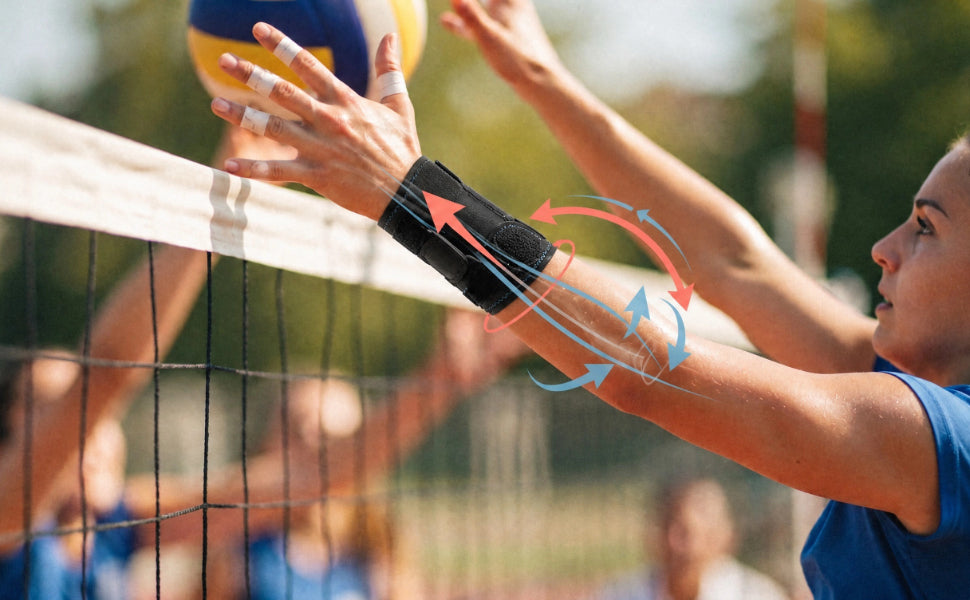
Blocking is arguably the most dangerous action for the wrist. When you press your hands over the net to shut down an attack, you are placing your body in the direct path of a ball traveling anywhere from 40 to over 70 mph.
- The Biomechanics: When the ball squarely strikes your palms, the wrist absorbs maximum compressive force. However, if a hitter purposefully targets the outside of your block, the ball strikes just your outer fingers. This violently twists the wrist backward and outward, applying a massive torsional load.
Spiking: The Whip Effect
A powerful spike relies on a rapid transition from wrist extension to forceful flexion—the classic "snap."
- The Biomechanics: As your hand makes contact with the ball at the peak of your swing, the wrist endures intense compressive shock. If your timing is slightly off and the ball is contacted behind your head, the hand is forced backward upon impact, resulting in a severe hyperextension load.
Setting: The Repetitive Strain
Setters may not absorb the violent impacts that blockers do, but they endure relentless repetitive stress.
- The Biomechanics: Pushing the ball out to the pins requires continuous, rapid wrist extension followed by a forward spring. This repetitive action creates micro-compressive and torsional forces. Over a long weekend tournament, these micro-traumas accumulate, often leading to deep tendon inflammation.
Digging and Passing: The Awkward Deflections
While the platform is primarily made of the forearms, emergency defensive plays often require throwing a single hand out to pop the ball up.
- The Biomechanics: Digging a hard-driven ball with an open hand forces the wrist into immediate, unbraced hyperextension.
Common Injury Patterns: When Biomechanics Break Down
When the structural limits of your wrist are exceeded by these forces, specific injuries occur. Many players desperately search for natural wrist pain relief when these happen, but understanding the injury is the key to actual recovery.
- TFCC Tears: The Triangular Fibrocartilage Complex (TFCC) is a cartilage structure on the pinky side of your wrist. It is highly susceptible to the torsional forces experienced during a sloppy block. A tfcc injury typically feels like a deep, clicking ache when you rotate your wrist.
- Flexor Carpi Radialis Tendinopathy: Common in heavy hitters, this repetitive strain injury results from the forceful snapping motion of spiking, leading to pain at the base of the thumb and palm.
- Scaphoid Compression Issues: The repetitive hyperextension from improper spiking or digging can compress the scaphoid bone against the radius, leading to deep, dull pain at the base of the wrist.
Bridging the Gap: Biomechanically Informed Prevention
Searching the internet for pain management can sometimes lead down strange rabbit holes—like reading obscure forum debates comparing a floor lamp vs wrist brace for desk posture fixes. But when it comes to sports biomechanics, clarity is key. Protecting your wrists requires targeted, sports-specific strategies.
If you truly want to understand how to prevent volleyball injuries, you must build resilience against the specific forces we just mapped out.
- Strengthen the Stabilizers: Exercises like wrist curls and reverse curls build the forearm muscles that act as shock absorbers during compressive impacts.
- Refine Your Technique: For blockers, focusing on penetrating the net—pressing the hands over rather than just reaching up—changes the angle of impact, turning a dangerous hyperextension load into a safer, manageable compressive load.
The Mechanics of External Support: Selecting the Right Gear
Eventually, mechanical problems require mechanical solutions. External supports aren't just thick bands of fabric; they are engineered tools designed to counteract the exact compressive, torsional, and hyperextension loads you face on the court.

Choosing the right wrist support for volleyball is about matching the architecture of the gear to your specific vulnerability:
- For the Torsional Blocker: If you are dealing with TFCC pain from twisting impacts, you need a support that offers moderate rigidity around the ulnar (pinky) side to prevent lateral rotation.
- For the Hyperextended Hitter: If spiking is bending your wrist too far back, a low-profile strap that limits end-range extension can save your joints while still allowing the forward snap.
- For the Repetitive Setter: A flexible compression sleeve helps with proprioception (joint awareness) and blood flow, easing tendinopathy without restricting the delicate touch needed to set the ball.
Many players wonder about the rules and mobility constraints, asking themselves if they can realistically wear a volleyball wrist brace during an official match. The answer is yes, provided the gear is sport-specific, free of exposed hard metal, and designed for dynamic movement.
FAQ: Volleyball Wrist Biomechanics
Why do my wrists hurt immediately after serving?
Serving mimics the biomechanics of a spike. Hitting the ball with a rigid, tense hand places a massive, sudden compressive load on the carpal bones. If your hand isn't perfectly aligned, that force turns into an injury-causing hyperextension load.
Is athletic tape as effective as a wearable support?
Tape is excellent for immediate, highly customized restriction, but it physically stretches and loses its rigidity as you sweat and play. Engineered supports maintain their structural integrity and mechanical resistance from the first serve to match point.
Can I still play with a minor wrist tweak?
While many athletes play through minor soreness, doing so without altering your biomechanics or adding external support simply invites a more severe tear or fracture. Address the mechanics first.
Next Steps for Your Game
As you pack your gear for the upcoming holiday weekend tournaments, take a moment to evaluate how your body is handling the stress of the game. Pain isn't a badge of honor; it's a biomechanical check engine light. By analyzing your position, the specific forces you absorb, and the mechanical supports available, you can confidently protect your wrists and stay on the court all summer long.