Fivali Hip Braces for Targeted Pain Relief Joint Sciatic Muscle

As the weather warms up and we gear up for Memorial Day weekend and an active summer outdoors, the last thing you want is to be sidelined by hip pain. But the hip region is a complex intersection of bone, muscle, and nerve pathways. When it hurts, the solution isn't always obvious. You know you need support to get back to your active lifestyle, but throwing a generic wrap around your waist won't solve the problem if it doesn't target the actual source of your discomfort.
Are you dealing with a deep joint ache, radiating nerve pain, or a localized muscle strain in your thigh or groin? Stop guessing. To find real relief, you need to match your specific symptoms to a brace engineered to address them.
Let’s map out exactly what is causing your pain and help you evaluate which Fivali hip brace provides the precise support mechanism you need to move confidently again.
Understanding Your Hip Pain: It's Not All The Same
Hip pain is often a blanket term covering three distinct structural issues. Knowing which one you are experiencing is the critical first step in choosing the right recovery tool.
1. Joint Pain (Osteoarthritis, Bursitis, Post-Op)
If your pain feels like a deep, dull ache directly inside the hip joint, or if you experience stiffness after sitting for long periods, you are likely dealing with a joint issue. This type of pain often requires structural stabilization to reduce the load on the joint capsule itself.
2. Sciatic Nerve Pain (Piriformis Syndrome, Herniated Disc)
Does your pain feel sharp, shooting, or burning? Does it start in your lower back or buttocks and travel down the back of your leg? If you notice that walking makes it worse or prolonged sitting triggers a radiating shock, the sciatic nerve is likely compressed or irritated.
3. Muscle Strain (Groin Pull, Hamstring Tear)
If you experienced a sudden, sharp pain during physical activity—like a quick sprint, a heavy lift, or a sudden change of direction—you’ve likely strained a muscle. This pain is usually localized to the inner thigh (groin) or the back of the leg and responds best to heat retention and targeted compression to reduce swelling and promote blood flow.
The Fivali Pain Profile: A Quick Self-Assessment
To pinpoint your ideal support system, take a moment to answer these three questions:
Where is the pain most intense?
- A) Deep inside the hip socket or outer hip bone.
- B) Radiating from the lower back/glute down the back of the thigh.
- C) Sharp and localized in the inner thigh, groin, or hamstring.
What type of pain are you experiencing?
- A) A dull, persistent ache and stiffness.
- B) A sharp, burning, or tingling sensation.
- C) A sudden, tender soreness that flares up when lifting the leg.
What is your primary goal right now?
- A) Gaining stability to walk without a limp.
- B) Relieving the shooting nerve pain so I can sit or stand comfortably.
- C) Supporting a pulled muscle so I can return to my workout routine.
Mostly A's: You need Joint Stabilization.
Mostly B's: You need Sciatic Nerve Decompression.
Mostly C's: You need Muscle Strain Compression.
Your Personalized Fivali Brace Recommendation
Once you've identified your pain profile, selecting the right support becomes straightforward. Fivali’s ecosystem of sports braces is designed with specific anatomical mechanisms in mind. Here is how our models align with your needs.
For Sciatic Nerve Relief and Piriformis Syndrome
People frequently ask us, do sciatic nerve leg braces work? The answer is a resounding yes, provided they utilize the correct mechanism. Sciatica is a symptom of compression. To relieve it, a brace must stabilize the sacroiliac (SI) joint to prevent the micro-movements that irritate the nerve.
If you are dealing with a deep ache in the buttocks that radiates downward, you need a brace for piriformis syndrome. This type of support applies targeted pressure to the piriformis muscle, preventing it from spasming and clamping down on the sciatic nerve. Additionally, using a dedicated thigh compression sleeve for sciatica pain provides soothing heat retention and structural wrapping that calms the nerve pathways down the leg.

For Groin Pulls and Muscle Strains
If you've overextended yourself during a spring run or a weekend sports match, your adductor (groin) or hamstring muscles need containment. A high-quality thigh support brace adjustable design allows you to customize the level of compression exactly where the muscle is torn.
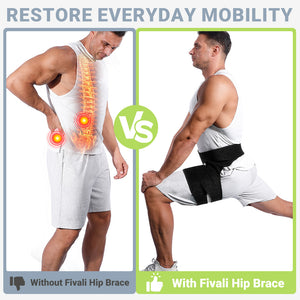
Our popular fhm04 model is engineered for this exact scenario. It wraps securely around both the waist and the thigh, ensuring that the compression doesn't slip down during movement. This dual-anchor design isolates the strained muscle, restricting the dangerous lateral movements that cause re-injury, while retaining body heat to accelerate cellular repair.
For Joint Instability and Post-Op Support
When dealing with osteoarthritis, hip dysplasia, or recovering from a surgical procedure, your primary need is load distribution. You need to take the weight and stress off the joint capsule.
In these cases, a hip abduction brace acts as an external ligament. By applying firm, uniform pressure around the pelvis and the upper femur, it holds the femoral head securely within the hip socket. This reduces the friction that causes deep joint aches and gives you the stability required to walk naturally without overcompensating and straining your lower back.
Frequently Asked Questions (FAQ)
Are these braces safe to wear all day?
Yes, Fivali braces are crafted from breathable, moisture-wicking materials designed for active lifestyles. However, for muscle strains and joint issues, we recommend wearing the brace during weight-bearing activities or when pain is most acute, and removing it while sleeping to allow the skin to breathe, unless specifically directed otherwise by a physical therapist.
Does a hip brace help sciatica if the pain is mostly in my lower leg?
Yes. Because the sciatic nerve originates in the lower back and passes through the hip/glute area, stabilizing the pelvis and preventing the piriformis muscle from compressing the nerve at its root can stop the pain from radiating all the way down to your calf or foot.
Will relying on a brace weaken my muscles?
This is a common concern, but a misconception when braces are used correctly. A Fivali brace provides the structural confidence you need to maintain mobility. Staying active prevents muscle atrophy. The brace acts as a temporary bridge, allowing you to move and perform rehabilitative exercises pain-free until your body fully heals.
Beyond the Brace: A Holistic Approach
While selecting the right Fivali brace is a massive step toward recovery, it works best when integrated into a broader pain management strategy. For acute muscle strains, remember the RICE protocol (Rest, Ice, Compression, Elevation) in the first 48 hours before relying purely on the heat retention of a brace. For joint and nerve pain, gentle stretching and core-strengthening exercises will provide long-term resilience. Always consult with a healthcare professional to get an official diagnosis for severe or chronic pain.

Ready to Reclaim Your Mobility?
You don't have to let a hip, groin, or sciatic issue dictate your summer plans. By understanding the unique mechanics of your pain—and matching it with a scientifically designed Fivali solution—you are taking control of your recovery.
Review your pain profile, select the Fivali support system engineered for your specific needs, and experience the difference that targeted, high-quality compression can make.