MCL Tear
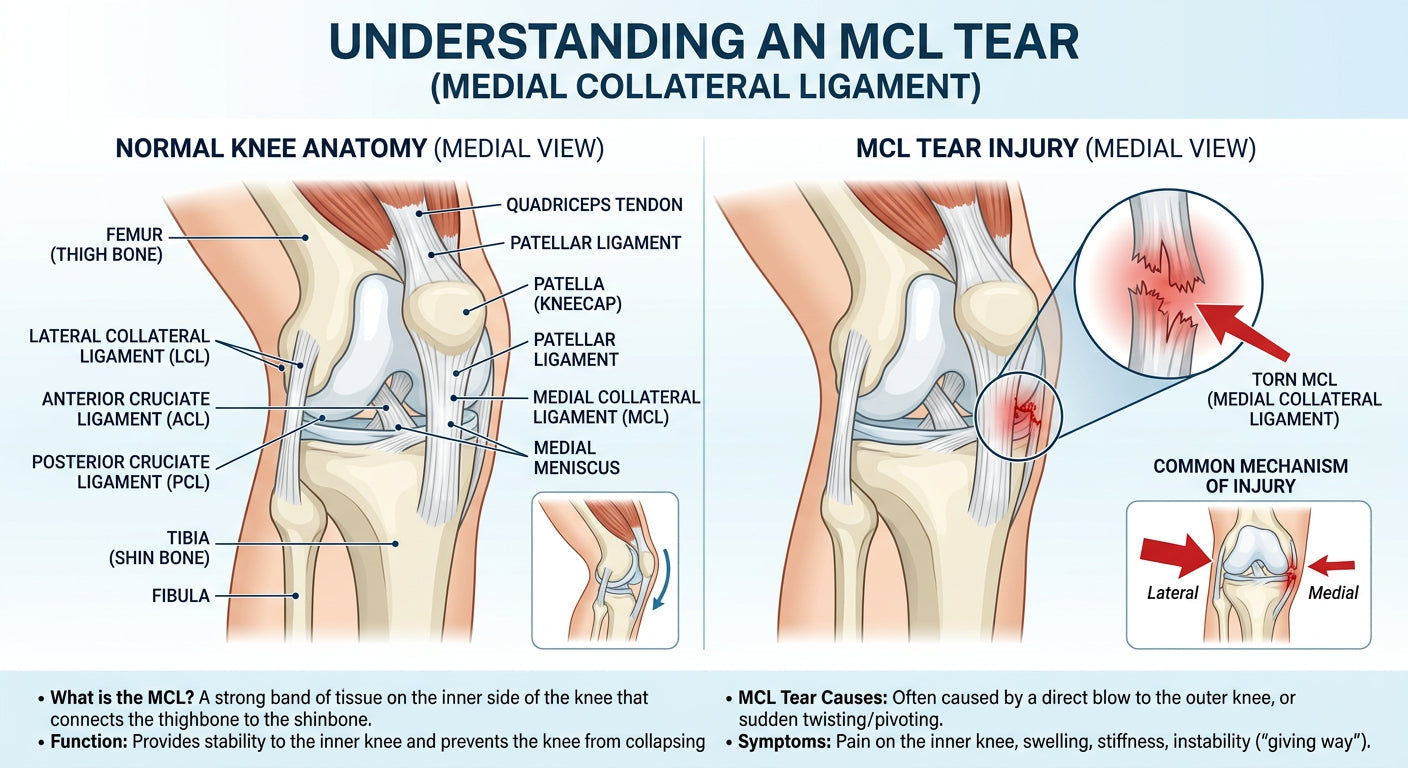
A torn medial collateral ligament (MCL) is a common knee injury, often associated with sports activities, but it can happen to anyone. The MCL is one of the four main ligaments that provide stability to the knee joint, connecting the thigh bone (femur) to the shin bone (tibia) on the inside of the knee. Its primary role is to prevent the knee from bending inward excessively.
Anatomy of the Knee and the MCL's Role
The knee is a complex hinge joint supported by several ligaments. The MCL runs along the inner side of your knee. It plays a vital role in stabilizing the knee against valgus stress – forces that push the knee inward, creating tension on the inner side of the joint. When this ligament is subjected to excessive force, it can stretch, partially tear, or completely rupture, leading to an MCL tear.
Causes of an MCL Tear
MCL tears commonly result from a direct blow to the outside of the knee, which pushes the knee inward. This mechanism of injury is common in contact sports such as football, soccer, and skiing. However, non-contact injuries can also lead to an MCL tear, such as sudden changes in direction while running, awkward landings from jumps, or hyperextension of the knee.
Recognizing the Symptoms of an MCL Tear
- Pain: Localized pain on the inside of the knee, which might worsen when bending or twisting the knee.
- Swelling: Mild to moderate swelling around the inside of the knee.
- Tenderness: The inside of the knee may be tender to the touch.
- Instability: A feeling that the knee might "give out" or buckle, especially with more severe tears.
- Stiffness: Difficulty fully straightening or bending the knee.
- Popping sound: Some individuals might hear or feel a "pop" at the time of injury.
 Compare MCL tear grades, expected recovery timelines, and Fivali support options to help decide between hinged protection and compression during rehabilitation.
Diagnosis of an MCL Tear
A healthcare professional, typically a doctor or sports medicine specialist, will diagnose an MCL tear through a physical examination. They will assess your knee's range of motion, tenderness, and stability. A specific test, known as the valgus stress test, helps determine the extent of laxity on the inner side of the knee. Imaging tests, such as an MRI, are often used to confirm the diagnosis, rule out other injuries (like an ACL tear or meniscus damage), and assess the grade of the MCL tear.
MCL tears are graded based on their severity:
- Grade 1 (Mild): The ligament is stretched but not torn. There is some tenderness and minor pain, but knee stability is usually good.
- Grade 2 (Moderate): The ligament is partially torn. More significant pain, swelling, and some instability are present.
- Grade 3 (Severe): The ligament is completely torn. This results in significant pain, swelling, and considerable instability of the knee joint.
Treatment and Recovery for an MCL Tear
Most MCL tears, especially Grade 1 and 2, heal well with conservative, non-surgical treatment. Surgical intervention is rare for isolated MCL tears but may be considered if multiple knee ligaments are severely injured.
Initial Treatment (R.I.C.E.): Immediately after the injury, the R.I.C.E. protocol is essential:
- Rest: Avoid activities that cause pain or stress to the knee.
- Ice: Apply ice packs for 15-20 minutes at a time, several times a day, to reduce swelling and pain.
- Compression: Using the best knee compression sleeve can help manage swelling and provide support.
- Elevation: Keep the injured leg elevated above heart level to reduce swelling.
Support and Protection: Protecting the injured ligament from further stress is crucial for healing. For moderate-to-severe tears, an MCL knee brace or a hinged knee brace may be recommended. These devices help stabilize the knee and prevent inward movement, allowing the ligament to heal without excessive strain. Finding the best brace for MCL injury is key to proper support. For less severe injuries, general MCL injury support options might include wraps or sleeves. These options can also provide a knee brace for pain relief during recovery.
Physical Therapy and Rehabilitation: A structured rehabilitation program guided by a physical therapist is vital for restoring strength, flexibility, and stability to the knee. This typically includes:
- Gentle range-of-motion exercises: To prevent stiffness.
- Strengthening exercises: Focusing on the quadriceps, hamstrings, and calf muscles.
- Balance and proprioception training: To improve stability and coordination.
- Gradual return to activity: A controlled progression back to sports and daily activities.
Recovery Timelines: Recovery time varies significantly based on the grade of the tear and individual factors:
- Grade 1: Typically 1 to 3 weeks.
- Grade 2: Often 2 to 4 weeks, but can extend to 6-8 weeks for a full return to activity.
- Grade 3: Can take 6 weeks to 3 months or more, depending on whether other ligaments are also injured.
Preventing MCL Tears
While some injuries are unavoidable, several strategies can help reduce the risk of an MCL tear:
- Strengthen surrounding muscles: Regular exercises for the quadriceps, hamstrings, and glutes can provide better knee support.
- Improve flexibility: Stretching can help maintain a good range of motion.
- Proper technique: Learning and practicing correct form in sports and exercises.
- Appropriate footwear: Wearing shoes that provide adequate support and traction.
- Protective equipment: In contact sports, protective gear can significantly reduce impact forces. For example, understanding how a knee brace in American football contributes to player safety or whether one should wear a knee brace while playing football can be critical
-
Veröffentlicht in
Knee Injuries