Optimize Performance and Protection: Fivali Tennis Elbow Support Brace

High-velocity racket swings, repetitive forehand top-spins, and powerful serves apply continuous kinetic force to the upper extremities. On the tennis court, micro-trauma from sudden ball impact travels directly through the wrist extensors into the lateral epicondyle, creating intense stress on muscle tendons. Gear engineered for targeted joint management allows athletes to maintain peak stroke speed without sacrificing long-term physical durability.
Anti-slip Design for Secure Fit
Fast-paced baseline exchanges demand gear that remains perfectly positioned despite rapid changes in movement direction. Equipment migration during a rally disrupts focus and reduces the mechanical advantage needed to absorb frame vibrations.
Advanced Silicone Grip Technology
Internal friction strips strategically placed along the upper hem form a firm seal against the forearm skin. Incorporating a specialized silicone strip design on the cuff of the Fivali Elbow Brace prevents any slippage or shifting during intense physical activities. This sticky grip compound resists moisture accumulation, keeping the brace anchored even during long sets in high humidity.
Operational Confidence During High-Impact Play
A migrating sleeve forces players to make constant mid-match adjustments, breaking mental momentum. Secure anchoring stabilizes muscle bellies during aggressive wrist snaps, ensuring consistent compression across every rally.
-
Vibration Dampening: Firm placement helps absorb frame-shock transmitted through the racket shaft.
-
Friction Elimination: Stable positioning stops material sliding that typically causes skin chafing.
-
Uninterrupted Concentration: Constant compression allows athletes to dedicate total attention to ball placement.
Snug Fit for Enhanced Mobility
Achieving maximum racket head acceleration requires smooth, uninhibited muscle expansion throughout the arm. Precision compression profiles cushion active tendons while adapting to dynamic muscle contours during extension.
Anatomical Compression Mapping
A snug fit provides essential flexibility and unrestricted motion by contouring smoothly around the elbow joint. Balanced pressure distribution supports micro-circulation without pinching sensitive skin folds during full forearm flexion.
| Engineering Aspect | Design Function | On-Court Advantage |
| Graduated Tension | Stabilizes tendon insertion points | Reduces micro-tears from off-center ball strikes |
| Contoured Stitching | Mirrors natural arm curvature | Prevents uncomfortable material bunching at the inner elbow crease |
| Elastic Polymer Blend | Adapts to rapid muscle expansion | Maintains firm tension during explosive power strokes |
Seamless On-Court Agility
Fluid execution relies on equipment that functions like a natural extension of the body. Light pressure guides proper kinetic chains, assisting muscle stabilization during long baseline rallies.
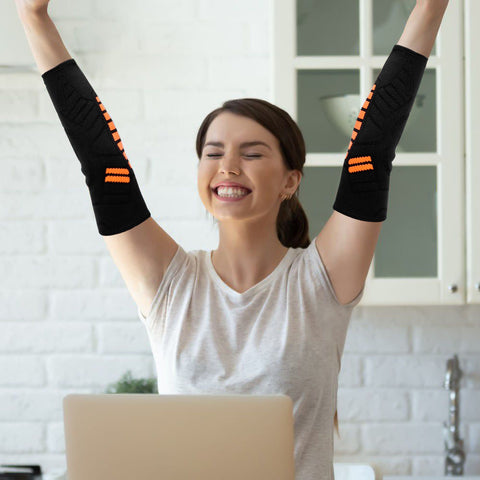
Full Range of Motion for Unrestricted Play
Restricted mechanics alter natural stroke technique, often shifting unwanted stress onto the shoulder or wrist joints. High-performance arm sleeves provide structural reinforcement without shortening the kinetic pathway of the arm.
Uninhibited Mechanics for Diverse Strokes
Maintaining complete movement freedom allows players to execute intricate spin variations and aggressive overhead slams. Utilizing a high-grade tennis elbow support brace ensures that fluid motion remains entirely unhindered throughout long matches.
-
Topspin Forehands: Full forearm pronation occurs naturally without resistance from tight outer fabrics.
-
Backhand Drive: Structural flex allows complete elbow extension during follow-through movements.
-
Serve Delivery: Overhead reaching mechanics remain unconstrained at maximum extension.
Dynamic Flexibility in Racket Control
Elbow stabilization should never force a player to compromise on touch or drop-shot precision. Material elasticity ensures that soft wrist rolls and delicate net volleys feel completely natural, keeping play styles versatile and dangerous.
Proper Support for Injury Prevention and Recovery
Sustained athletic performance requires a multi-faceted approach to physical care. Combining functional support equipment with sound physical conditioning helps mitigate cumulative tendon fatigue.
Reducing Mechanical Strain on Epicondylar Tendons
Repetitive impacts from off-center string hits transfer high-frequency tremors into the forearm muscles. Applying external compression lowers the physical load placed on tendon anchors, mitigating tissue micro-trauma during intense training blocks. Incorporating a supportive tennis elbow support brace into routine sessions helps manage fatigue accumulation across back-to-back competition days.
Active Gear Integration and Daily Maintenance
Proactive joint care extends across pre-match preparation, live match play, and post-session cool-downs.
-
Warm-Up Phase: Wear support gear during pre-match hitting to help keep arm tendons supple.
-
Active Competition: Rely on specialized sleeves during high-volume rallies to damp mechanical frame shock.
-
Post-Match Care: Pair gear removal with mild forearm stretching and hydration to accelerate tissue repair.
Continuous muscle stabilization, combined with smart gear choices, establishes a resilient foundation for long-term athletic success on the court.
Comprehensive Safeguards for Long Term Court Play
Sustaining top performance over an entire season involves combining dynamic equipment with balanced athletic habits. Utilizing a specialized tennis elbow support brace protects vulnerable arm tendons from cumulative impact forces without restricting raw power. When high-performance gear is integrated alongside targeted forearm conditioning, strategic court positioning, and adequate rest cycles, athletes can play with complete confidence, knowing their joints are well-protected for years to come.
-
Posted in
Healthy Lifestyle, Joint, sports