LCL Tear
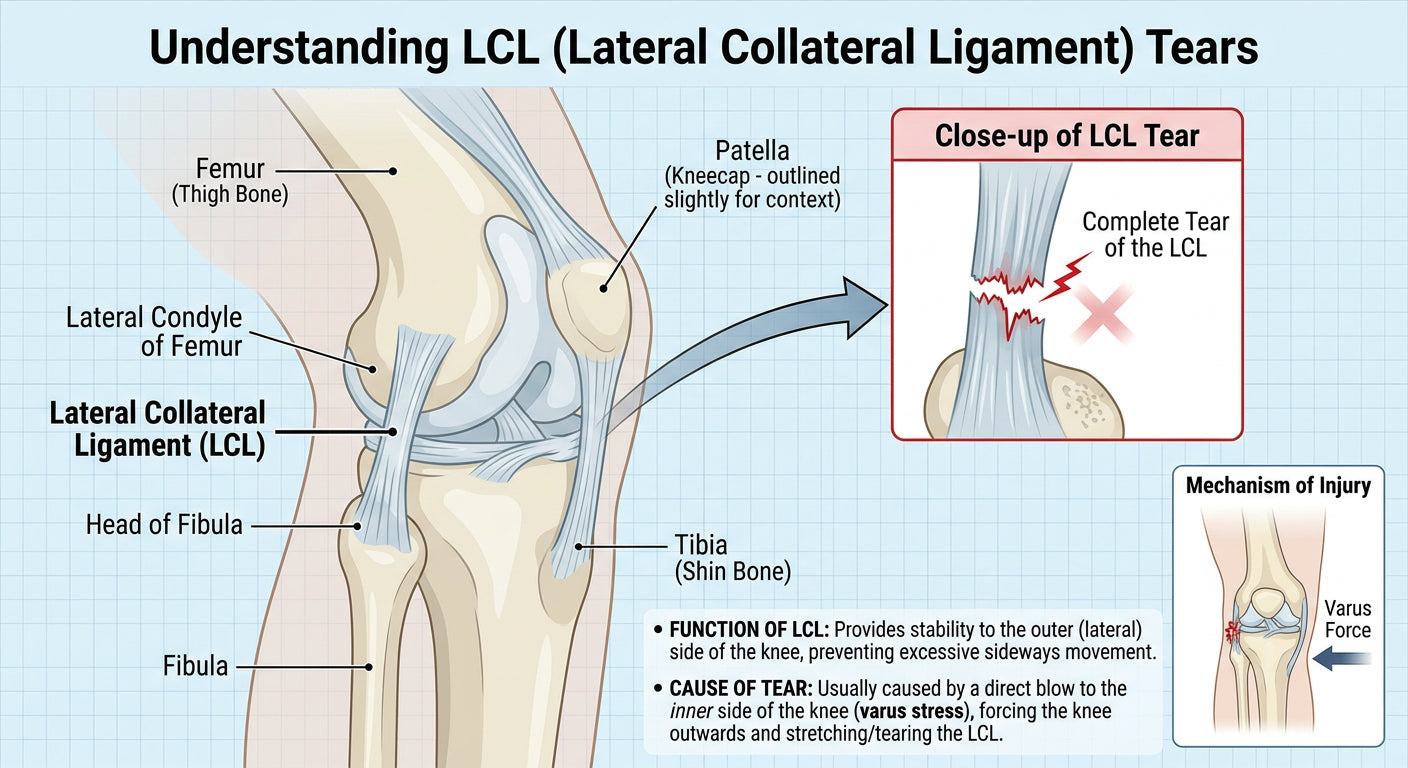
The lateral collateral ligament (LCL) is a crucial band of tissue located on the outside of your knee. It connects your thigh bone (femur) to your shin bone (fibula), providing essential stability to the knee joint, particularly against forces that push the knee inward (varus stress). An LCL tear, also known as an LCL sprain, occurs when this ligament is stretched or torn. These injuries can range from mild (a slight stretch) to severe (a complete rupture), significantly impacting knee function and daily activities.
Causes of an LCL Tear
LCL tears typically result from a direct blow or force to the inside of the knee that pushes the knee joint outward, stressing the lateral side. Common scenarios include:
- Contact Sports: Activities like football, rugby, or soccer, where direct impacts or collisions are frequent.
- Falls: Landing awkwardly after a fall, especially if the leg is twisted or hit on the inside.
- Hyperextension: When the knee is forcibly straightened beyond its normal range of motion. A hyperextended knee can put significant strain on the LCL.
- Repetitive Stress: While less common for acute tears, repeated strain over time can weaken the ligament, making it more susceptible to injury.
Recognizing LCL Tear Symptoms
Identifying the signs of an LCL injury is important for timely diagnosis and treatment. The common LCL tear symptoms include:
- Pain: Localized pain on the outside of the knee, often immediately after the injury. The intensity can vary depending on the grade of the tear.
- Swelling: Fluid buildup in knee, sometimes leading to visible swelling around the knee joint. Learning how to reduce fluid in the knee can be part of the recovery process.
- Tenderness: The outside of the knee may be tender to the touch.
- Instability: A feeling that the knee is "giving out" or is unstable, particularly when walking on uneven surfaces or pivoting. This sensation is more pronounced with higher-grade tears.
- Stiffness: Difficulty bending or straightening the knee fully due to pain or swelling.
- Bruising: While not always present, some individuals may experience bruising around the injured area. Have you wondered whether I tore my LCL if you experienced a painful pop and instability?
Diagnosing an LCL Tear
A healthcare professional will diagnose an LCL tear through a combination of physical examination and imaging studies.
- Physical Examination: The doctor will assess your knee for pain, swelling, and tenderness. A key part of the examination involves applying a "varus stress" test, gently pushing the knee inward while the lower leg moves outward. This maneuver helps evaluate the stability of the LCL.
- Imaging: X-rays may be used to rule out bone fractures. Magnetic Resonance Imaging (MRI) is often the definitive diagnostic tool, providing detailed images of soft tissues, including the LCL, to confirm the tear and its severity.

Treatment Options for an LCL Tear
Treatment for an LCL tear depends heavily on the injury's grade and the patient's activity level. Tears are graded from I (mild stretch) to III (complete rupture).
Conservative Treatment (Non-Surgical)
Most Grade I and II LCL tears can be successfully treated without surgery. The primary goals are to reduce pain and swelling, restore range of motion, and strengthen the knee.
- RICE Protocol: Rest, Ice, Compression, and Elevation are fundamental to use immediately after an injury to manage pain and swelling.
- Pain Management: Over-the-counter pain relievers can help reduce discomfort.
-
Physical Therapy & Rehabilitation: A structured rehabilitation program is crucial. This typically involves:
- Early Motion Exercises: Gentle movements to maintain knee flexibility without stressing the healing ligament.
- Strengthening Exercises: Gradually strengthening the muscles surrounding the knee (quadriceps, hamstrings, calves) to improve stability and support.
- Proprioception Training: Exercises to improve balance and coordination, helping the knee respond effectively to movements.
- Bracing: An LCL knee brace can provide support and protect the healing ligament, especially during the initial recovery phase and as you gradually return to activities. For general knee discomfort, exploring knee brace for pain options can be beneficial.
- Activity Modification: Avoiding activities that put stress on the LCL during the healing process is vital.
Surgical Treatment
Surgery is typically reserved for Grade III LCL tears, especially if other knee ligaments (like the ACL or PCL) are also injured, or if conservative treatment fails.
- LCL Repair: If the ligament has torn cleanly from the bone, it can sometimes be reattached.
- LCL Reconstruction: In cases where the ligament is severely damaged or chronic instability exists, a graft (tissue from another part of the body or a donor) is used to reconstruct the LCL.
Recovery from surgery involves a significant period of rehabilitation, often taking several months.
Rehabilitation and Recovery
- Initial Phase: Focuses on reducing pain and swelling, protecting the knee, and performing gentle range-of-motion exercises.
- Intermediate Phase: Aims to restore the full range of motion, improve muscle strength, and begin balance training.
- Advanced Phase: Concentrates on functional exercises, sport-specific drills, and gradually increasing activity levels to prepare for a return to pre-injury activities.
- Return to Activity: This is a guided process. The timing depends on the severity of the injury, your individual healing, and the demands of your desired activities. Wearing appropriate support, such as the best knee brace for athletes, might be recommended during this phase.
Preventing Future LCL Tears
- Strength and Conditioning: Maintain strong thigh and hamstring muscles to provide better support for the knee joint.
- Proper Technique: Learn and practice correct techniques for sports and physical activities to avoid awkward movements that stress the knee.
- Warm-up and Cool-down: Always perform appropriate warm-up exercises before physical activity and cool-down stretches afterward.
- Listen to Your Body: Avoid pushing through pain, and allow adequate rest and recovery time, especially after intense physical exertion.
By understanding the LCL and taking proactive steps, you can help protect your knees and maintain an active lifestyle.
-
Veröffentlicht in
Knee Injuries