Skier's/Gamekeeper's Thumb
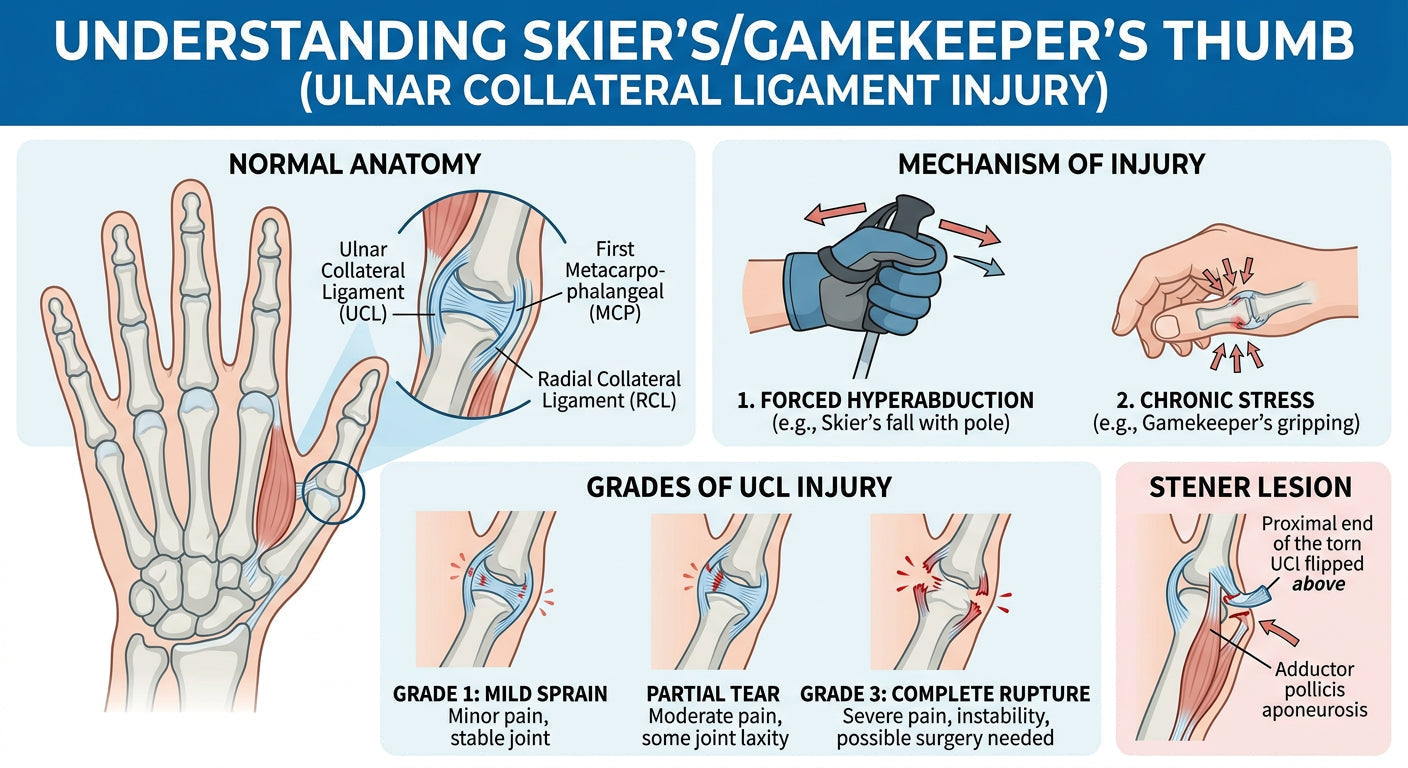
Skier's Thumb, also known as Gamekeeper's Thumb, is a common injury affecting the ulnar collateral ligament (UCL) of the thumb. This crucial ligament is located at the base of the thumb, on the side closest to the index finger, and plays a vital role in stabilizing the thumb's metacarpophalangeal (MCP) joint. When this ligament is stretched, partially torn, or completely ruptured, the ability to pinch, grasp, and perform everyday tasks can be significantly impaired. While traditionally associated with skiing accidents, hence "Skier's Thumb," the injury can arise from any forceful hyperextension or abduction (outward bending) of the thumb, making "Gamekeeper's Thumb" a more encompassing term for its diverse causes.

Anatomy of the Thumb and the UCL
The thumb is a remarkably versatile digit, largely due to the unique structure of its joints and supporting ligaments. The MCP joint of the thumb connects the long bone of the thumb (metacarpal) to its first bone (proximal phalanx). The ulnar collateral ligament (UCL) is a critical soft tissue structure on the inner side of this joint. Its primary function is to prevent the thumb from bending too far outwards, providing stability for pinching and gripping actions. When the UCL is compromised, the thumb becomes unstable, making simple actions surprisingly difficult and painful.
Causes and Risk Factors
- Skiing Accidents: Falling while holding a ski pole, where the pole acts as a lever, forcing the thumb outwards.
- Sports Injuries: High-impact sports like football, basketball, or wrestling can lead to similar hyperextension or abduction injuries.
- Falls: Tripping and falling onto an outstretched hand, where the thumb takes the brunt of the impact.
- Chronic Strain: Less commonly, repetitive minor traumas can lead to a gradual weakening and stretching of the ligament. The historical term "Gamekeeper's Thumb" refers to a chronic injury among Scottish gamekeepers who repeatedly snapped the necks of small game, leading to progressive UCL laxity.
Symptoms of Skier's/Gamekeeper's Thumb
- Pain: Immediate and often intense pain at the base of the thumb, particularly on the palm side near the web space between the thumb and index finger.
- Swelling and Bruising: Inflammation and discoloration around the MCP joint.
- Weakness: Difficulty gripping objects or performing a strong pinch.
- Instability: A feeling that the thumb "gives out" or is loose, especially when trying to hold items.
- Tenderness: Pain upon touching the area of the injured ligament.
- Difficulty moving the thumb: Restricted range of motion due to pain and swelling.
Diagnosis
Diagnosing Skier's/Gamekeeper's Thumb typically involves a physical examination by a healthcare professional. They will assess the stability of the thumb's MCP joint by applying stress to the ligament and gently moving the thumb to determine whether there is excessive looseness or pain.
- Physical Examination: This is the primary diagnostic tool. The doctor will check for pain and swelling and test UCL stability.
- X-rays: Used to rule out any fractures, especially avulsion fractures, where a small piece of bone is pulled away by the ligament.
- MRI (Magnetic Resonance Imaging): Often used to visualize the soft tissues, confirm the extent of the ligament tear (partial vs. complete), and identify a "Stener lesion." A Stener lesion occurs when the completely torn UCL flips over an adductor pollicis tendon, preventing natural healing and almost always requiring surgery.
Treatment Options
Conservative Management
- RICE Protocol: Rest, Ice, Compression, and Elevation to reduce pain and swelling.
- Pain Management: Over-the-counter anti-inflammatory medications can help manage discomfort.
- Immobilization: Protecting the thumb with a specialized support is crucial for healing. A thumb splint brace or a spica splint is commonly used to immobilize the thumb and wrist, allowing the ligament to heal without further strain. You can find various options for thumb support designed to provide the necessary stability. For comprehensive stabilization, a thumb spica brace can be very effective.
- Physical Therapy: Once initial healing occurs, a therapist can guide you through exercises to restore range of motion, strength, and stability.
- Taping/Wrapping: Learning how to tape a sprained thumb or how to wrap a sprained thumb can provide temporary support during activity or as part of a rehabilitation program.
Surgical Intervention
Surgery is typically recommended for complete tears of the UCL, especially if a Stener lesion is present. In these cases, the ligament needs to be reattached or reconstructed to restore stability and function.
- Surgical Goal: The main objective of surgery is to repair the torn ligament, re-establish joint stability, and allow the thumb to regain its full range of motion and strength.
- Post-Surgery Care: After surgery, the thumb will be immobilized, usually in a cast or a wrist brace with thumb stabilizer for several weeks. Physical therapy will be essential to regain strength and mobility.
Recovery and Rehabilitation
- Early Mobilization (as guided): Gentle exercises to prevent stiffness.
- Strengthening Exercises: Gradually increasing resistance to rebuild muscle strength around the thumb and wrist.
- Functional Training: Exercises that mimic daily activities to help you regain practical use of your hand.
- Activity Modification: Learning how to protect your thumb during sports or work to prevent re-injury.
- For those experiencing thumb pain when gripping, dedicated exercises and support can significantly aid recovery. For broader support, consider exploring options for wrist support for pain.
Full recovery can take several weeks to a few months, depending on the severity of the injury and adherence to the rehabilitation program.
Prevention
While not all injuries can be prevented, you can reduce your risk of Skier's/Gamekeeper's Thumb by:
- Proper Technique: In sports, learn and practice correct techniques for falls and equipment handling.
- Appropriate Equipment: Ensure ski pole straps are not too tight, or consider poles without straps if prone to this injury.
- Awareness: Be mindful of hand placement during activities that could lead to hyperextension.
- Strengthening: Maintain overall hand and wrist strength to improve joint stability.
-
Veröffentlicht in
Wrist Injury