Unlock Your Hip Pain Pattern: The Smart Guide to Knowing When to Rest vs. When to Use Support

As the weather warms up and we gear up for Memorial Day weekend hikes, yard games, and neighborhood barbecues, the last thing you want is a nagging hip slowing you down. When your hip suddenly whispers—or shouts—in discomfort during a festive family gathering, your first instinct is likely to head straight for the couch. After all, the conventional wisdom for joint pain has almost always been to stay off it, rest, and wait.
But what if resting is exactly the opposite of what your body needs?
A massive paradigm shift is happening in how we understand joint recovery: blind rest isn't always best. For many hip issues, complete rest can actually lead to muscle deconditioning, joint stiffness, and a longer road to recovery. The key to staying active during the long weekend and beyond lies in decoding what your specific pain is trying to tell you, so you know exactly when you need to switch from resting to supporting.

This visual clarifies key hip pain types and their common locations, helping readers identify their pain pattern to distinguish need for support or rest.
Your Hip Pain Decoder Ring: What is Your Body Saying?
Understanding your hip pain starts with paying attention to the specific patterns. Your hip is a complex ball-and-socket joint surrounded by a robust network of ligaments, tendons, and muscles. By pinpointing the sensation and location, you can start making informed decisions about your next steps.
Activity-Related Ache
Does your hip feel like it has a deep, dull ache after a long walk or a day of gardening? This slow-building discomfort usually points to muscular fatigue or mild wear-and-tear. When you experience an activity-related ache, completely immobilizing yourself can cause the surrounding muscles to tighten up further. Instead of silencing the joint with total rest, gentle, supported movement often helps keep the area lubricated and flexible.
Sharp Movement Pain
If you experience a sudden, sharp "catching" sensation when you pivot, climb stairs, or internally rotate your leg, you are likely dealing with a mechanical issue. This pattern tells you that a specific motion is aggravating a structure within the joint. Pushing through sharp pain unprotected is a bad idea, but stopping all movement isn't necessary either. This is a classic scenario where stabilizing the joint to prevent that specific aggravating movement can allow you to keep moving safely.
The Feeling of Instability or "Giving Way"
Sometimes pain is secondary to a more unsettling feeling: the sensation that your hip might just buckle or give out beneath you. This indicates potential ligamentous laxity or joint instability. In these cases, your body is literally asking for external reinforcement. For individuals dealing with these sensations, finding the right hip support can be a game-changer, providing the proprioceptive feedback and structural reinforcement needed to feel confident on your feet again. You might also find specific guidance on hip braces for hypermobility beneficial.
Referred Pain
Not all hip pain actually comes from the hip. If your pain radiates down the back of your leg or starts primarily in your lower back before wrapping around to the side, you might be dealing with referred pain from your lumbar spine or sacroiliac (SI) joint. Tracking exactly where the pain starts and stops is crucial for identifying the true source.
Becoming Your Own Hip Detective: Tracking and Testing
To bridge the gap between identifying a problem and finding a solution, you need to track your symptoms systematically. Creating a simple daily log can reveal incredible insights.
How to Log Your Symptoms Effectively:
- Timing: Is it worse first thing in the morning, or does it degrade as the day goes on?
- Triggers: What specific activities (sitting, standing from a chair, carrying groceries) provoke the issue?
- Severity: Rate your discomfort on a scale of 1-10 before and after activities.

Step-by-step visual guide on simple hip movement tests users can perform safely to gauge stability and identify pain triggers.
Simple Movement Tests You Can Do Safely
Before assuming you need to spend the week in bed, try a few gentle self-assessments to better understand your limitations.
- The Single-Leg Stance: Stand near a wall or sturdy chair for balance. Lift your unaffected leg slightly off the ground. If standing on the affected leg causes immediate sharp pain or a feeling that your pelvis is dropping significantly on one side, it indicates weakness or instability that could greatly benefit from external support.
- Gentle Range of Motion (ROM) Check: Lie on your back and slowly pull your knee toward your chest. Then, gently let your knee fall outward. Take note of exactly where the motion feels restricted or sharp.
Note: These tests are meant for self-observation, not medical diagnosis. If you experience severe, unbearable pain, it’s time to consult a healthcare professional.
FAQ: Navigating Your Hip Health
Q1: How can I tell if my hip pain requires rest or if I should use support and keep moving?
A1: The key is identifying your pain pattern. Sharp, catching pain during specific movements usually indicates a need for stabilization to prevent aggravation. A dull, activity-related ache often benefits from gentle, supported movement to maintain lubrication and flexibility, rather than complete immobilization. Never push through severe, sharp pain.
Q2: What are the common types of hip pain, and what do they signify?
A2: We can categorize hip pain into several patterns: an activity-related ache (muscular fatigue/mild wear-and-tear), sharp movement pain (mechanical issue aggravated by specific motions), a feeling of instability or "giving way" (potential ligament laxity/joint instability), and referred pain (originating from the lower back or SI joint). Each pattern suggests a different approach to care.
Q3: Are hip supports or braces only for serious hip injuries?
A3: Not at all. Supportive wear can be used proactively for everyday fatigue, minor instability, or to prevent smaller issues from escalating. They provide crucial compression and joint awareness, helping you stay active and confident.
Q4: Can excessive rest negatively impact my hip recovery?
A4: Yes, prolonged complete rest can lead to muscle deconditioning, joint stiffness, and a longer recovery path. Joints need movement to circulate vital fluids and deliver nutrients. Inactivity can weaken supporting muscles, potentially worsening instability.
Q5: When should I consider consulting a healthcare professional for my hip pain?
A5: While self-observation is helpful, if you experience severe, unbearable pain, persistent symptoms that don't improve with self-care, or any concerns about a potential serious injury, it's always best to consult a healthcare professional for an accurate diagnosis and personalized treatment plan.

This framework helps readers connect their specific hip pain pattern to the appropriate supportive brace type that preserves mobility and stability.
Empowering Your Hip: Choosing Stability Without Losing Mobility
Once you recognize that your pain pattern requires support rather than complete isolation, the next step is choosing the right tool. The goal of a modern hip brace is not to immobilize you like a cast, but to act as an external set of ligaments, providing stability while allowing for a functional range of motion.
Evaluating Your Support Options
When selecting support, you have to look beyond simply buying "a brace." Consider the features that align with the pain patterns you tracked:
- For General Aches and Fatigue: Look for lightweight compression materials. These increase blood flow and keep the joint warm during activities like walking the dog or doing yard work.
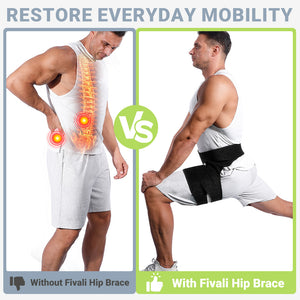
- For Sharp Pain or Instability: You'll want a device that offers structural reinforcement. A well-designed fivali hip and leg brace can help offload the stress from the joint, effectively absorbing the shock of your footsteps so your internal structures don't have to bear the full brunt.
Your Path to Persistent, Pain-Free Movement
Listening to your hip isn't about giving in to limitations; it's about making intelligent adjustments. By understanding the difference between an ache that needs gentle movement and a sharp catch that requires stability, you empower yourself to take control of your joint health.
As you head into this holiday weekend, don't let the fear of discomfort keep you sidelined. Start tracking your symptoms, assess your triggers, and remember that sometimes the best way to rest an overworked joint is simply to give it the support it deserves to keep moving.