The Top Knee Support for College and National Team Players: the Fivali Compression Brace
Elite competition demands unrelenting physical output, exceptional joint resilience, and unyielding gear reliability. College athletes competing in NCAA programs and national team players operate under biomechanical loads that push the human body to its absolute limits. During high-impact landings, rapid lateral cuts, sudden decelerations, and heavy strength conditioning, the knee joint absorbs forces several times greater than body weight. To preserve athletic durability and sustain peak performance throughout demanding seasons, high-level competitors require specialized protective equipment.
The Fivali Compression Knee Brace is designed specifically to meet the rigorous demands of elite collegiate and international sports. Engineered to balance targeted stabilization with flexible movement, this high-performance gear helps athletes manage dynamic joint stress without sacrificing speed or agility. High-level competition leaves no room for gear failure or discomfort, making structured compression an essential component of every serious athlete's equipment bag.
Biomechanical Demands of Elite Athletics
High-level athletes in sports such as basketball, volleyball, soccer, track and field, and football place extraordinary dynamic stress on their lower extremities. The kinetic chain relies heavily on the structural integrity of the knee joint to transfer power efficiently from the ground through the hips and torso. When key stabilizing structures experience fatigue during late-game situations, joint mechanics can degrade, increasing susceptibility to strain.
-
Rotational Stress: Fast pivots and direction changes create multi-axial torque across the joint line.
-
Axial Shock Absorption: Repeated jumping and running on rigid surfaces send reverberating impact energy through the tibia and patella.
-
Muscle Fatigue: As stabilizing musculature tires over extended play, external compression helps maintain proper mechanical tracking.
-
Proprioceptive Response: Surface pressure on skin and underlying tissues enhances subconscious joint awareness during fast-paced maneuvers.
Protective Compression, Yet Very Comfortable
When it comes to finding the best knee brace, NCAA athletes need a balance of protective compression and comfort. High-level players cannot afford gear that restricts natural range of motion or pinches skin during full flexion. Optimal compression offers structural support while maintaining fluid mobility across every phase of movement.
The engineered compression profile hugs the knee firmly, promoting stability and limiting excessive joint displacement during high-impact plays. By applying uniform external pressure across the soft tissues surrounding the patella, the brace aids in managing local strain and maintaining proper alignment. Despite its protective compression, the brace ensures an ergonomic, comfortable fit that integrates seamlessly with standard athletic uniforms. Athletes can maintain complete focus on tactical execution without distraction, knowing their lower extremities are fully supported during intense multi-period matches.
Breathable Design: Stay Cool and Dry During NCAA Activities
NCAA athletes engage in intense workouts, multi-session practices, and high-stakes tournament games that inevitably generate significant heat and body moisture. Traditional rubber or heavy neoprene supports trap thermal energy and sweat, causing discomfort, skin irritation, slipping, and chafing. Preventing moisture buildup is crucial for maintaining both hygiene and equipment fit over long duration play.
Modern sports engineering solves this problem by using advanced knitting technology designed for breathability and active moisture management. Choosing the best knee brace requires looking closely at fabric ventilation and air transmission capabilities. The specialized woven structure allows continuous air exchange while rapidly pulling sweat away from the epidermis to evaporate on the outer surface. This design ensures that the knee area stays cool, dry, and secure, even during grueling double-header sessions or extended overtime periods. By preventing slippage and heat buildup, players maintain consistent support without needing constant adjustments during stoppage of play.
Stability Support: Enhancing Performance and Preventing Injuries
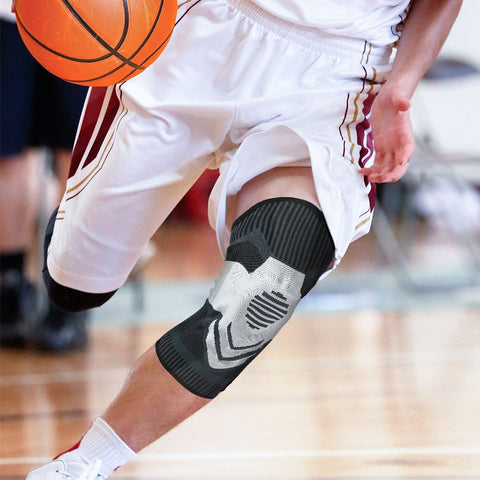
Stability support is critical for collegiate and national team players who routinely perform high-velocity movements under physical pressure. Structural reinforcement must be subtle enough to allow full explosive power while firm enough to resist abnormal lateral twisting or joint buckling.
Dual-sided spring stabilizers integrated into the lateral and medial channels hug the knee joint, delivering targeted dynamic reinforcement. These dual springs flex naturally during forward bending and extension, then exert restorative force to stabilize the joint during sudden lateral cuts. Distributing mechanical stress evenly across the joint capsule minimizes concentrated load on collateral ligaments and soft tissues during intense sports activities. By limiting harmful lateral shift and supporting the patellar track, this advanced stabilizing architecture provides the ideal balance of defense and agility, making it the best knee brace option for national-level competitors seeking long-term physical longevity.
Structural Comparison of Athletic Knee Support Solutions
Selecting the appropriate level of knee support depends on the intensity of activity, mechanical load demands, and mobility requirements. The table below outlines how compression gear with flexible spring stabilizers compares to standard non-reinforced sleeves and rigid hinged braces.
| Gear Category | Lateral Reinforcement | Thermal Management | Range of Motion | Ideal Application |
| Standard Compression Sleeve | None (Fabric only) | Moderate to High | Unrestricted (100%) | Light warm-ups, general daily wear |
| Spring-Stabilized Compression Brace | Dual flexible side springs | Exceptional (Woven knit) | High (95-98%) | Elite practice, competitive NCAA/National matches |
| Rigid Hinged Knee Brace | Heavy metal/plastic hinges | Low (Dense neoprene) | Moderate (70-85%) | Post-surgical recovery, severe joint instability |
Advanced Materials and Technical Architecture
The construction of elite athletic support gear involves precise material selection to withstand rigorous training cycles, frequent washing, and continuous friction without losing elasticity or shape.
High-Density Elastic Weave
A high-tensile blend of synthetic microfibers creates targeted gradient compression. The weave density varies strategically across the brace structure: looser over the kneecap to allow unrestricted patellar tracking, and denser along the surrounding muscular attachment points for augmented pressure.
Flexible Dual-Spring Core
Constructed from lightweight, resilient spring steel, the side stabilizers flex along the sagittal plane (forward and backward movement) while resisting bending along the frontal plane (side-to-side shear forces). This construction ensures protection against awkward landings without hindering sprinting mechanics.
Anti-Slip Silicone Gripping System
To prevent the brace from rolling down or bunching during repetitive sprinting and jumping, inner borders feature dual-waved silicone gripping strips. These strips adhere gently to the skin without pulling hair or causing skin friction.
Integration into Training and Match Day Routines
To maximize the functional benefits of supportive compression gear, athletes follow structured habits regarding equipment application, care, and usage cycles.
-
Pre-Game Preparation: Apply the support to dry skin prior to dynamic warm-up drills to allow the fabric to adapt to body temperature and contour.
-
In-Game Adjustment Check: Ensure silicone bands rest flush against the mid-thigh area to preserve vertical alignment throughout play.
-
Post-Match Care: Remove gear immediately after activity to let skin air out, and wash gear regularly in cool water to clear salt crystals and maintain elastic recovery force.
Meeting the Standards of Elite College and National Teams
Athletes competing at the highest levels require gear engineered to match their intensity. Combining targeted protective compression, ergonomic comfort, breathable air-channel knitting, and resilient side-spring stabilization provides a comprehensive support system tailored for intense physical play. By prioritizing structural stability and thermal regulation, players can step onto the field or court with total confidence in their movement, speed, and endurance.
-
Posted in
Healthy Lifestyle, Joint, Pain, sports