Ankle Biomechanics and Ligament Stress in Walking and Running
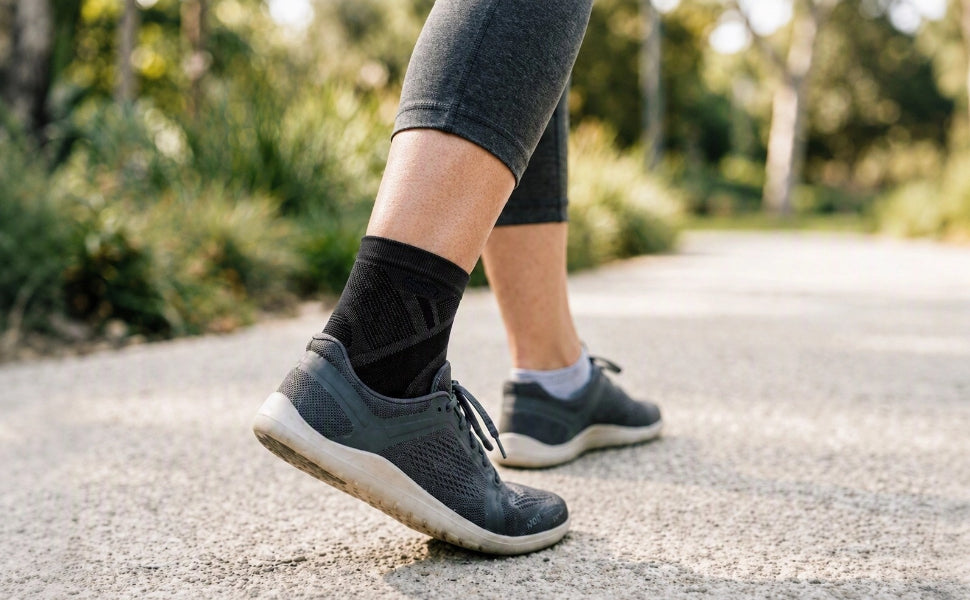
As we head into the vibrant summer season—marked by upcoming Memorial Day weekend hikes, Fourth of July 5Ks, and long evening neighborhood walks—our feet are putting in overtime. But have you ever been enjoying a brisk walk or jog, taken one seemingly normal step on slightly uneven ground, and felt that sudden, sharp roll of your ankle?
If you have, you’re not alone. Ankle sprains are among the most common orthopedic injuries in the world. But why does the ankle roll that specific way? Why does a casual jog carry different risks than a fast-paced run?
Understanding the intricate mechanics of your ankle isn't just for physical therapists or elite athletes. By demystifying the basic biomechanics of walking and running, you can connect the dots between how your foot moves, where ligament stress occurs, and what targeted support you actually need to enjoy an active, pain-free lifestyle. Let's break down the science of your stride.
The Foundation: Decoding Ankle Movements
Before we can understand how injuries happen, we need to understand how the ankle is designed to move. The ankle isn't just a simple hinge; it's a complex multi-directional joint. Here are the primary motions you need to know:
- Plantarflexion and Dorsiflexion: Think of this as the "gas pedal" motion. Plantarflexion is pointing your toes downward (stepping on the gas), while dorsiflexion is pulling your toes up toward your shin.
- Inversion and Eversion: These are the side-to-side tilting motions. Inversion happens when the sole of your foot turns inward (facing your other foot). Eversion is when the sole turns outward.
- Supination and Pronation: These are complex, combination movements. Pronation is your body's natural shock absorption system—as your foot strikes the ground, the arch flattens and rolls slightly inward. Supination is the opposite, where the foot rolls outward and becomes a rigid lever to push off the ground.
The Ligament Stress Zones: Inversion vs. Eversion Mechanics
Ligaments are the tough, fibrous bands that connect bone to bone, providing stability to your joints. When an ankle motion exceeds its normal range, these ligaments stretch and potentially tear, causing a sprain.
The Notorious Inversion Sprain
The vast majority of ankle sprains (roughly 80-90%) are inversion sprains. This occurs when the foot rolls too far inward, placing immense stress on the lateral (outer) ligaments of the ankle.
The primary victim here is usually the Anterior Talofibular Ligament (ATFL). Because the bone on the outside of your ankle (the fibula) extends further down than the bone on the inside (the tibia), your ankle naturally has more room to roll inward than outward. If you step on a rock or land awkwardly off a curb, the ankle gives way to an inversion roll, stretching the ATFL beyond its capacity.
The Less Common Eversion Sprain
Conversely, an eversion sprain happens when the foot rolls excessively outward. This stresses the strong deltoid ligament on the medial (inner) side of the ankle. Because this ligament is incredibly thick and the bone structure naturally blocks severe outward rolling, eversion sprains are much less common but often more severe when they do occur. People who severely overpronate—where the arch collapses heavily inward—are placing chronic micro-stress on these medial structures.

The Gait Cycle: How Walking and Running Change the Rules
To truly understand when your ankle is most vulnerable, we have to look at the gait cycle—the continuous sequence of events that happens from the moment one foot hits the ground to the moment that same foot hits the ground again.
Walking: The Consistent Load
During a walking gait, one foot is always in contact with the ground.
- Heel Strike: Your heel touches the ground. The ankle is slightly dorsiflexed and often slightly supinated.
- Midstance: Your full body weight passes over the ankle. The foot pronates to absorb the shock.
- Toe-Off: Your heel lifts, the ankle plantarflexes, and you push off into the next step.
In walking, the forces traveling through your ankle are roughly 1 to 1.5 times your body weight. The moment of highest vulnerability is usually right at heel strike on an uneven surface, where the foot can be forced into an unexpected inversion angle before the stabilizing muscles have time to react.
Running: The Amplified Force
Running isn't just faster walking; it’s a completely different biomechanical process. The defining feature of running is the "flight phase"—a moment where neither foot is on the ground.
When you land during a run, your ankle has to absorb forces equal to 2 to 3 times your body weight. The initial contact is much faster, meaning your proprioception system (your brain's awareness of where your body is in space) has less time to correct a misstep. If you happen to land on a slightly inverted foot while running, the multiplied force drastically increases the peak load on those lateral ligaments. This heightened risk often leads people to wonder, should i wear an ankle brace while running to protect against these amplified forces?

Linking Biomechanics to Targeted Support
So, how does this scientific deep dive help you stay active? By understanding your biomechanics, you can identify exactly what kind of support you need.
- If you struggle with "weak ankles" that constantly roll outward: This is chronic ankle instability, usually a result of overstretched lateral ligaments from past inversion sprains. You need motion-control features that physically block excessive inversion. Look for supports with lateral stabilizers.
- If you overpronate: Your foot rolls too far inward during midstance, placing stress on the medial ligaments and tendons. You require support that bolsters the arch and limits eversion.
- For general stability and proprioception: Sometimes, the goal isn't restricting movement, but enhancing awareness. A high-quality compression ankle brace applies gentle, continuous pressure. This pressure acts as a tactile cue to your brain, enhancing your proprioception and helping your muscles activate faster to stabilize the joint before a severe sprain occurs.
Frequently Asked Questions (FAQ)
What is the most dangerous phase of the gait cycle for an ankle sprain?
The initial contact phase, specifically the transition from heel strike to midstance, is the most vulnerable point. If the foot is improperly angled (inward or outward) right as your full body weight shifts onto it, the ligaments must absorb the peak load, increasing the risk of a sprain.
Why do I keep spraining the same ankle?
Once a ligament is severely stretched or torn during an inversion or eversion sprain, it heals with slight laxity (looseness). Additionally, the nerve endings that communicate with your brain for balance (proprioception) are often damaged. This combination creates a cycle of chronic ankle instability, making subsequent sprains much easier to trigger.
How do I know what type of support is right for my walking or running routine?
It depends entirely on your biomechanical needs. If you are recovering from a severe injury or have severe chronic instability, rigorous ankle braces with structured side-stabilizers are ideal to prevent inversion. However, if you are looking to boost circulation, reduce swelling, and enhance muscle awareness without restricting your natural running gait, people often ask, do ankle compression socks work? The answer is yes—compression sleeves are excellent for mild support and enhanced proprioception during daily activities or light jogging.
Empowering Your Next Step
Your ankles are biomechanical marvels, engineered to adapt to different terrains, absorb massive forces, and propel you forward. By understanding the differences between inversion and eversion, and how forces multiply from walking to running, you are no longer leaving your joint health to chance.
Whether you're gearing up for a festive summer race or just trying to navigate your local hiking trails with confidence, paying attention to your unique gait patterns is the first step toward a healthier, more active life.
Ready to dive deeper into how you can protect your joints? Keep exploring your biomechanical profile, invest in targeted supportive gear, and listen to the subtle signals your body sends during every stride.