How Body Weight Affects Knee Stress and Biomechanics
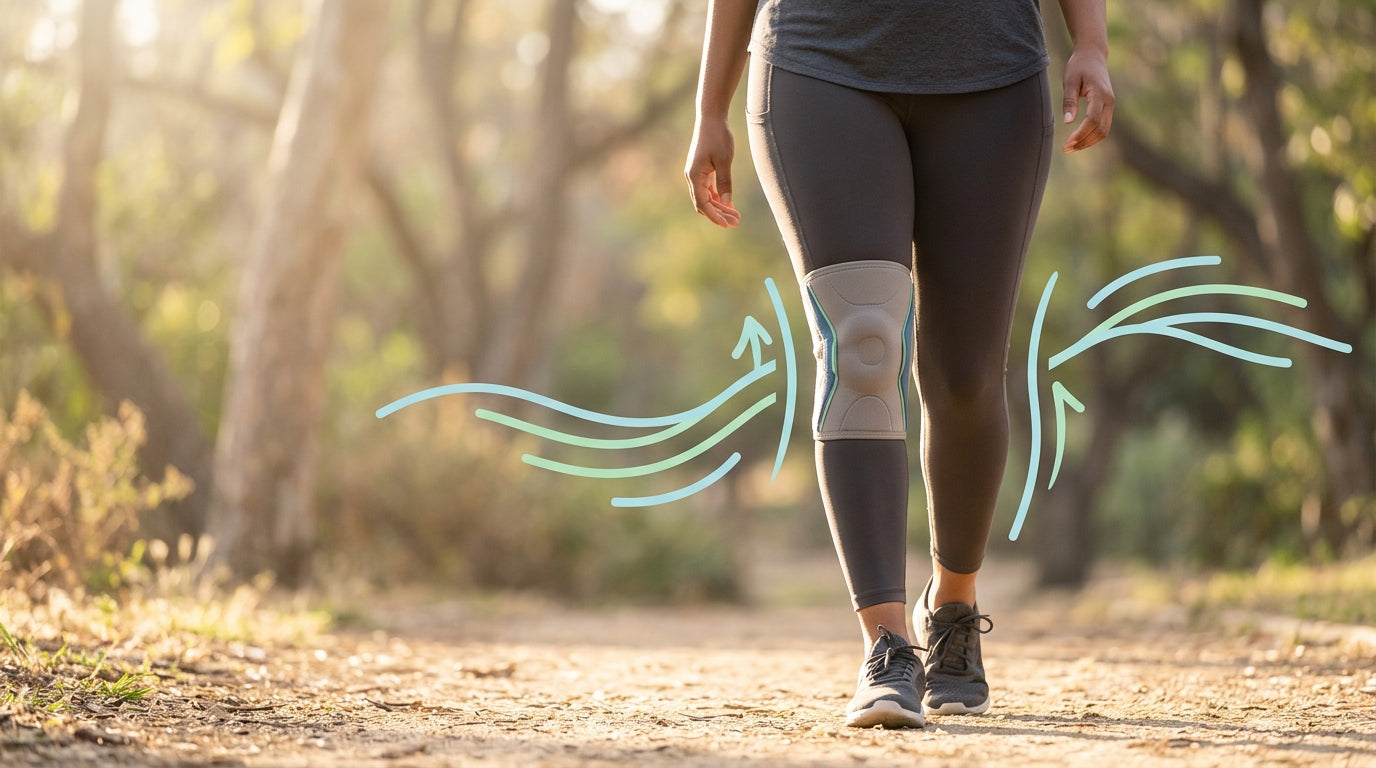
As Memorial Day weekend approaches, kicking off the summer season of backyard barbecues, park walks, and outdoor adventures, many of us are eager to get moving. But if you carry extra weight, the simple act of standing up from a picnic table or walking down a flight of stairs might come with a sharp, familiar ache in your knees.
For years, the standard advice for plus-size individuals experiencing knee pain has been simply to "lose weight." While well-intentioned, this advice completely skips over the why. It fails to explain the fascinating, albeit frustrating, mechanical changes happening inside your joints.
Understanding your body’s biomechanics is the first step toward finding real comfort. Your knees aren't just bearing weight; they are managing complex forces. Once you understand how these forces work, you’ll experience an "aha" moment that explains exactly why your knees feel the way they do—and why finding the right structural support is the key to enjoying an active, pain-free summer.

The "Multiplier Effect": Basic Knee Biomechanics Simplified
To understand plus-size knee pain, we have to look at the knee not just as a joint, but as a mechanical lever. Think of your knee like a seesaw. The fulcrum (the middle pivot point) is the knee joint itself.
Because of the way our bodies are engineered, the force exerted on our knees isn't a 1-to-1 ratio with our body weight. Every single pound of body weight translates to roughly 3 to 6 pounds of force across the knee joint during daily activities.
- Walking on level ground: Your knees absorb a force equal to about 1.5 times your body weight.
- Climbing stairs: The force spikes to 3 to 4 times your body weight.
- Squatting to pick something up: The force can reach up to 5 times your body weight.
If you carry an extra 20 pounds, you aren't just putting 20 pounds of pressure on your knees when you take the stairs—you are asking them to manage an extra 60 to 80 pounds of force with every single step. This "multiplier effect" is the foundational reason why plus-size knees require different care and robust structural support to function smoothly.
Altered Anatomy: What Actually Happens Inside Your Joint
Increased body mass doesn't just push down harder; it actually changes the angles at which your knee operates.

Cartilage Under Pressure
Your knee joint consists of two main compartments: the medial (inner) and the lateral (outer). In a perfectly aligned leg, weight is distributed evenly across the cartilage of both sides. However, increased body weight often alters an individual's gait, causing the knees to take on a slightly different angle.
Most commonly, this added pressure forces the majority of the weight onto the medial (inner) compartment of the knee. This abnormal loading acts like a misaligned car tire. The uneven friction accelerates cartilage breakdown, turning a smooth, gliding surface into a rough, painful one.
The Ligament Toll: Valgus Stress and Instability
Because the weight distribution changes, your knee's supporting ligaments are forced to work overtime. Plus-size individuals often experience what biomechanical experts call "valgus stress"—a tendency for the knees to slightly collapse inward toward each other under heavy loads.
This inward collapse puts immense tension on the knee ligaments, particularly the Medial Collateral Ligament (MCL) on the inside and the Lateral Collateral Ligament (LCL) on the outside. When these ligaments are continuously stretched beyond their comfort zone, you experience that frightening feeling of the knee "giving out."
Being aware of how these specific structural elements react is crucial. For instance, if you experience sudden pain on the outside of your knee along with instability, you might be looking at early lcl tear symptoms. Conversely, stretching the inner ligaments too far can lead to painful setbacks. Depending on the severity, mcl sprain grade 12 recovery weeks can stretch into a frustratingly long period of inactivity, derailing your summer fitness goals entirely.
Recognizing the Signs: Is It Structural Stress?
How do you know if your knee pain is related to altered biomechanics rather than just fatigue? Look for these signs:
- The "Start-Up" Ache: Pain that is sharpest right when you stand up after sitting for a long time, which then slightly improves as you walk.
- Instability or Wobbling: A sensation that your knee might buckle inward or backward when you shift your weight.
- Staircase Agony: Pain that is significantly worse when walking down stairs compared to walking up them (because walking downward requires your knees to act as brakes, drastically increasing the mechanical load).
Why Structural Support is the Missing Puzzle Piece
Many people delay taking action, thinking they need to lose weight before their knees can feel better. But movement is essential for joint health—it lubricates the cartilage and strengthens the surrounding muscles. You need to be able to move today without pain.
If you are researching the best knee support for overweight individuals, the answer lies in mechanical correction. Flimsy compression sleeves might keep your joint warm, but they do nothing to correct the altered biomechanics or prevent valgus inward collapse. To truly offset the "multiplier effect," you need external structural support that acts as a scaffolding for your knee.
Decoding Brace Mechanisms: Hinge vs. Side-Stabilizer
Understanding your mechanical pain directly dictates what kind of support you need.
When to Choose a Side-Stabilizer
If your primary issue is a feeling of medial/lateral weakness—that sense that your knee wants to wobble side-to-side during a neighborhood walk—a knee brace with side stabilizers is typically the best starting point. These braces contain flexible spring mechanisms on the left and right sides of the joint. They allow for a full range of forward-and-backward motion while acting like gentle guardrails, preventing the knee from bowing outward or collapsing inward under heavy loads.
When You Need a Hinged Brace
If you experience severe instability, have a history of ligament sprains, or struggle with your knee hyperextending (bending backward), you require heavier mechanical intervention. A hinged knee brace features solid, articulating metal or heavy-duty plastic hinges on either side of the joint.
These hinges physically absorb a significant portion of the weight-bearing load, bypassing the damaged cartilage and strained ligaments altogether. Because plus-size bodies have different anatomical proportions, investing in a properly fitted plus-size knee brace ensures that the hinges align correctly with your joint without rolling down or pinching your thighs.
Frequently Asked Questions (FAQ) About Plus-Size Knee Health
Can losing just a small amount of weight really make a difference?
Absolutely. Because of the multiplier effect, losing just 10 pounds removes 30 to 40 pounds of mechanical force off your knees with every single step you take.
Is walking bad for my knees if I am overweight?
Walking is incredibly beneficial for your joints as it promotes fluid circulation that nourishes cartilage. The key is ensuring you have the right structural support (like a stabilizing brace) and well-cushioned shoes to keep the joint in proper alignment while you move.
Why do my knees hurt worse the day after an activity?
This is often due to the dual nature of joint stress. Mechanical wear and tear triggers an inflammatory response. Fat tissue also releases systemic inflammatory markers. This combination means that the physical strain from a Saturday afternoon hike might manifest as swelling and stiffness on Sunday morning.
Empowering Your Next Steps
Your knee pain isn't just a symptom of a number on a scale; it's a mechanical reality based on physics, angles, and load distribution. By understanding how the "multiplier effect" alters your joint biomechanics, you can stop fighting your body and start supporting it correctly.
As we head into the warm summer months, don't let mechanical stress keep you on the sidelines. Evaluate your specific symptoms, choose the structural support mechanism that addresses your unique biomechanical needs, and step back into your active lifestyle with confidence.