Overweight & Knee Pain? Uncover the Daily Habits Secretly Damaging Your Joints
As Memorial Day approaches and we gear up for the unofficial start of summer, our calendars quickly fill with outdoor plans. We’re deep-cleaning the house for guests, spending hours on our feet prepping backyard BBQs, and taking advantage of the warmer weather to get moving again. But if you’re carrying extra weight, these celebratory bursts of activity can come with an unwelcome guest: sharp, aching knees.
Perhaps you've noticed sudden knee pain during workout routines, or simply after a long afternoon pulling weeds in the garden. You aren't alone, and your pain isn't just in your head.
To understand why this happens, consider this staggering fact: every ten pounds of extra body weight places roughly 30 to 60 extra pounds of pressure on your knees with every single step. But it isn't just about the amount of movement; it’s about the type of movement. Certain daily activities subtly place disproportionate stress on your joint tissues, accelerating wear and tear before you even realize what's happening.
Let's explore the biomechanics behind your knee pain, identify the highest-risk everyday tasks, and build a toolkit of safer, low-impact alternatives so you can enjoy your summer pain-free.

The Biomechanics: Understanding Your Knees’ Silent Struggle
Think of your knee as a complex shock absorption system. The cartilage acts as a smooth, frictionless coating over the ends of your bones, while the menisci (C-shaped pieces of tough cartilage) sit between them like rubber washers, distributing weight.
When you carry excess weight, these structures face two distinct enemies:
- Mechanical Overload: Activities that require extreme bending or sudden stopping create massive "shear" (sliding) and "compressive" (squashing) forces. Over time, these forces physically grind down the cartilage.
- Systemic Inflammation: Adipose (fat) tissue is biologically active and can release inflammatory chemicals into your bloodstream. This means your knees aren't just dealing with physical weight; they are also battling low-grade inflammation that makes joint tissue more vulnerable to damage.
Finding true overweight knee pain relief requires addressing these specific forces by changing how we move through our day.

The "High-Risk" Everyday Activities (And Safer Alternatives)
Many people assume running or jumping are the only culprits. In reality, mundane household tasks often inflict the most damage due to poor body mechanics and repetition.
1. Repetitive Deep Squatting and Sustained Kneeling
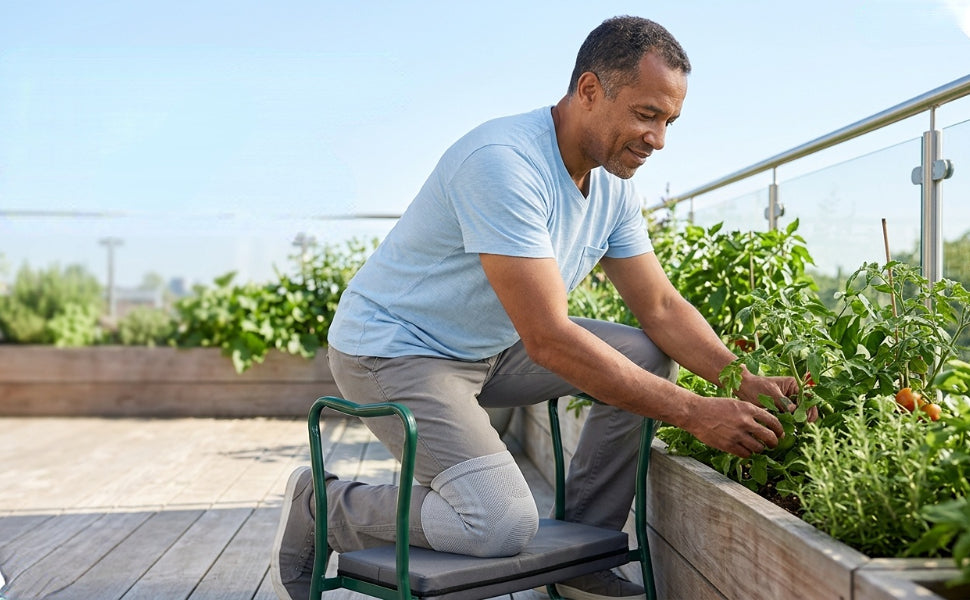
Whether you're planting the spring garden, cleaning baseboards, or retrieving heavy pots from bottom kitchen cabinets, crouching low forces your knee joint into acute angles. With extra body weight, this magnifies the compressive force on the back of your kneecap exponentially.
- The Safer Alternative: "Deconstruct" the movement. Instead of a free-standing deep squat, use the "Up and Down" chair method. Place a sturdy stool or chair nearby to bear your weight as you lower yourself. For gardening, invest in a padded, elevated kneeling bench with handles, which allows your arms to absorb the strain when standing back up.
2. Long Downhill Walking
You might think walking is universally good, but prolonged downhill walking—like hiking a sloped trail or even repeatedly walking down a steep driveway—forces your knees to act as brakes. This eccentric muscle contraction pulls aggressively on the patellar tendon and creates high shear force. It is a frequent, hidden trigger for knee pain from exercise and outdoor activity.
- The Safer Alternative: Stick to flat terrain whenever possible. If you must go downhill, try to "zig-zag" your path to decrease the steepness of the angle. Take smaller, slower steps, keeping your knees slightly bent to allow your thigh muscles, rather than the joint hardware, to absorb the impact.
3. Prolonged Standing in One Place
Standing at the grill cooking hot dogs for the neighborhood, or standing at the sink doing dishes, forces static, unmoving weight onto isolated parts of the cartilage.
- The Safer Alternative: Implement the "Weight-Shift Strategy." Keep a small step stool nearby and alternate resting one foot on it. This subtly changes the angle of your pelvis and redistributes the load across different areas of the knee joint. Additionally, place a thick anti-fatigue mat where you stand most often.
The Pacing Playbook: Managing Energy and Joint Load
Protecting your knees isn't about stopping activity altogether; it’s about strategic pacing. The cartilage in your knees doesn't have its own blood supply; it gets nutrients through the compression and release of joint fluid during gentle movement.
Implement the 20-Minute Rule: Never do the same continuous physical task for more than 20 minutes. If you are vacuuming, stop after 20 minutes to sit and fold laundry. If you are sitting at a desk, stand up and do some gentle calf raises every 20 minutes. Task-switching prevents any single joint from becoming overworked while keeping the synovial fluid (your knee's natural lubricant) actively circulating.
A Holistic Approach: Where Supportive Devices Fit In
As you modify your daily movements, you might wonder what does a knee guard do and if it's worth incorporating into your routine.
Supportive devices, such as compression sleeves or hinged braces, are powerful tools—when used correctly. They work by providing gentle compression, which retains warmth, reduces swelling, and enhances proprioception (your brain's awareness of where your joint is in space). This added stability is incredibly reassuring when you're navigating uneven grass at a summer picnic or trying new low-impact exercises.
However, a support device should never be treated as a magical cure-all or a replacement for building internal strength. It is a complementary tool. Proper fit is crucial; a support that rolls down or pinches behind the knee can do more harm than good. Finding a properly contoured plus size knee brace ensures that you get secure, comfortable compression that actually stays in place while you move.
These devices work best when used defensively during your highest-risk activities, while you simultaneously focus on learning how to strengthen knee muscles like the quadriceps and hamstrings to build your body's natural internal support system.

Frequently Asked Questions (FAQ)
How does carrying extra weight affect my knees during daily activities?
The article explains that every ten pounds of extra body weight places roughly 30 to 60 extra pounds of pressure on your knees with every single step. This mechanical overload, combined with systemic inflammation from adipose tissue, accelerates cartilage wear and makes joint tissue more vulnerable to damage.
What common daily movements are most harmful for knee joints when you're overweight?
The article highlights repetitive deep squatting (like gardening or cleaning baseboards), long downhill walking (which forces knees to act as brakes), and prolonged standing in one place (e.g., cooking or washing dishes). These activities create excessive compressive and shear forces, contributing to knee wear.
Can a small amount of weight loss make a significant difference for knee pain?
Absolutely. According to the article, losing just 5% of your body weight can lead to a substantial 50% reduction in knee discomfort for many adults. Significant relief can be felt without needing to reach an "ideal" body mass index.
When is the best time to use a knee support or compression sleeve?
The article suggests using supportive devices strategically during "highest-risk activities" that typically trigger discomfort, such as long walks, gardening, or navigating stairs. It's generally not recommended to wear them all day, as this can lead to muscle reliance and weakness.
Are stairs completely off-limits if I experience knee discomfort due to excess weight?
Not necessarily. The article recommends the "Good up, Bad down" rule: lead with your stronger leg when going up, and lead with your weaker/painful leg when going down, allowing the stronger leg to slowly lower your weight. Always utilize handrails to reduce stress on your knees.
Creating Your Personalized Knee-Safe Action Plan
As the warmer seasons invite us to be more active, you don't have to resign yourself to sitting on the sidelines. By understanding how certain forces impact your joints, you can make intelligent, micro-adjustments to your daily routine.
Start by identifying the one household chore or daily activity that causes you the most discomfort. Apply a pacing strategy or a mechanical modification to that single task tomorrow. As you integrate smarter movements, consider pairing them with targeted, low-impact muscle strengthening and appropriately sized supportive wear. By transforming how you navigate your daily environment, you take the first, most crucial step toward long-term joint health and a more vibrant, active lifestyle.