Rigid vs Flexible Volleyball Wrist Braces Choosing Optimal Support
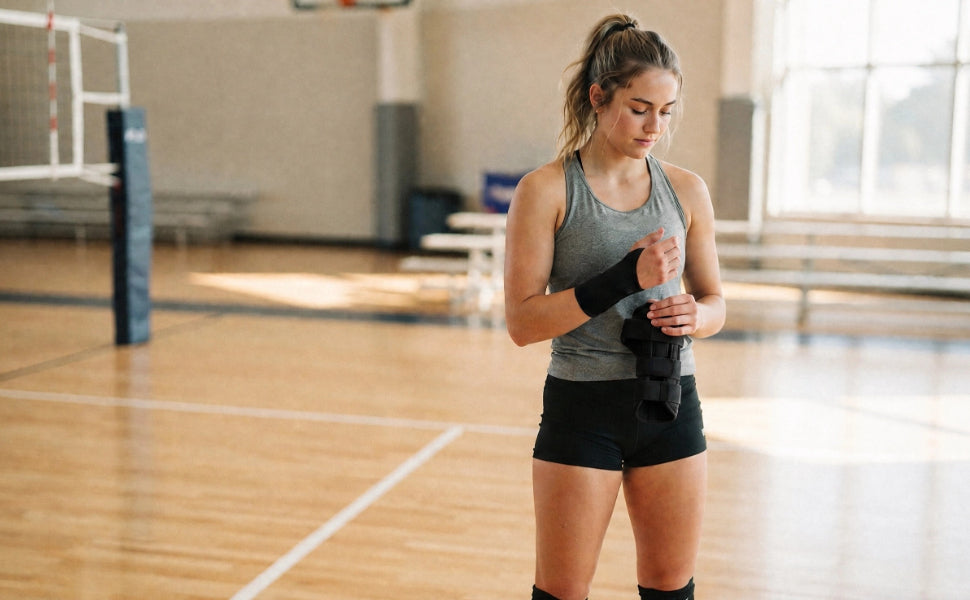
As we gear up for the height of the summer beach volleyball season and those intense 4th of July weekend tournaments, protecting your joints under competitive pressure is more critical than ever. Whether you are diving for a dig in the sand or absorbing the heavy impact of a front-row block on the hardwood, your wrists take a massive amount of repetitive stress.
When a tweak or an injury forces you to seek extra protection, you are immediately faced with a critical evaluation: should you choose a rigid brace with structural splints, or a flexible compression sleeve?
The wrong choice won't just leave you uncomfortable—it can restrict your setting dexterity, violate official league rules, or fail to provide the necessary stability to prevent further injury. In this comprehensive guide, we will break down the crucial differences between rigid and flexible designs. We will look closely at the biomechanics of wrist support, helping you evaluate which volleyball wrist brace aligns best with your playing position, recovery stage, and performance goals.
The Volleyball Player's Dilemma: Finding Support That Moves With You
Volleyball demands an incredibly unique balance of explosive power and fine motor control. When evaluating your brace options, you are essentially weighing maximum stability against maximum mobility. If you find yourself asking, "should i wear a wrist brace for tendonitis or a sprain while playing?", the answer heavily depends on the structural makeup of the gear you choose.
To understand how to make the right choice, we need to explore the underlying mechanics. For those who want to dive deeper into the science of joint protection, exploring The Biomechanics of Wrist Support: How Braces Protect Joints reveals that effective support isn't just about wrapping a joint tightly—it is about managing force distribution during high-impact moments while maintaining necessary proprioception (your body's awareness of its position in space).

Technical Deep-Dive: Rigid vs. Flexible Solutions
Rigid Wrist Braces: Maximum Stability & Targeted Protection
Rigid braces are designed with structural inserts—most commonly metal splints, aluminum plates, or hardened polymer inserts. Their primary function is immobilization and severe impact deflection.
The Biomechanics in Volleyball:
A rigid brace physically blocks the joint from entering dangerous ranges of motion, specifically preventing severe hyperextension when blocking a powerful spike or breaking a fall.
Pros for Volleyball:
- Provides unparalleled stability for acute injuries and post-surgical recovery.
- Delivers maximum impact absorption.
- Highly effective for complete immobilization when resting between tournament matches.
Cons for Volleyball:
- Significantly limits the fine dexterity required for clean setting.
- Can be bulky and may feel restrictive during fast-paced defensive transitions.
- Crucial Note: Any exposed hard materials will violate standard indoor and beach volleyball regulations.
Ideal Scenario:
If you are recovering from a severe sprain and need total joint isolation during practice drills (where rules are relaxed), a rigid fivali wrist brace featuring a highly contoured, concealed aluminum plate offers the structural integrity required to heal safely without entirely leaving the court.
Flexible Wrist Braces: Adaptive Support & Enhanced Mobility
Flexible braces rely on advanced compression fabrics, adjustable straps, and targeted elasticity rather than hard metal or plastic. They embody the philosophy of offering support that moves with your body.
The Biomechanics in Volleyball:
Instead of locking the joint, flexible braces provide circumferential compression. This increases blood flow, retains therapeutic warmth, and enhances proprioceptive feedback, alerting your nervous system to stabilize the wrist naturally before hyperextension occurs.
Pros for Volleyball:
- Maintains the full range of motion necessary for setting, serving, and snapping the wrist on a hit.
- Comfortable enough for all-day tournament wear.
- 100% compliant with official volleyball rules (no hard components).
Cons for Volleyball:
- Does not offer the locked-in structural immobilization needed for acute, severe trauma.
Ideal Scenario:
For the player dealing with minor tweaks, general soreness, or transitioning back to full competitive play, an adaptive flexible option like the Fivali Sprained Wrist Brace 1 Pack FWH02 provides the perfect balance. It delivers just enough tension to relieve wrist pain while keeping you fully mobile.
The Fivali Recovery & Performance Continuum
Choosing between rigid and flexible isn't always an "either/or" lifetime commitment. It is often a progression based on where you are in your recovery journey.

Phase 1: Acute Injury & Maximum Pain (Days 1-7)
When you have just sustained an injury, your primary goal is protection. Here, a rigid brace is highly recommended off the court to immobilize the joint. (This is also the phase where you should seek guidance on When to Opt for Professional Medical Advice for Wrist Injuries).
Phase 2: Active Recovery & Transition (Weeks 2-4)
As the pain subsides and you begin light pepper drills or controlled passing, transition to a reliable sprained wrist support. A flexible wrap allows you to reintroduce load to the tendons safely. Interestingly, players who engage in off-court weight lifting often use a wrist brace for tennis elbow during this phase, as the compressive support principles similarly aid in general tendon recovery.
Phase 3: Full Performance & Prevention (Ongoing)
You are back to full-speed games. At this stage, lightweight flexible sleeves or adjustable straps are your best friend. They prevent re-injury by providing continuous compression and warmth, especially crucial if you suffer from chronic flare-ups and need a tendonitis brace wrist solution that won't hinder your aggressive swings.
Rule Compliance: What Does the Rulebook Say?
A major point of anxiety for evaluating players is whether their chosen brace will get them benched by a referee.
Whether you play under FIVB, NCAA, or high school association rules, the mandate is clear: players may not wear any equipment that provides an artificial advantage or poses a danger to themselves or other players. This explicitly bans exposed metal splints, hard plastics, and unpadded rigid structures.
If you must wear a brace with a rigid aluminum plate, that plate must be completely encased in padded fabric and often approved by the head official prior to the match. For guaranteed compliance and peace of mind during gameplay, flexible compression wraps are the gold standard.
Quick Reference Guide by Player Position
Different positions put entirely different loads on the wrist. Here is a breakdown of how to match your role with the right wrist support.
-
Setters: Dexterity is everything. You cannot afford palm restriction.
Verdict: Flexible, highly adjustable wraps that leave the palm and fingers entirely free while compressing the lower carpal region. -
Hitters / Middle Blockers: You deal with the highest velocity impacts. To understand Impact Absorption Technologies in Sports Braces Explained, look for products with reinforced, multi-directional strapping.
Verdict: Heavier-duty flexible braces or rule-compliant concealed-splint braces for maximum shock absorption. -
Liberos / Defensive Specialists: You are constantly floor-bound, requiring braces that won't snag on the court during a pancake dig.
Verdict: Low-profile, seamless compression sleeves that offer warmth without bulk.
Frequently Asked Questions (FAQ)
Will wearing a wrist brace weaken my wrist over time?
This is a common misconception. Wearing a flexible brace during high-impact sports does not cause muscle atrophy because you are still actively engaging your muscles to play. However, relying on a rigid brace 24/7 during non-activity periods can lead to stiffness. Always transition to flexible support as soon as safely possible.
Can I wash my volleyball wrist brace after a sweaty tournament?
Yes. For Fivali braces, we recommend hand washing in cold water with mild detergent and air-drying. Never machine dry, as high heat can degrade the elasticity of flexible wraps and warp the protective pockets of rigid ones.
How tight should my flexible brace be?
It should feel snug and supportive, offering noticeable compression without causing numbness, tingling, or skin discoloration in your fingers.
Confidently Step Onto the Court
Selecting between rigid and flexible support isn't about guessing; it is about matching the biomechanical demands of your injury and your volleyball position to the right technology. When you require maximum rest and structural isolation, rigid rules the day. But when the whistle blows and you need support that adapts to your dynamic movements, flexible compression is unmatched.
Ready to equip yourself with gear that genuinely understands your game? Explore the complete volleyball wrist brace collection at Fivali and find the exact level of support you need to dominate the net this season.