Knee Brace for Pain: Should You Choose Compression or an Adjustable Brace?

Choosing the right knee brace can feel overwhelming. You know you need support, but the options—flexible compression sleeves, sturdy adjustable braces—seem to serve entirely different purposes. Making the wrong choice means more than wasted money; it could mean inadequate protection, delayed recovery, or unnecessary discomfort during the activities you love. You're not just looking for a product; you're looking for confidence in every step, squat, and stride.
This guide is designed to be your trusted resource in that decision. We'll break down the key differences between compression and adjustable knee braces, helping you match your specific pain level, activity intensity, and stability needs to the right solution.

Understanding Your Knee: A Quick Self-Assessment
Before diving into product specifics, let's clarify what your knee needs. Different types of pain, from a dull ache to a sharp burning sensation in the knee, require different solutions. The global market for knee braces is valued at over $1.8 billion, driven by people seeking solutions for everything from osteoarthritis to sports injuries. Finding your place in that landscape starts with answering three simple questions.

-
What's Your Pain Level?
- Mild: General aches, slight stiffness, or discomfort after activity.
- Moderate: Consistent pain that limits some movements, noticeable swelling.
- Severe: Sharp, persistent pain, significant instability, or post-surgical recovery.
-
What's Your Activity Intensity?
- Low: Daily walking, light household chores, standing for long periods.
- Moderate: Jogging, gym workouts, hiking, cycling, or sports like dancing that can lead to issues like dancers knee.
- High: Competitive sports (basketball, soccer), heavy lifting, or activities involving sudden pivots and jumps.
-
How Much Stability Do You Need?
- Flexible Support: You want to reduce swelling and improve awareness of your joint's position (proprioception) without restricting movement.
- Moderate Stabilization: You need to prevent side-to-side (lateral) movement and feel more secure during activity.
- Maximum Protection: You need to limit your range of motion to protect a healing ligament or prevent hyperextension.
Your answers create a clear profile of your needs, guiding you directly to the brace designed to help you thrive.
The Case for Compression: Flexible Support for Active Lifestyles
A compression knee brace is a sleeve that fits snugly around the joint. Its primary function isn't to immobilize the knee but to provide uniform pressure. This compression helps improve blood flow, reduce swelling, and enhance proprioception—your brain's sense of where your knee is in space.
You should choose a compression brace if:
- You experience mild to moderate pain, arthritis, or tendonitis.
- Your goal is injury prevention during moderate activities like running or gym sessions.
- You need all-day comfort for managing swelling and general aches.
- You want full range of motion while still feeling supported.
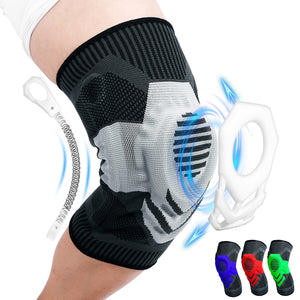
Fivali Spotlight: The Compression Sports Knee Brace (FKR07)
For those seeking reliable, flexible support, Fivali's Compression Sports Knee Brace stands out. Its advantage lies in the high-density 3D knitted fabric. Unlike basic neoprene sleeves, this advanced material offers superior breathability and moisture-wicking properties, making it comfortable for extended wear. It provides consistent, medical-grade compression that won't slip or bunch up, ensuring you get the benefits of reduced inflammation and enhanced stability without sacrificing comfort.
The Power of Adjustability: Rigid Stability for Recovery and High-Impact Activity
An adjustable knee brace offers a higher level of structural support. These braces often feature rigid components like metal hinges or stays, combined with straps that allow you to customize the fit and level of compression. They are designed to protect the knee from unnatural movements and provide significant stability.
You should choose an adjustable brace if:
- You're recovering from a moderate to severe injury like an ACL/MCL tear or meniscus damage.
- You need post-operative support to control the range of motion.
- You engage in high-impact sports and need to prevent hyperextension or lateral instability.
- You suffer from significant osteoarthritis and require structural offloading of the joint.
Fivali Spotlight: The Hinged Knee Brace for Pain
When your knee demands uncompromising stability, an adjustable knee brace is the answer. Fivali’s design incorporates dual-side support bars that act like an external ligament, preventing dangerous side-to-side movements that can cause re-injury. The addition of adjustable pressure straps allows you to apply targeted compression exactly where you need it, helping to manage pain and swelling. This level of customizable protection is crucial for anyone returning to activity after a significant injury or looking for a robust knee stabilizer for demanding sports.

At a Glance: Fivali Compression vs. Adjustable Brace
| Feature | Compression Knee Brace (FKR07) | Adjustable Knee Brace (Hinged) |
|---|---|---|
| Support Level | Mild to Moderate | Moderate to Maximum |
| Primary Function | Reduce swelling, improve blood flow & proprioception | Provide structural stability, limit unsafe movement |
| Best For | Arthritis, tendonitis, general pain, injury prevention | Ligament injuries (ACL/MCL), post-surgery, major instability |
| Activity Level | Daily wear, jogging, gym, moderate sports | High-impact sports, rehabilitation, demanding work |
| Mobility | Full range of motion | Controlled, sometimes limited range of motion |
| Key Technology | High-density 3D knitted fabric | Dual-side support bars, adjustable straps |
| Wearability | Comfortable for all-day use | Best for specific activities or recovery periods |
Frequently Asked Questions
What is the main difference between a compression and an adjustable knee brace?
A compression brace is a sleeve designed to reduce swelling and improve joint awareness (proprioception) through uniform pressure, making it ideal for mild pain and general activity. An adjustable brace provides structural support with features like hinges and straps to limit unsafe movement, making it the choice for recovering from severe injuries or for high-impact sports.
Which knee brace is better for arthritis or general knee pain?
For most cases of arthritis and general knee aches, a compression knee brace is ideal. The consistent pressure helps improve blood flow and reduce inflammation, offering comfort and support throughout the day without restricting your range of motion.
Can I use a compression sleeve for a major injury like an ACL tear?
No, a compression sleeve does not provide enough stability for a major ligament injury like an ACL tear. For this level of injury or for post-operative recovery, an adjustable brace with hinges is necessary to protect the knee from harmful movements and ensure a safe healing process.
When is an adjustable knee brace the right choice?
You should choose an adjustable knee brace if you are recovering from a moderate to severe injury (e.g., ligament or meniscus tear), need post-surgical support, or participate in high-impact sports where you need to prevent hyperextension and lateral instability.
How do I make sure I get the right size knee brace?
To ensure the best fit, check the sizing chart on the product page. You will typically need to measure the circumference of your thigh a specific distance above your kneecap. A proper fit is crucial for the brace to be effective.
How do I properly care for my knee brace?
Most fabric braces can be hand-washed with a mild detergent and left to air-dry. It's important to follow the specific care instructions for your brace, such as knowing how to put on knee brace with velcro properly. Avoid using a machine dryer, as high heat can damage the elastic fibers and reduce the brace's effectiveness.
Make Your Confident Choice Today
Choosing between a compression and an adjustable knee brace is no longer a guess. It's a calculated decision based on your unique needs. If you need flexible, comfortable support to stay active and manage mild pain, a high-quality compression sleeve is your ideal partner. If you require serious stability to protect a healing injury or prevent re-injury during intense activity, an adjustable knee wrap with structural support is the right tool for the job.
Fivali is committed to helping you live an active life, free from the limitations of pain. By focusing on superior materials and thoughtful design, we provide professional-grade support that's both effective and affordable.
Ready to find the perfect match for your knee? Explore our complete collection of knee braces and supports to find the confidence you need to get back in the game.