How to Identify Mild Moderate and Severe Ankle Sprains
As Memorial Day weekend approaches and we officially kick off the summer season, our weekends quickly fill up with backyard barbecues, hiking excursions, and beach games. But as outdoor activity increases, so does the risk of injury. Whether it’s a sudden volleyball ankle injury in the sand or a misstep on a rocky trail, the dreaded "ankle roll" is something almost all of us will experience at least once.
When you look down and see your ankle swelling like a balloon, a flurry of questions naturally follows: Is it just a tweak? Did I tear something? Can I walk this off, or do I need to go to urgent care right now?
Understanding how to differentiate between a mild, moderate, and severe ankle sprain isn't just about satisfying your curiosity. It’s the foundational knowledge that dictates whether you’ll be back on your feet in a few days or dealing with chronic ankle instability for years. Let's break down the clinical signs, expected recovery timelines, and simple self-assessments that will help you judge the severity of your injury.

The Anatomy of an Ankle Roll: What Actually Happens?
Think of your ankle ligaments as heavy-duty rubber bands that connect your bones and keep the joint stable. When you roll your ankle—most commonly inwards, known as an inversion sprain—you force those rubber bands to stretch beyond their natural limit.
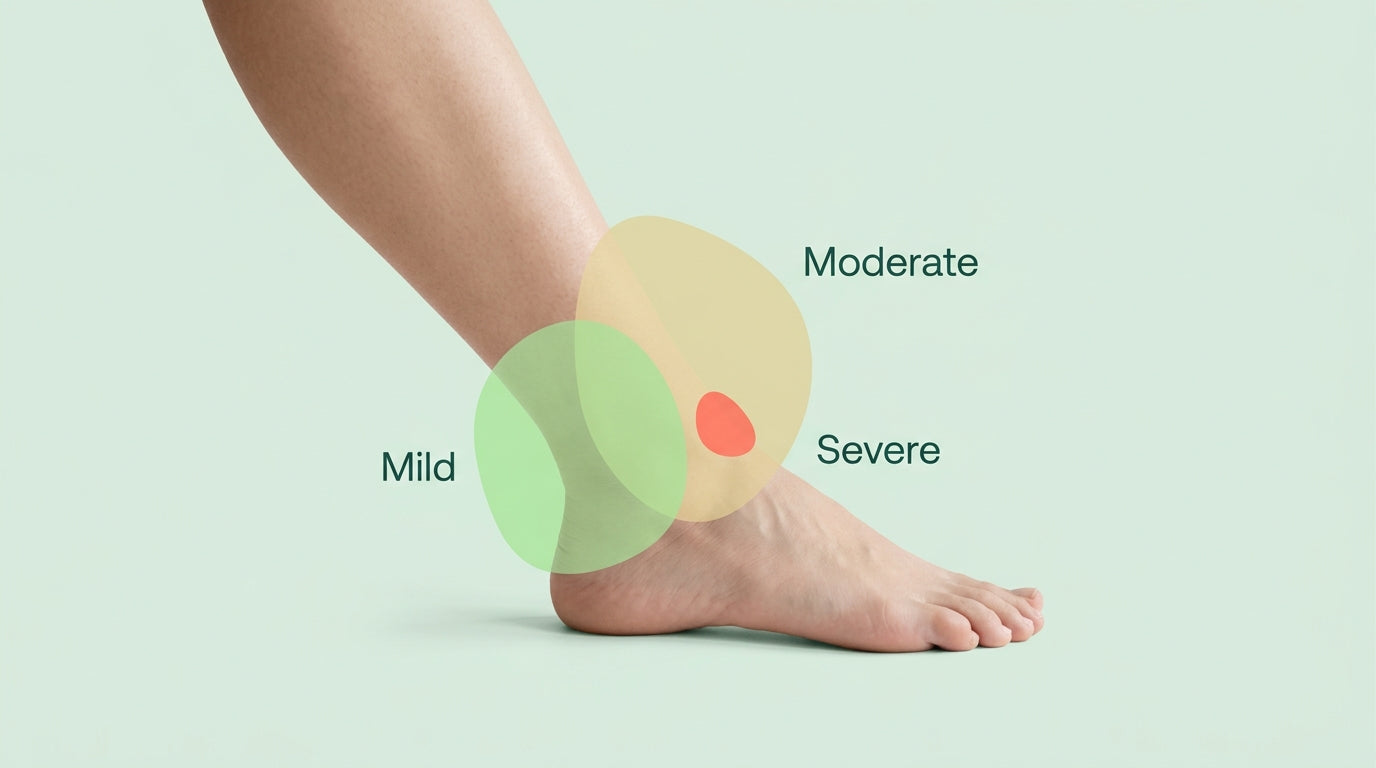
Medical professionals grade ankle sprains on a scale of 1 to 3 based on exactly how much damage those "rubber bands" sustain.
Grade 1 (Mild): The Micro-Stretch
In a Grade 1 sprain, the ligament is stretched, causing microscopic tears, but it remains fully intact.
- Clinical Signs: You will experience mild pain, slight tenderness right over the bone, and very minimal swelling. Bruising is usually absent.
- Self-Assessment Cue: "Can I walk normally?" With a Grade 1 sprain, you can typically bear full weight on the foot with minimal to no limping.
- Expected Timeline: 1 to 3 weeks to fully return to activity.
Grade 2 (Moderate): The Partial Tear
This is the gray area that trips most people up. In a Grade 2 sprain, the ligament is partially torn. The ankle's structural integrity is compromised, so the joint feels a bit "loose."
- Clinical Signs: You'll notice immediate, moderate pain. Swelling will be obvious, and you will likely see bruising develop around the outer ankle or down into the foot over the next 24 to 48 hours. Patients constantly ask how long a sprained ankle stays swollen at this stage, as the inflammation can be surprisingly persistent.
- Self-Assessment Cue: "Can I hop?" Walking is usually possible but painful, resulting in a noticeable limp. Hopping on the affected foot is incredibly difficult or painful.
- Expected Timeline: 4 to 6 weeks.
Grade 3 (Severe): The Complete Rupture
A Grade 3 sprain means the ligament is completely torn or ruptured. The rubber band has snapped.
- Clinical Signs: Severe pain at the moment of injury, though strangely, the pain might subside slightly later because the nerve endings themselves may be torn. Swelling is rapid and massive. Bruising will be extensive.
- Self-Assessment Cue: Did you hear a loud "pop" or feel a distinct "snap"? Are you completely unable to put any weight on the foot without it giving out? These are classic Grade 3 indicators.
- Expected Timeline: 6 to 12 weeks, sometimes longer, and often requires structured physical therapy to regain joint stability.

Essential Myth-Busting: What Your Symptoms Aren't Telling You
When you're in pain, it's easy to misinterpret what your body is signaling. Let's clear up some common misconceptions about ankle sprains.
Myth 1: If I can walk on it, it isn't broken or severely sprained.
The Reality: Shock and adrenaline are powerful natural painkillers. Many people can walk a few steps on a fractured ankle or a Grade 3 sprain immediately after it happens. Focus on how it feels a few hours later when the adrenaline wears off.
Myth 2: I can find a secret on how to heal a sprained ankle overnight.
The Reality: Physiology takes time. Ligaments lack a robust blood supply compared to muscles, which means healing is inherently slower. While you can significantly reduce pain and swelling overnight with proper care, you can't rush tissue healing.
Myth 3: The bigger the bruise, the worse the sprain.
The Reality: Bruising is simply trapped blood beneath the skin. Thanks to gravity, blood from a minor ligament tear can pool down into your toes, making the injury look catastrophic even if it’s just a moderate sprain. Swelling and joint instability are much more accurate indicators of severity than the color of your skin.
When to Escalate Care: The "Red Flag" Checklist
While Grade 1 and many Grade 2 sprains can be managed at home, certain symptoms mandate a trip to a healthcare professional to rule out fractures or severe nerve damage. Use a simplified version of the "Ottawa Ankle Rules"—a clinical tool doctors use—to decide if you need an X-ray.
Seek immediate medical attention if you experience:
- Inability to bear weight: You cannot take four steps (even limping steps) immediately after the injury, AND at the time you are evaluating it.
- Bone tenderness: Press firmly on the bony bumps on the inside and outside of your ankle (the medial and lateral malleoli). If you feel sharp, wincing pain directly on the bone rather than the soft tissue beneath it, you may have a fracture.
- Deformity: If the ankle looks physically misaligned or out of place.
- Numbness or tingling: A "pins and needles" sensation spreading into your toes indicates potential nerve compression.
Bridging the Gap: From Acute Care to Active Recovery
For decades, the standard advice for sprains was R.I.C.E. (Rest, Ice, Compression, Elevation). Today, modern rehabilitation favors the PEACE & LOVE protocol.
In the immediate acute phase (PEACE), you Protect the joint, Elevate it, Avoid anti-inflammatories (which can hinder the natural healing process initially), Compress the area, and Educate yourself on your body's signals.
As you transition into the subacute phase after the first few days (LOVE), the focus shifts to loading the joint with gentle weight, maintaining Optimism, engaging in cardiovascular Vascularization to increase blood flow, and starting Exercise to rebuild strength.
During this transition back to activity, many people ask what ankle braces do and whether they are necessary. The primary value of external support isn't just locking the ankle in place; it's providing proprioception—your body's subconscious awareness of where it is in space. A high-quality compression ankle brace gives your skin sensory feedback that reminds your brain to stabilize the muscles around the joint, helping prevent re-injury while managing residual swelling.
Of course, a tool is only as good as how you use it. Knowing exactly how to put on an ankle brace ensures you receive the intended mechanical support without restricting healthy blood flow.

Frequently Asked Questions (FAQ)
Can I make my ankle sprain worse if I keep walking on it?
Yes. If you have a Grade 2 or Grade 3 sprain, pushing through the pain can turn a partial tear into a complete rupture, or cause surrounding tendons to overwork and become inflamed.
Should I use ice or heat on a new ankle sprain?
Stick to ice for the first 48 to 72 hours. Heat increases blood flow, which can actually cause more swelling and inflammation in a freshly injured, bleeding ligament. After the initial swelling peaks and begins to subside, you can use heat to relax stiff muscles.
Why does my ankle still feel weak months after a sprain?
Ligaments contain tiny sensors that communicate with your brain for balance. When a ligament tears, those sensors are damaged. Without specific balance and stability exercises during your recovery, your ankle can develop "chronic instability," making it feel weak and highly susceptible to future sprains.
Is a "high ankle sprain" worse than a regular sprain?
A high ankle sprain involves the ligaments that connect your two lower leg bones (tibia and fibula) together just above the ankle joint. Because these ligaments endure immense stress every time you take a step, high ankle sprains generally take significantly longer to heal than traditional lateral (outer) ankle sprains and often require more conservative management.
Taking the Right Next Step
The moments immediately following an ankle injury set the tone for your entire recovery journey. By learning to tune into your body's cues—assessing your ability to bear weight, pinpointing the location of the pain, and monitoring swelling progression—you shift from an anxious patient to an empowered participant in your own healing.
Remember, an ankle sprain shouldn't be an injury that sidelines you permanently. By accurately judging your injury grade, escalating care when red flags appear, and smartly reintroducing movement with the right supportive guidance, you can get back to your summer hikes and beach games stronger than before.