Meniscus Injuries
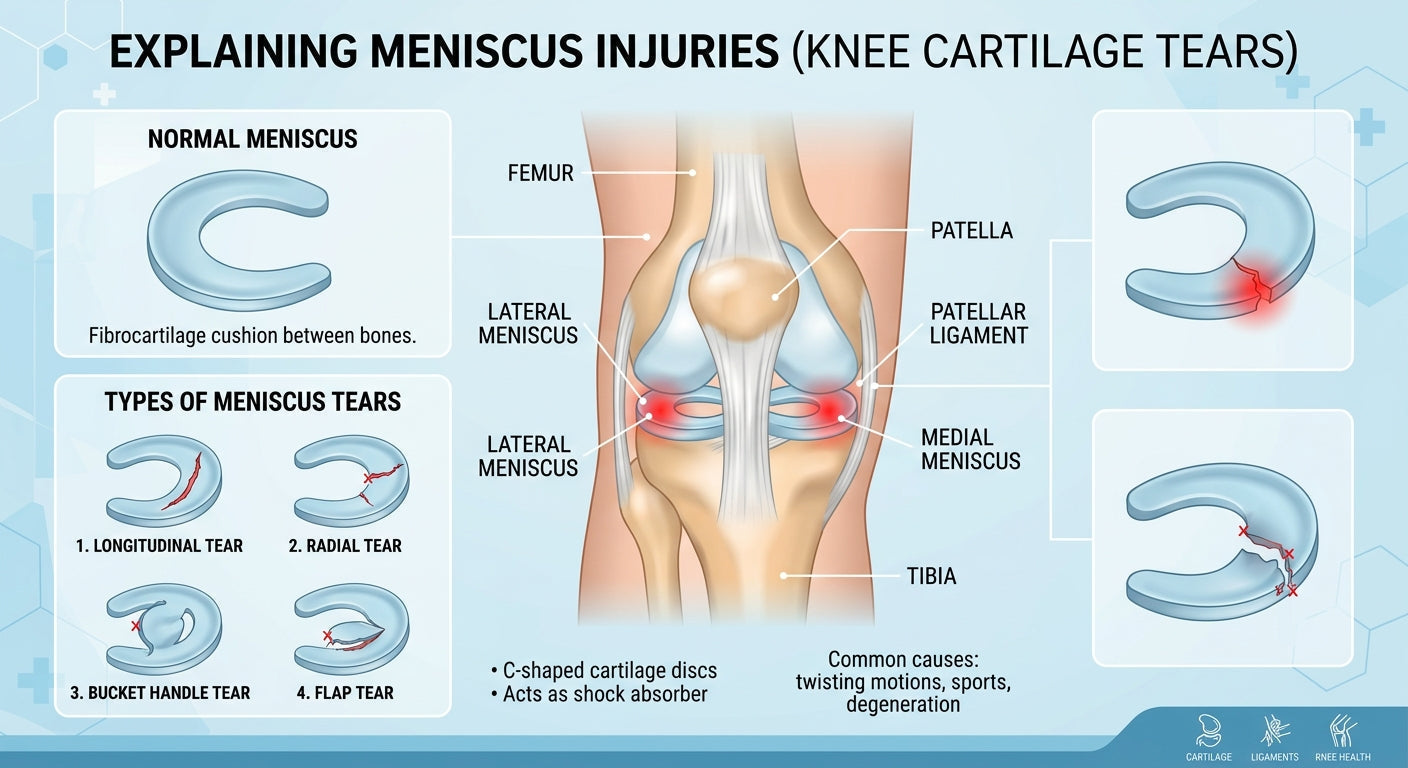
Meniscus injuries are among the most common knee injuries, affecting individuals across all ages and activity levels. Located within the knee joint, the menisci are crucial cartilage pads that cushion, stabilize, and enable smooth movement. A tear in this vital structure can cause significant pain, limited movement, and a prolonged recovery if not properly managed.
What is the Meniscus?
Your knee joint houses two crescent-shaped pieces of cartilage called menisci: the medial meniscus (on the inner side of your knee) and the lateral meniscus (on the outer side). These tough, rubbery structures sit between your thigh bone (femur) and shin bone (tibia), acting as shock absorbers and distributing weight evenly across the joint. They also contribute to joint stability and lubricate the knee, allowing for fluid motion.
Types of Meniscus Tears
- Radial Tears: Occur in the central part of the meniscus, often affecting its ability to absorb shock.
- Horizontal Tears: Run along the length of the meniscus, often separating it into upper and lower sections.
- Flap Tears: A portion of the meniscus tears and flips into the joint space.
- Bucket-Handle Tears: A large horizontal tear where the inner portion of the meniscus detaches and resembles a bucket handle, often causing the knee to lock.
- Complex Tears: A combination of different tear patterns.
- Degenerative Tears: Often seen in older individuals, resulting from wear and tear over time rather than a single acute injury.
The tear's location matters, especially whether it's in the "red zone" (outer, blood-rich area, more likely to heal on its own) or the "white zone" (inner, poor blood supply, less likely to heal on its own).
Causes and Risk Factors
- Sports Injuries: Athletes participating in contact sports or those that involve pivoting, jumping, and cutting (such as soccer, basketball, football, and skiing) are at high risk.
- Degenerative Changes: As we age, the menisci can weaken and become more brittle, making them susceptible to tears with minimal trauma, such as simply standing up or squatting.
- Traumatic Injuries: Direct impact to the knee can also cause tears.
Common Symptoms of a Meniscus Tear
- Pain: Often localized along the joint line, which may worsen with twisting, squatting, or activity.
- Swelling: Developing gradually over several hours or days after the injury.
- Stiffness: Difficulty fully straightening or bending the knee.
- Catching or Locking: A sensation that the knee is getting stuck, especially with certain movements.
- Popping Sensation: Sometimes heard or felt at the time of injury.
- Tenderness: When touching the joint line.
Diagnosis
A healthcare professional will typically diagnose a meniscus injury through a physical examination that evaluates your knee's range of motion, stability, and tenderness. They may also perform specific tests, such as the McMurray test, to check for clicking or catching sensations. Imaging, most commonly an MRI (Magnetic Resonance Imaging), is often used to confirm the diagnosis, determine the tear's type and location, and assess for other associated knee damage.

Treatment Options for Meniscus Injuries
Treatment for meniscus injuries ranges from conservative, non-surgical approaches to surgical intervention, depending on factors like the tear's size, location, type, the patient's age, activity level, and overall health.
Conservative (Non-Surgical) Treatment
For smaller tears, especially those in the red zone, or for degenerative tears, non-surgical management is often the first step.
- RICE Protocol: Rest, Ice, Compression, and Elevation can help reduce pain and swelling.
- Pain Management: Over-the-counter pain relievers can alleviate discomfort.
- Physical Therapy: A structured program of exercises designed to strengthen the muscles around the knee, improve flexibility, and restore the full range of motion. This is crucial for regaining strength and function.
- Activity Modification: Avoiding activities that exacerbate pain and stress on the knee.
Many wonder, "Can a meniscus tear heal on its own?" The answer depends heavily on the tear's location and blood supply. Tears in the well-vascularized "red zone" have a better chance of healing, especially with proper rest and physical therapy. Tears in the "white zone" typically don't heal because of limited blood flow.
Surgical Treatment
Meniscus Repair
This procedure involves stitching the torn edges of the meniscus back together. It's typically performed for tears in the red zone, where a good blood supply supports healing. Meniscus repair aims to preserve the meniscus, maintain its natural shock-absorbing function, and potentially reduce the risk of future joint issues. Recovery from a meniscus repair can be longer and more restrictive than a meniscectomy, as the repaired tissue needs time to heal.
Partial Meniscectomy (Meniscus Trimming)
In this procedure, the surgeon carefully trims away the damaged or torn part of the meniscus, leaving as much healthy tissue as possible. This is commonly done for tears in the white zone or for complex tears that cannot be repaired. A partial meniscectomy often leads to quicker pain relief and a faster return to activity than repair, but it also removes some of the natural cushioning.
Recovery and Rehabilitation
- Reduce pain and swelling.
- Restore range of motion.
- Strengthen surrounding muscles (quadriceps, hamstrings, calves).
- Improve balance and stability.
- Gradually return to daily activities and sports.
For those considering support, you might ask, "Will a knee brace help a torn meniscus?" Many find that using a specialized knee brace for a meniscus tear can provide support and stability, and reduce stress on the knee during recovery and when returning to activities. Especially after surgery, a post-op knee brace is often prescribed to limit movement and protect the healing meniscus. When choosing, consider which knee brace for a meniscus tear offers enough stability without restricting the movement needed for rehabilitation. A good knee stabilizer can help throughout recovery.
It’s also common to wonder, "Will walking on a torn meniscus make it worse?" While light activity may be tolerated, excessive or strenuous walking can exacerbate the tear or hinder healing. Listen to your body and follow your healthcare provider's activity recommendations.
Managing discomfort is key, and a knee brace can sometimes provide relief during everyday activities. The overall goal is to return to your desired activity level safely and effectively, minimizing the risk of re-injury.
Prevention Tips
While not all meniscus injuries can be prevented, especially those from traumatic accidents, several strategies can reduce your risk:
- Strengthen Leg Muscles: Strong quadriceps and hamstrings provide better support for the knee joint.
- Warm-Up Properly: Prepare your muscles for activity with dynamic stretches.
- Use Proper Technique: Learn and use correct form for sports and exercises, especially those involving pivoting or squatting.
- Wear Appropriate Footwear: Shoes with good support and traction can reduce strain on your knees.
- Gradual Increase in Activity: Avoid sudden increases in exercise intensity or duration.
-
Posted in
Knee Injuries