How to know what size elbow brace to get?
As the long Memorial Day weekend approaches, signaling the unofficial start of summer, our calendars quickly fill up with outdoor activities. Between the first backyard barbecues, neighborhood tennis matches, and ambitious weekend yard work projects, our joints are about to put in some serious overtime. But there is nothing that ruins a beautiful summer afternoon quite like persistent joint discomfort.
If you have decided to take a proactive approach to protecting your joints this season, you are already on the right track. However, many people hit a frustrating roadblock right at the beginning: figuring out their size. If you have ever wondered how do i choose the right size arm brace?, you are not alone.
Guessing your size based on your favorite t-shirt often results in a support that either slides down your arm mid-swing or pinches so tightly it leaves red marks. Finding the perfect fit isn't about guesswork; it is about understanding your body's unique landmarks and how they interact with different support designs.

Why Guessing Your Size Leads to Frustration
When a support doesn't fit correctly, it fails to perform its primary job. A size too large will inevitably slip down during activity, providing zero structural support when your joint needs it most. Conversely, a size too small creates dangerous pressure points. It can restrict blood flow, cause tingling in your fingers, and actually delay your recovery by compressing the nerves and blood vessels surrounding the joint.
Getting the size right ensures the material can apply even, therapeutic pressure exactly where biomechanics dictate it should.
The Foundation: Understanding Your Arm's Landmarks
To get an accurate measurement, you first need to understand the three critical zones of your arm that dictate how a support will fit and function.
1. The Forearm Circumference
Typically measured a few inches below the joint, your forearm measurement targets the thickest part of the muscle belly. This is a crucial metric, especially when determining proper tennis elbow brace placement. A snug fit here ensures that the support can effectively disperse the tension that travels up your forearm tendons during repetitive motions like gripping a golf club or swinging a racket.
2. The Elbow Crease (Mid-Joint)
This is the dead center of the joint. Measuring directly over a slightly bent joint provides the core circumference needed for a standard elbow brace. This measurement ensures that the central hinge or compression zone aligns perfectly with your natural pivot point.
3. The Upper Arm (Bicep/Tricep)
Measured a few inches above the joint, this area acts as the primary anchor. If you are opting for a full elbow compression sleeve, the upper arm measurement is what prevents the fabric from rolling or sliding down your arm when gravity and sweat enter the equation.

Sizing Goals: Light Compression vs. Firm Stabilization
Your specific goals should influence your final sizing decision. A common question people ask is how tight should an elbow brace be? The answer depends entirely on what you want it to do.
For Light Compression and Daily Wear: If you want gentle warmth and improved blood flow for all-day wear (like working at a computer or casual gardening), you want a "true to size" or comfortable fit. It should feel like a firm, supportive hug that you can easily ignore after five minutes.
For Firm Stabilization and Activity: If you are managing acute recovery or preparing for heavy lifting, you might prioritize maximum stability. In these scenarios, some individuals choose a slightly snugger fit to ensure the joint is firmly locked in place, minimizing unwanted lateral movement.
The Hidden Factors: Posture, Activity, and Swelling
Measurements are not static. The state of your arm when you pull out the tape measure dramatically impacts the number you see.
- Muscle Tone & Posture: Should you flex or relax? Generally, you should measure with a relaxed arm. Flexing puffs up the bicep and forearm, which might lead you to buy a size too large, causing the support to slip when your arm returns to a resting state. Furthermore, measuring with your arm slightly bent (about 30 degrees) mimics the natural resting posture of the joint, yielding a more accurate real-world measurement than locking your arm out completely straight.
- The "Swelling" Factor: Muscles expand when they are working hard. If you measure your arm first thing in the morning before activity, the support might feel uncomfortably tight during an intense workout. If you know your arm swells significantly post-exercise or due to an ongoing issue, you may need to factor this in, potentially choosing the larger option if you fall between sizes.
Different Braces, Different Rules
Not all supports are sized identically because they serve different mechanical purposes.
If you are looking at targeted straps, you might wonder how does a tennis elbow strap work compared to a full sleeve. Straps apply focused, localized pressure to the forearm tendons rather than encasing the whole joint. Therefore, finding the best brace for tennis elbow usually only requires an accurate forearm measurement, completely ignoring the upper arm.
On the other hand, if you are looking for a comprehensive elbow brace for pain that wraps the entire area to combat generalized aching, you must balance the measurements of your bicep, joint crease, and forearm to ensure a contoured fit.

Troubleshooting Fit: Are You Making These Mistakes?
If you already own a support and it feels "off," you might be experiencing one of these common sizing pitfalls:
- The Constant Pull-Up: If you are constantly tugging your sleeve back up your arm, it is too loose. This usually happens when people measure over a flexed bicep or measure too high up the arm where the muscle is thickest, rather than the designated anchor point closer to the joint.
- The Pinching Sensation: If the edges of the material are rolling over or digging into your skin, creating a tourniquet effect, it is too tight. This often occurs when people arbitrarily "size down" hoping for faster recovery, inadvertently cutting off healthy circulation.
Your Step-by-Step Sizing Guide
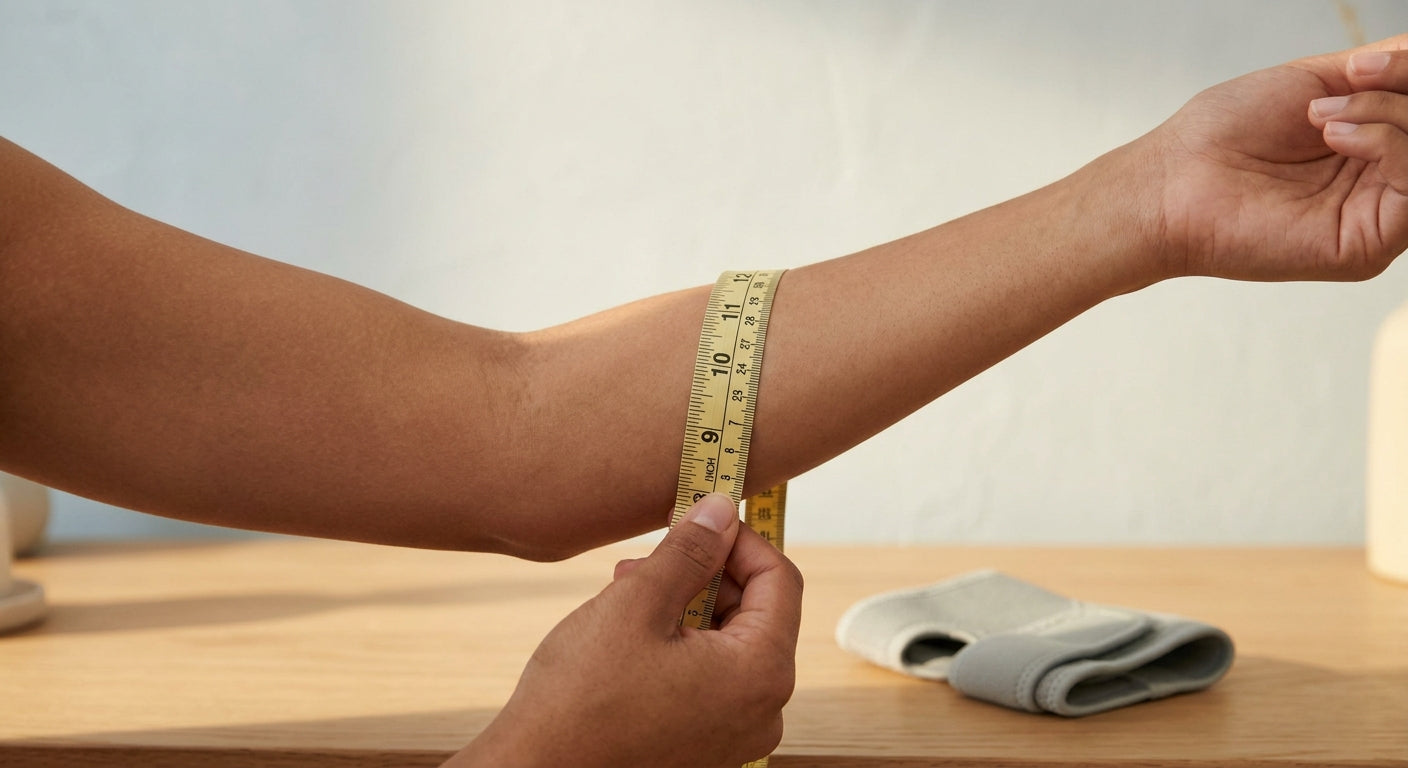
Ready to find your perfect fit? Grab a flexible fabric measuring tape (or a piece of string and a ruler) and follow these simple steps:
- Prep Your Posture: Stand or sit comfortably. Let your arm hang down, but keep it slightly bent at about a 30 to 45-degree angle. Keep your muscles completely relaxed.
- Find the Center: Locate the exact center of your joint (the crease).
- Measure the Anchor Points: Based on the specific product's sizing chart, measure the exact distance above and below the center point requested by the manufacturer (usually 4-5 inches up for the bicep, and 4-5 inches down for the forearm).
- Wrap the Tape: Wrap the measuring tape evenly around these specific points. The tape should lay flat against your skin—snug, but not squeezing or indenting the flesh.
- Consult the Chart: Take your numbers and compare them directly to the product's unique sizing chart.
Frequently Asked Questions (FAQ)
What should I do if my measurements fall exactly between two sizes?This is where your sizing goals come into play. If your priority is maximum compression and stability for intense, short-duration activities, choose the smaller size. If your priority is all-day comfort, recovery, and accommodating potential swelling, choose the larger size.
Does it matter if I measure my left or right arm?Absolutely. For most people, their dominant arm has slightly more muscle mass and can measure noticeably larger than their non-dominant arm. Always measure the specific arm that requires the support.
When is the best time of day to measure?If you plan to wear the support primarily during exercise, it is wise to measure your arm shortly after a workout when your muscles are experiencing a natural "pump." If you are buying it for daily, general wear, taking your measurements in the morning or middle of the day while at rest is ideal.
By taking the time to understand your body's landmarks and the biomechanical purpose of your gear, you eliminate the guesswork of sizing. With the right fit, you can step into this summer season with confidence, fully supported and ready for whatever activities come your way.