Best Fivali Ankle Braces for Your Sport Optimizing Performance and Injury Prevention
As the long Memorial Day weekend approaches, it officially signals the kickoff to summer sports leagues, intense outdoor tournaments, and rugged hiking adventures. But for athletes, this seasonal shift brings a familiar dilemma: how do you balance aggressive, all-out play with the need for joint safety?
If you are actively comparing options to protect your ankles this season, you already know that a generic solution won't cut it. You don't just need support; you need a brace that understands the unique biomechanics of your specific sport. A runner’s forward momentum requires entirely different mechanics than a basketball player’s explosive lateral cuts.
This is where Fivali’s core philosophy—SUPPORT THAT MOVES WITH YOU—becomes your competitive advantage. Instead of locking the joint down in a rigid cast that limits your agility, modern athletic support is about optimizing performance while neutralizing injury risks. Let's break down how to evaluate and select the exact gear you need to dominate your sport this summer.
Understanding Your Sport's Ankle Demands & Injury Risks
To choose the right equipment, you first have to understand the specific forces your body is absorbing. Common ankle injuries rarely happen in a vacuum; they are the direct result of sport-specific movements pushing the joint beyond its natural limit.
Basketball: High Impact and Lateral Forces
In basketball, the primary threats are inversion sprains (rolling the ankle outward). This happens during quick pivots, lateral defensive slides, or landing awkwardly on another player's foot after a rebound. You need an ankle brace for basketball that offers exceptional lateral stability and impact absorption without hindering your vertical leap.
Soccer: Quick Turns and Dynamic Agility
Soccer demands rapid changes in direction, explosive kicking motions, and constant micro-adjustments on turf or grass. Because players rely so heavily on touch and foot articulation, the ideal soccer ankle brace must prioritize flexibility and a low-profile fit that won't interfere with the cleat.
Running: Repetitive Impact and Terrain Variability
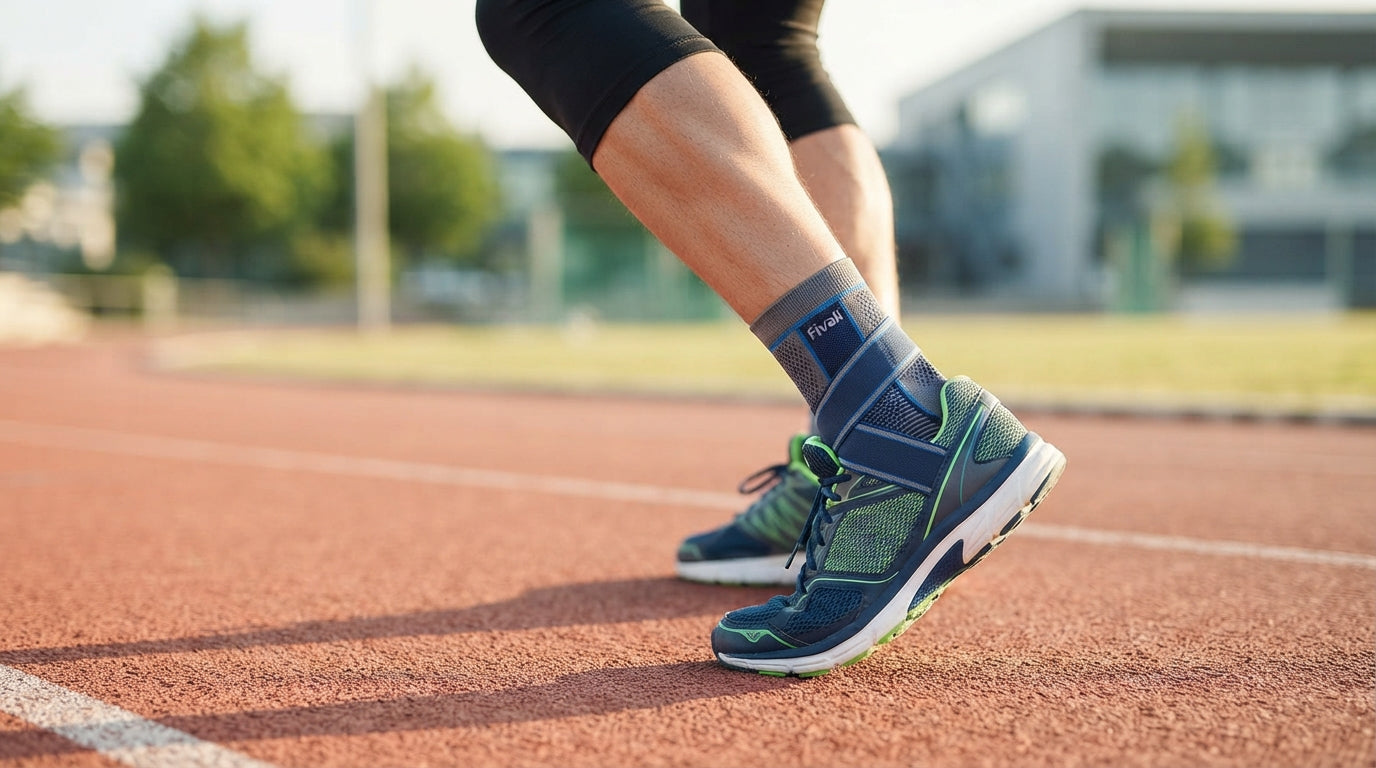
Runners face a different challenge. The repetitive impact of striking the pavement or navigating uneven trail surfaces can lead to overuse injuries, Achilles strain, or rolled ankles on unexpected terrain. Here, a great ankle compression sleeve for running focuses on shock absorption, promoting healthy blood flow, and subtle proprioceptive feedback to keep the foot aligned.
Hiking: Prolonged Support on Uneven Ground
Hikers deal with sustained, unpredictable inclines and declines. Carrying a heavy pack shifts your center of gravity, placing immense pressure on the ankles to stabilize your body on loose rocks or mud. Hiking demands durable, sustained support that prevents fatigue over several hours.
Key Evaluation Criteria for Choosing Your Gear
When looking through basketball ankle braces or general athletic supports, decision-makers often get stuck on three main trade-offs. Here is how to evaluate them:
1. Flexibility vs. Stability
This is the golden rule of athletic bracing. Highly rigid designs offer maximum stability but can rob you of the natural range of motion (ROM) needed for sprinting or jumping. Conversely, pure elastic sleeves offer great flexibility but minimal structural support against a severe roll. Fivali bridges this gap by using targeted compression and strategic structural supports that map to the ankle’s natural ligaments.
2. Impact Protection & Shock Absorption
If your sport involves jumping and hard landings, look for materials that disperse shock. The shell and strapping mechanisms should act as a secondary shock absorber, taking the brunt of the force before it reaches your ligaments.
3. Fit, Comfort & Shoe Compatibility
A brace is useless if you can't fit it into your shoe or if it causes blisters within ten minutes of play. Modern designs prioritize breathable, moisture-wicking fabrics and slim profiles that seamlessly integrate with your existing footwear.

Fivali's Sport-Specific Solutions: The Decision Guide
Knowing what you need is half the battle. Matching those needs to the right technology is the next step. If you want to explore the full breadth of what's available, exploring a comprehensive ankle support collection is a great start. But let's look at the heavy hitters tailored for performance.
The High-Impact Dominator: Fivali Lace Up Ankle Stabilizer
Ideal For: Basketball, Volleyball, Tennis. When you are crashing the boards or lunging for a baseline volley, you need uncompromising support. The Fivali Lace Up Ankle Stabilizer features a secure, customizable fit that mirrors professional taping. The figure-eight strapping design locks the heel and midfoot in place, specifically countering the inversion forces that cause sprains. Even with its robust protection, it aligns perfectly with the SUPPORT THAT MOVES WITH YOU philosophy, ensuring your Achilles can extend naturally during a jump. (And if team colors matter for your uniform, picking up a white ankle brace basketball style keeps you looking sharp on the court).
Agile Support & Targeted Relief: Fivali Ankle Compression Wrap for Sports
Ideal For: Soccer, Flag Football, Trail Running. When evaluating an ankle brace for soccer players, agility cannot be sacrificed. This compression wrap is engineered for dynamic sports. It provides targeted pressure that enhances proprioception—your brain's awareness of where your joint is in space. This means your muscles react faster to unstable ground, actively preventing rolls before they happen, all while remaining thin enough to slip right into a tight soccer cleat.
Lightweight Performance: Fivali Compression Sleeves (FAR01, FAR05)
Ideal For: Running, Hiking, General Fitness, Recovery. For athletes looking for mild support and enhanced recovery, a compression ankle brace sleeve is the perfect daily driver. The FAR01 and FAR05 models utilize 3D-knitted fabrics to provide consistent, comfortable pressure. This increases blood flow, reduces swelling during long Memorial Day weekend hikes, and keeps the joint warm and pliable, which is a crucial factor in soft tissue injury prevention.
Taping vs. Bracing: Which Method Offers Superior Support?
Many athletes wonder if they should just stick to athletic tape. While taping can provide excellent, highly customized immediate stiffness, research and sports biomechanics show that tape loses up to 50% of its supportive strength within the first 20 minutes of intense play due to sweat and movement.
Alternatively, a well-engineered basketball ankle brace provides consistent, unwavering support from tip-off to the final buzzer. Bracing is also vastly more cost-effective over a season and allows the athlete to easily adjust the tension mid-game without needing an athletic trainer.
Beyond the Brace: Enhancing Agility and Stability
Even the best gear works optimally when paired with a strong physical foundation. Before hitting your summer tournaments, incorporate these ankle-strengthening exercises into your routine to enhance agility and stability naturally:
- Resistance Band Eversions & Inversions: Attach a band to a heavy table leg, loop it around your foot, and practice pulling your foot outward (eversion) and inward (inversion) against the resistance.
- Single-Leg Balance Drills: Stand on one leg on a squishy surface (like a yoga mat or balance pad) for 60 seconds. Close your eyes to challenge your proprioception further.
- Calf Raises with a Slow Descent: Strengthen the Achilles complex by rising onto your toes quickly, but lowering your heels back to the ground over a slow 3-4 second count.
Frequently Asked Questions (Evaluating Your Purchase)
Will wearing a brace constantly weaken my ankles?
This is a common myth. If you are actively participating in high-stress sports, the brace is protecting you from acute trauma, not replacing your muscles. However, to maintain intrinsic strength, you should combine bracing during play with targeted strengthening exercises during your downtime.
How exactly does the technology protect me?
If you want to dive deeper into the mechanics of how does ankle brace work, it comes down to biomechanical restriction. Features like figure-eight straps mimic the anatomy of your ligaments, engaging only when the ankle is pushed dangerously close to a sprain, leaving normal forward motion unrestricted.
Can I wash my sports sleeves and lace-ups?
Yes. Given the sweat involved in summer athletics, hygiene is crucial. Hand washing with mild soap and letting them air dry ensures the elastic and compression materials retain their supportive integrity over time.
Play Confidently This Season
Evaluating sports gear is ultimately about risk mitigation and performance enhancement. You shouldn't have to dial back your competitive edge out of fear of an injury. By understanding the unique demands of your sport—whether it's the high-impact landings of basketball, the rapid cuts of soccer, or the relentless endurance of a long trail run—you can choose a solution that empowers your natural movement.
Fivali’s commitment to providing accessible, high-quality protection means you can focus entirely on the game. Equip yourself with support that moves with you, and make this summer sports season your most dominant and injury-free yet.