Broken Ankle
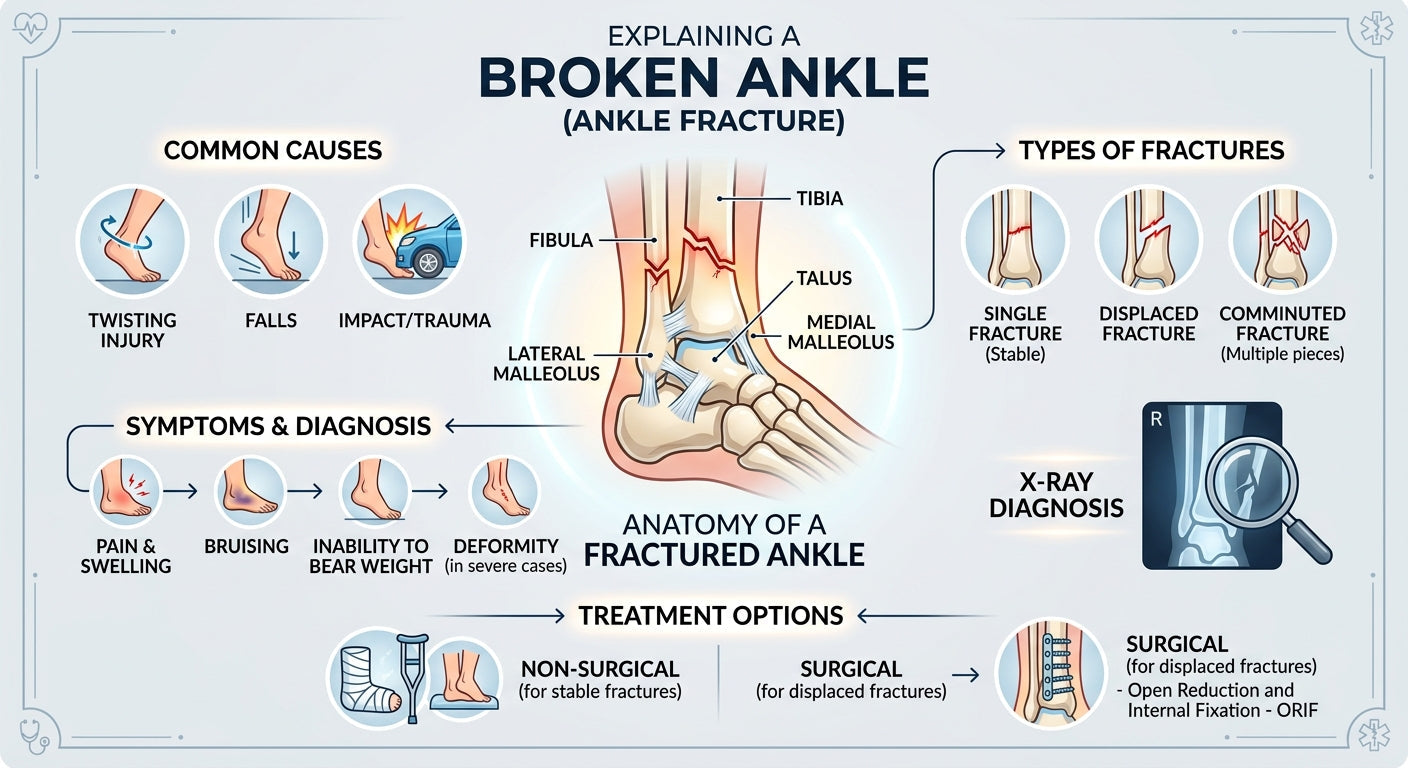
A broken ankle, also known as an ankle fracture, is a common injury that can happen to anyone, from competitive athletes to individuals who simply misstep on an uneven surface. It involves a break in one or more of the bones that make up the ankle joint: the tibia (shinbone), the fibula (the smaller bone in the lower leg), and the talus (a small bone between the heel and the tibia/fibula).
 Compare common causes and symptoms of a broken ankle, see a clear "8–12 weeks" recovery estimate, and assess treatment phases to make informed next-step decisions.
What Causes a Broken Ankle?
Ankle fractures typically result from rotational force or high-impact stress on the joint. Common scenarios include:
- Twisting or rolling: Awkwardly rolling your ankle during sports or a simple walk can cause a fracture.
- Falls: Tripping and falling, or landing on your feet from a significant height, can place immense pressure on the ankle joint.
- Impact: A direct blow to the ankle, such as in a car accident or a collision in a contact sport, can easily cause a break.
- Missteps: Stepping incorrectly on a curb, a crack in the pavement, or an uneven surface can lead to a fracture.
Identifying the Symptoms of a Broken Ankle
The signs of a fracture are often immediate and intense, making it difficult to ignore. Key symptoms include:
- Immediate, Severe Pain: A sharp, throbbing pain is the most prominent symptom.
- Swelling and Bruising: Significant swelling often develops quickly around the ankle. Bruising may appear soon after or within a day or two. Understanding the cause of ankle swelling can help differentiate it from other conditions.
- Inability to Bear Weight: One of the biggest questions people have is, "Can you walk on a broken ankle?" In most cases, putting any weight on the injured foot is extremely painful, if not impossible.
- Visible Deformity: The ankle may look out of place or dislocated if the bones are significantly displaced.
- Tenderness to the Touch: The area around the fracture will be very sensitive to pressure.
- A "Pop" or "Snap" Sound: Some people report hearing or feeling a snap at the moment of injury.
If you experience these symptoms after an ankle injury, it is crucial to seek medical attention immediately for a proper diagnosis, which typically involves a physical examination and an X-ray.
Treatment for a Broken Ankle
Treatment depends on the severity and stability of the fracture. A healthcare professional will determine the best course of action after evaluating the injury.
Non-Surgical Treatment
For stable fractures where the bones are not out of place, non-surgical methods are often effective. This approach usually involves:
- Immobilization: The primary goal is to keep the bones in the correct position while they heal. This is achieved using a cast or a walking boot. An inflatable ankle support might be used for initial stabilization before a more permanent device is fitted. A walking boot or an air cast for the ankle allows for some mobility while protecting the joint.
- Pain Management: Over-the-counter or prescription pain relievers can help manage discomfort.
- The RICE Method: Rest, Ice, Compression, and Elevation are vital in the early stages to reduce pain and swelling.
Surgical Treatment
If the fracture is unstable or the bones are displaced, surgery is often required. The most common procedure is called an Open Reduction and Internal Fixation (ORIF). During this surgery, an orthopedic surgeon repositions the bone fragments into their normal alignment and uses plates, screws, or pins to hold them in place while they heal.
The Recovery Timeline
Recovering from a broken ankle is a gradual process that requires patience and adherence to your doctor's instructions.
- Initial Healing (0-6 weeks): The first 6 weeks focus on bone healing. You will likely be non-weight-bearing and use crutches. The ankle will be immobilized in a cast or boot.
- Weight-Bearing and Physical Therapy (6-12 weeks): Once the X-rays show sufficient healing, your doctor will likely allow you to start putting weight on your ankle, often while still wearing a protective boot. This is also when physical therapy typically begins. A physical therapist will guide you through exercises to restore range of motion, strength, and balance. Learning when to stop wearing a walking boot is a key milestone determined by your doctor based on your progress.
- Returning to Normal Activity (3-6+ months): As your strength and mobility improve, you can gradually return to your normal daily activities. During this phase, wearing an ankle brace for pain can provide extra stability and confidence. For those transitioning out of a boot, finding the best ankle brace after a fracture is important for continued support during more demanding activities. It may take several months to a year to fully regain pre-injury function, especially for high-impact sports. The best ankle brace after a broken ankle will strike a balance between support and flexibility to meet your specific needs.
Full recovery from a broken ankle is a marathon, not a sprint. By following medical advice, committing to physical therapy, and listening to your body, you can ensure a successful return to an active, pain-free life.
-
Posted in
Ankle Injuries