Conquer Elbow Pain: The Active Person's Guide to Healing While Staying Strong
With summer just around the corner and Memorial Day kicking off the season of outdoor sports and intensive gym sessions, there’s nothing more frustrating than an unexpected injury derailing your momentum. You’re ready to hit the tennis courts, perfect your golf swing, or increase your lifting volume, but a nagging, sharp ache on the inside or outside of your elbow has other plans.
If you are an active person, you’ve likely heard the standard advice: "Just rest it." But for someone who thrives on movement, complete rest isn't just frustrating—it’s often counterproductive to long-term tissue strengthening. The secret to healing without losing your hard-earned progress doesn't lie in stopping altogether. It lies in mastering the art of activity pacing and load management.

Understanding Your Elbow Pain: The "Boom-Bust" Cycle
Before we dive into solutions, we need to understand the problem. Whether you are dealing with lateral epicondylitis (commonly known as tennis elbow) or medial epicondylitis (golfer's elbow), you are essentially dealing with tendons that have been asked to do more work than they are currently capable of handling. When trying to understand their injury, many people search online for a photo dikhaye (visual representation) to see exactly how these forearm muscles connect to the elbow joint.
The biggest mistake active individuals make is falling into the "boom-bust" cycle. It goes like this:
- Your elbow hurts, so you completely stop your activity (the "bust").
- After a week or two, the pain subsides.
- Assuming you are healed, you immediately jump back into your previous level of intense activity (the "boom").
- The sudden spike in stress overloads the weakened tendon, and the pain returns—often worse than before.
Complete rest reduces pain, but it also reduces the capacity of your tendons. To get back to the sports and lifting you love, you must gradually build that capacity back up.
What is Activity Pacing and Load Management?
While they sound like complex sports science terms, activity pacing and load management are simply ways of intelligently rationing your energy and joint stress.
Activity Pacing is about breaking your activities down into manageable chunks. Instead of trying to power through a two-hour workout, pacing involves "micro-dosing" your activity. You do just enough to stimulate the tissue without crossing the threshold into damaging pain.
Load Management is the broader strategy of monitoring and adjusting the physical stress placed on your body. "Load" isn't just the weight on the barbell. It encompasses:
- Volume: How many reps, sets, or minutes you are active.
- Intensity: How heavy the weight is, or how fast you are swinging a racket.
- Frequency: How many days a week you train.
- Complexity: The range of motion and technical difficulty of the movement.

The Role of Support: Enabling Safer Activity
A crucial part of load management isn't just modifying the weight; it's modifying how the load affects your tendons. This is where supportive gear becomes a highly strategic tool.
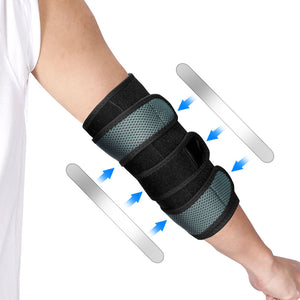
Using a well-designed elbow support helps disperse the force that travels up your forearm muscles before it hits the sensitive attachment point at your elbow. By slightly compressing the muscle belly, a counterforce brace changes the angle of the tendon, effectively acting as a secondary attachment point.
This mechanical shift offloads the injured tissue just enough to let you safely perform rehabilitative exercises and modified workouts. It bridges the gap between doing nothing and returning to full strength, proving that an elbow brace is less of a crutch and more of a proactive training enabler.
Structured Load Progression: Returning to Your Routine
So, how do we put this into practice? You need objective markers to advance your activities rather than just waiting to "see how it feels tomorrow."

Phase 1: Establishing Your Baseline
Find the amount of activity you can do with a pain level no higher than a 3 out of 10. This discomfort should settle completely within 24 hours. If it aches intensely the next morning, your baseline was set too high.
Phase 2: Modifying the Variables
If you're asking yourself what weight lifting exercises can i do with tennis elbow, the answer is usually: movements that allow you to modify your grip and range of motion.
- Change the Grip: Switch from an overhand grip to a neutral (palms facing each other) or underhand grip to relieve stress on the outer elbow.
- Reduce the Lever: Instead of lateral dumbbell raises with straight arms, bend your elbows to 90 degrees.
- Slow Down: Use a slower tempo, particularly on the lowering (eccentric) phase of a lift. This builds tendon resilience without heavy weight.
Phase 3: Gradual Advancement
Use the Rate of Perceived Exertion (RPE) scale. Start your modified exercises at an RPE of 4 or 5 out of 10. Week by week, assuming your "next-day pain" stays at a 3/10 or below, gradually increase the weight or reps by no more than 10%. Wearing the best tennis elbow brace for weightlifting during this phase is incredibly helpful for keeping those daily pain scores low while you progressively overload the tissue.
FAQ: Managing Elbow Pain While Staying Active
Why does my elbow hurt when lifting?
Elbow pain from lifting often stems from tendons being overloaded – asked to do more work than their current capacity allows. Repetitive gripping, heavy weights, or incorrect form can place excessive stress on forearm tendons, leading to conditions like tennis or golfer's elbow, and resulting in micro-damage and discomfort.
Can I still lift with elbow pain?
Yes, you can often continue lifting with elbow pain, but strategic modification is key. The article emphasizes that complete rest can be counterproductive, reducing tendon capacity. Instead, focus on activity pacing and load management to find a 'sweet spot' that stimulates tissue without aggravating the injury, allowing you to build strength gradually.
How do I know the difference between "good" pain and "bad" pain?
Distinguishing between 'good' and 'bad' pain is crucial for effective load management. 'Good' discomfort might feel like muscle fatigue or a mild ache that subsides quickly. 'Bad' pain, however, is sharp, shooting, or intensely localized at the tendon attachment point. If your pain exceeds a 3 out of 10, forces a change in your movement mechanics, or persists intensely beyond 24 hours, the article suggests you've pushed beyond your current capacity and need to adjust your activity.
Should I use supportive gear while recovering?
Yes, supportive gear, like an elbow support or counterforce brace, plays a strategic role in recovery. As detailed in the article, these items help disperse force, offload injured tendons by creating a secondary attachment point, and reduce mechanical strain. This allows you to safely perform rehabilitative exercises and modified workouts, aiding in progressive load management and keeping daily pain scores low.
Next Steps: Keep Moving Forward Safely
Overcoming elbow pain doesn't mean hanging up your athletic shoes or canceling your gym membership. It simply requires a strategic shift in how you view your training. By abandoning the "all-or-nothing" mindset and embracing intelligent activity pacing and careful load progression, you are actually training smarter.
Start today by establishing your pain-free baseline, experimenting with grip modifications, and utilizing proper physical support to offload those overworked tendons. You'll find that with patience and a structured approach, you can successfully navigate recovery while remaining the active person you love to be.