Shoulder Exercises
The shoulders are pivotal joints, crucial to nearly every upper-body movement, from lifting groceries to reaching for a high shelf. Maintaining their strength, flexibility, and stability is essential for daily function, athletic performance, and preventing discomfort. Neglecting these vital joints can lead to various issues that impact quality of life.

Foundational Principles for Effective Shoulder Workouts
- Warm-up: Always begin with light cardio and dynamic stretches to prepare the muscles and joints.
- Proper Form: Incorrect execution can lead to strain. Focus on controlled movements rather than heavy weights or excessive speed. If you're unsure how to perform an exercise, watch instructional videos or consult with a fitness professional.
- Progressive Overload: Gradually increase resistance, repetitions, or sets as your strength improves.
- Listen to Your Body: Never push through sharp discomfort. If an exercise causes pain, stop immediately.
- Cool-down: Finish with static stretches to improve flexibility and aid muscle recovery.
Strengthening Exercises for Robust Shoulders
Building strength in the shoulder complex involves targeting all three deltoid heads (anterior, medial, posterior) and the rotator cuff muscles. These exercises help to build shoulder muscles at home, enhancing both power and definition.
-
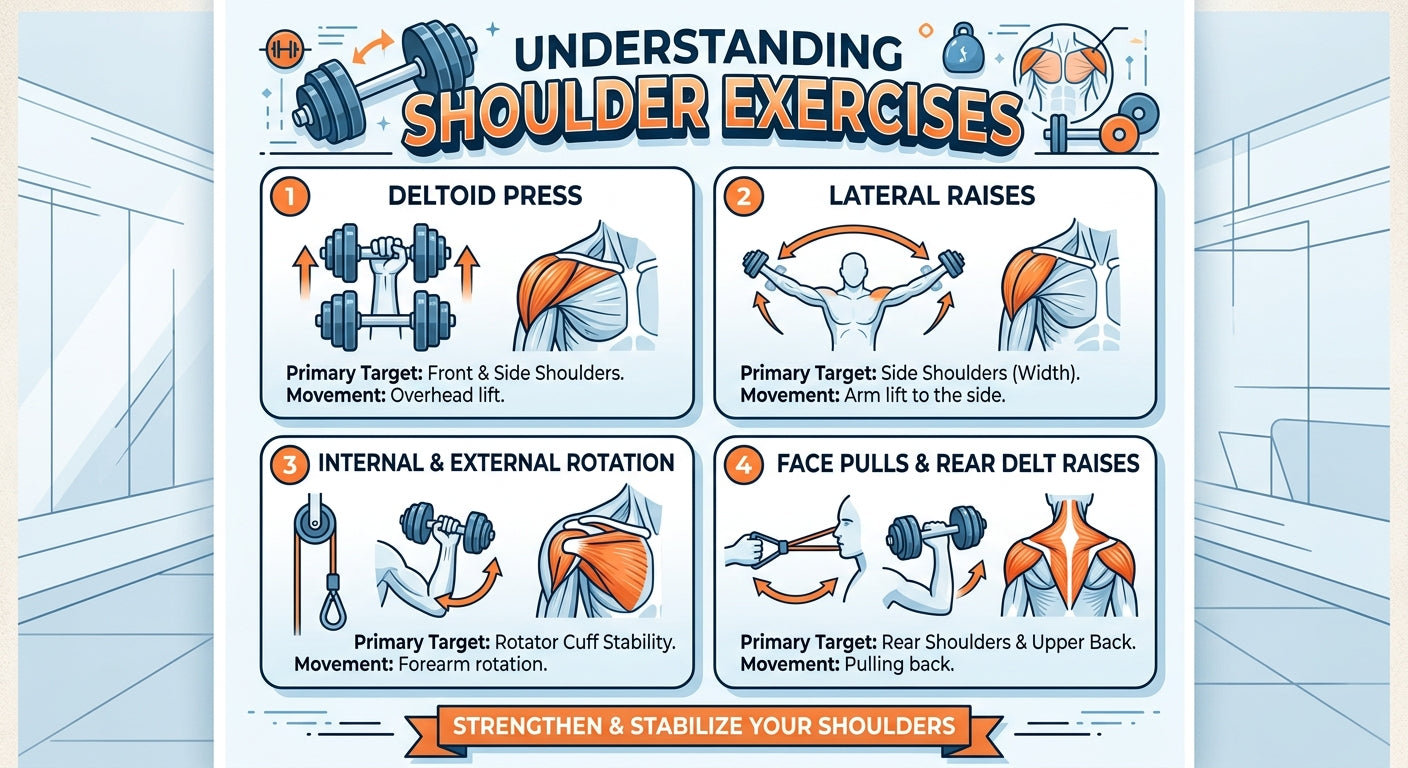
Overhead Press: A compound exercise that works all deltoid heads and triceps.
- Execution: Hold weights at shoulder height, palms facing forward. Press them directly overhead until arms are fully extended, then slowly lower back to the start.
-
Lateral Raises: Primarily targets the medial (side) deltoids, contributing to shoulder width.
- Execution: Stand with a slight bend in your elbows and hold the weights at your sides. Raise your arms out to the sides until they are parallel to the floor, then slowly lower.
-
Front Raises: Focuses on the anterior (front) deltoids.
- Execution: Stand with weights in front of your thighs, palms facing you. Raise your arms straight out in front of you until they are parallel to the floor, then slowly lower.
-
Bent-Over Reverse Flyes: Essential for posterior (rear) deltoids and upper back, often neglected in typical routines.
- Execution: Hinge at your hips, keeping your back straight, with weights hanging below your chest. With a slight bend in your elbows, raise your arms out to the sides like wings, squeezing your shoulder blades. Slowly return.
Wondering how many shoulder exercises per workout are ideal? It often depends on your fitness level and goals, but a balanced routine typically includes 2-4 strength-focused movements.
Flexibility and Mobility for Optimal Range of Motion
Flexibility exercises are crucial for maintaining a full range of motion and preventing stiffness. They also play a significant role in addressing issues like how to fix rounded shoulders by improving posture.
-
Arm Circles: Gentle rotation warms up the joint.
- Execution: Stand with arms extended to the sides. Make small circles, gradually increasing the size, both forward and backward.
-
Cross-Body Stretch: Targets the posterior deltoid and rotator cuff.
- Execution: Bring one arm across your body, using the other arm to gently pull it closer to your chest. Hold for 20-30 seconds.
-
Pendulum Swings: A passive range of motion exercise, often used for recovery.
- Execution: Lean forward and let your affected arm hang freely. Gently swing it forward/backward, side to side, and in small circles.
If you're experiencing shoulder pain while lifting weights, evaluate your form and consider lighter loads or modified exercises. Similarly, learning how to relieve shoulder pain from sleeping can significantly improve overall comfort.
Rehabilitation and Stability Exercises
-
External and Internal Rotations: Targets the small muscles of the rotator cuff.
- Execution: Using a light resistance band anchored to a door, stand sideways to the anchor. Keep your elbow tucked at your side and rotate your forearm away from your body (external) or across your body (internal).
-
Scapular Squeezes: Strengthens the muscles that stabilize the shoulder blades.
- Execution: Sit or stand tall. Gently squeeze your shoulder blades together and down, as if trying to hold a pencil between them. Hold for a few seconds and release.
If you're dealing with a sprain, understanding how to heal a sprained shoulder means taking a gradual approach to stability movements.
Integrating Support and Protection
While exercises build strength, external support can add confidence and stability, especially during demanding activities. Many ask, "Do shoulder compression sleeves work?" For many, they provide proprioceptive feedback and mild compression, which can be beneficial. Athletes often seek shoulder support in sports to enhance stability during dynamic movements. For those who frequently lift heavy objects, shoulder support for lifting weights can provide an added layer of protection and comfort. For more specific issues, such as a rotator cuff concern, support for a torn rotator cuff can be part of a comprehensive recovery strategy, helping stabilize the joint and reduce unwanted movement. Shoulder supports can help with rotator cuff injuries by providing compression and limiting excessive motion, which can support healing.
-
Posted in
Shoulder pain