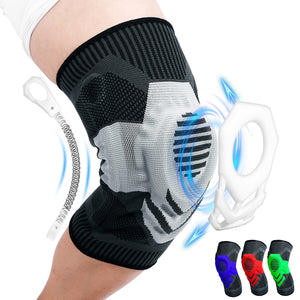
Best Knee Brace for Patellar Tendonitis
- Black
- Green
- Orange
- Pink
- Black
- Blue
- Green
- Red
- Orange
- Blue
- Dark Blue
- Black
- White
- Red
- Blue
- Black
- Blue
- Red
- Orange
- Yellow
- Black
- Blue
- Green
- Red
- Blue
- Black
- White
- Red
- Dark Blue
- Grey
- Black
- Blue
- Pink
- Grey
- Black
- White
- Light Black
- Black
- Light Grey
- Grey
- Magenta
- Black
- Green
- Black
- Grey
- Red
- Blue
What is the Main Stabilizer for Patellar Tracking?
Patellar tracking refers to the precise, biomechanical movement of the kneecap (patella) as it glides seamlessly along the trochlear groove of the thigh bone (femur) during regular knee flexion and extension. When the patella shifts out of its normal anatomical alignment—a condition frequently referred to as patellar maltracking—it can lead to chronic anterior knee pain, structural instability, and debilitating conditions such as patellar dislocation, patellar subluxation, or patellofemoral pain syndrome (often known as runner's knee).
To prevent these painful orthopedic issues, the knee relies on a complex network of active and passive anatomical structures. The main stabilizer for patellar tracking is the delicate balance between the surrounding muscles and ligaments, most notably the quadriceps muscle group and its highly specialized inner component, the vastus medialis obliquus (VMO).
The Anatomy of Knee Movement: Active and Passive Stabilizers
Understanding how the kneecap stays in its proper lane requires a closer look at both the active stabilizers (the muscles) and the passive stabilizers (the ligaments and joint capsule). Together, these elements act as a sophisticated pulley system that keeps the joint functioning smoothly without painful grinding, clicking, or popping.
The Role of the Quadriceps and the VMO (Active Stabilizers)
The quadriceps muscle group, consisting of four distinct muscles at the front of the thigh, plays the most crucial active role in stabilizing the patella during dynamic movement. As you bend and straighten your leg, the quadriceps contract and pull on the patellar tendon.
Among these four muscles, the vastus medialis obliquus (VMO) is exceptionally important. Located on the inner lower portion of the thigh, just above the knee, the VMO is uniquely designed to pull the patella medially (inward). This inward pull is absolutely vital because the natural biomechanics of the human leg generally encourage the kneecap to drift laterally (toward the outside). If the quadriceps are weak, fatigued, or neurologically imbalanced—particularly if the VMO is underdeveloped or under-firing—the lateral muscles overpower the medial muscles. This results in improper lateral patellar tracking, increased friction against the femur cartilage, and eventual joint dysfunction.
The Medial Patellofemoral Ligament (Passive Stabilizers)
Beyond dynamic muscular support, the fibrous ligaments around the knee joint provide essential passive and structural stability. The most critical ligament for keeping the kneecap centered is the medial patellofemoral ligament (MPFL).
The MPFL acts as a strong anatomical tether connecting the inner edge of the femur directly to the inner edge of the patella. Its primary job is to physically block the kneecap from dislocating or subluxating laterally during the early stages of knee bending. If the MPFL is stretched, damaged, or torn from a prior dislocation or chronic joint laxity, it can cause severe, ongoing tracking problems.
Common Symptoms of Patellar Maltracking
When the main stabilizers fail to keep the kneecap aligned within the trochlear groove, individuals typically experience a range of disruptive symptoms. Recognizing these early can prevent long-term cartilage degradation, such as chondromalacia patellae. Common signs include:
- A dull, aching pain behind or around the kneecap, especially when climbing stairs, squatting, or sitting for long periods.
- Audible popping, clicking, or a grinding sensation (crepitus) when bending the knee.
- A sudden feeling that the knee is "giving way" or buckling under physical stress.
- Noticeable swelling or stiffness in the joint after exercise.
How to Correct and Support Improper Tracking
Restoring optimal alignment requires a comprehensive approach that addresses both the weakened anatomical structures and the immediate need for joint support.
Targeted Physical Therapy and Rehabilitation
Because the VMO is the main active stabilizer, rehabilitative physical therapy is usually the first line of defense. A well-rounded physical therapy routine focuses on quadriceps hypertrophy and neuromuscular activation. Strengthening exercises such as straight leg raises, step-ups, and wall sits are often prescribed to improve the coordination between the VMO and the lateral thigh muscles. Additionally, strengthening the hip abductors and core can prevent inward knee collapse (valgus), which can further worsen lateral patellar tracking.
The Role of External Knee Support
While rehabilitating the muscles is a long-term fix, people experiencing pain, structural instability, or fear of dislocation need immediate external support to safely navigate daily movements and exercises. Specialized knee supports are meticulously designed to mimic the stabilizing effects of the MPFL and VMO.
For those seeking to optimize recovery and protect the joint from further cartilage wear, investing in the best knee brace for patellar stabilization can provide significant relief. These targeted orthopedic garments often feature an integrated patellar tracking guide, a C-shaped or O-shaped silicone buttress, and adjustable tension straps. These features work together to block lateral drift, keep the patella centered in the femoral groove, and dramatically reduce compressive load on the joint. By promoting proper biomechanical movement patterns, a high-quality stabilization brace helps individuals stay active while their internal muscles and ligaments heal and strengthen.