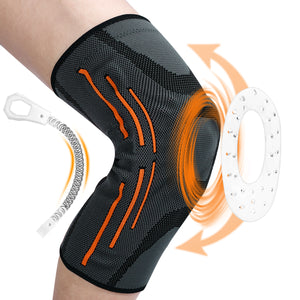
Best Knee Sleeves For Squats
- Black
- Green
- Orange
- Pink
- Black
- Blue
- Green
- Red
- Orange
- Blue
- Dark Blue
- Black
- White
- Red
- Blue
- Black
- Blue
- Green
- Red
- Dark Blue
- Grey
- Black
- Blue
- Pink
- Grey
- Black
- White
- Light Black
- Black
- Light Grey
- Grey
- Magenta
- Black
How Do I Protect My Knees When Squatting?
Squats are universally recognized as the ultimate lower-body exercise, essential for building strength, increasing flexibility, and enhancing overall athletic performance. Whether you are a seasoned weightlifter or a beginner starting a fitness journey, squatting engages your quadriceps, hamstrings, glutes, and core. However, a common concern among fitness enthusiasts is joint discomfort. If you're wondering how to prioritize knee health during leg day, you are not alone.
Poor mechanics, mobility restrictions, or lifting too heavy too soon can lead to unnecessary strain. Fortunately, with a few strategic practices, you can protect your joints, prevent injury, and maximize your lower-body gains.
Understanding the Anatomy of a Safe Squat
Before diving into protective measures, it is important to understand how your lower body moves. A successful squat requires synchronized movement across the hips, ankles, and knees. When one area lacks mobility—such as tight ankles or stiff hips—the knee joint often compensates and bears the brunt of the load. Protecting your joints means addressing the entire kinetic chain to ensure smooth, pain-free movement.
Actionable Strategies to Prevent Knee Discomfort
1. Master Proper Squat Technique and Form
Form is everything. Before adding barbell plates, ensure your foundational mechanics are flawless. Stand with your feet roughly shoulder-width apart, pointing your toes slightly outward to match your natural hip structure. As you initiate the descent, hinge at the hips first—imagining sitting back into a chair—rather than simply pushing your knees forward.
Keep your chest elevated, your core braced, and your spine neutral. Crucially, watch your knee tracking; your knees should align with your toes and never cave inward (valgus collapse). Hitting a deep squat is fantastic for muscle activation, but only lower yourself as far as your mobility allows without compromising form or feeling sharp discomfort.
2. Incorporate a Comprehensive Dynamic Warm-Up
Cold muscles and stiff joints are a recipe for injury. A dynamic warm-up increases blood flow, lubricates the joints, and prepares your central nervous system for heavy lifting. Incorporate bodyweight movements like leg swings, hip openers, and forward lunges before hitting the squat rack. Focusing on ankle mobility and hip flexibility will help you achieve a deeper, safer squat, reducing compensatory stress on your kneecaps.
3. Practice Gradual Progressive Overload
Ego lifting is a fast track to joint pain. To avoid straining your ligaments and tendons, you must steadily and carefully increase your training volume and intensity. Start with bodyweight squats or an empty barbell. Add resistance only when you can perform multiple repetitions with impeccable form. This slow, methodical progression gives the structural tissues around your knee time to adapt to heavier loads, ensuring long-term resilience.
4. Strengthen Surrounding Muscle Groups
Your knees rely heavily on the muscles surrounding them for shock absorption and stability. A well-rounded strength-training routine that targets the entire leg will significantly enhance your joint protection. Focus on exercises that isolate the hamstrings, glutes, and calves. Accessory movements like Romanian deadlifts, Bulgarian split squats, and leg presses build a robust muscular foundation. Strong glutes and hamstrings act as an anchor, preventing the knees from drifting out of alignment during the most challenging parts of the lift.
5. Select Optimal Weightlifting Footwear
What you wear on your feet drastically impacts your biomechanics. Everyday running shoes with thick, squishy soles can create an unstable surface, causing your ankles to wobble and transferring that instability straight up to your knees. Instead, choose footwear designed for lifting. Flat-soled sneakers or specialized weightlifting shoes with a slightly elevated, hard heel provide essential grounding, arch support, and balance. This solid foundation helps you generate force safely without placing undue torque on your joints.
6. Maximize Stability with Supportive Gear
Even with perfect form and a comprehensive warm-up, heavy lifting requires extra joint support. One of the best ways to improve safety and performance is to use dedicated fitness accessories. Wearing a knee brace compression sleeve offers major benefits, including therapeutic warmth, improved blood circulation, and essential joint stability. The snug fit of these accessories provides proprioceptive feedback, meaning your brain becomes more aware of your knee positioning throughout the entire range of motion.
When shopping for protective gear, look for items that support the joint without restricting natural movement. High-quality knee brace sleeves are designed from breathable, durable materials that offer reliable, consistent compression. They help lock in body heat, which keeps the synovial fluid inside the joint moving smoothly, ultimately preventing the stiffness that often leads to injury. Choose a size that fits snugly but stays comfortable enough to wear through an intense workout.
Listen to Your Body
Pain is your body's internal alarm system. A dull muscle burn is expected during a tough workout, but sharp or stabbing joint pain is a clear signal to stop. Pushing through joint discomfort will only exacerbate underlying issues. Take enough rest days, prioritize sleep and nutrition for recovery, and don't hesitate to lower your weights if fatigue makes your form break down.