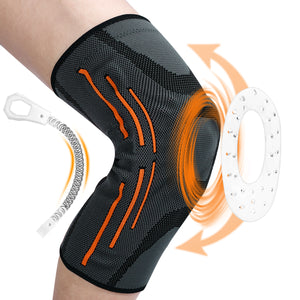
Extra Large Knee Support
- Black
- Green
- Orange
- Pink
- Black
- Blue
- Green
- Red
- Orange
- Blue
- Dark Blue
- Black
- White
- Red
- Blue
- Black
- Blue
- Red
- Orange
- Yellow
- Black
- Blue
- Green
- Red
- Blue
- Black
- White
- Red
- Dark Blue
- Grey
- Black
- Blue
- Pink
- Grey
- Black
- White
- Light Black
- Black
- Light Grey
- Grey
- Magenta
- Black
- Green
- Black
- Grey
- Red
- Blue
How Much Weight Can a Knee Support?
During normal daily activity, the physical pressure placed on your knee joints fluctuates dramatically based on the type of movement you are performing. Whether you are standing still, walking through the park, or climbing steep stairs, your knees are subjected to pressures far greater than your body weight. For heavier individuals or those dealing with excess weight, the baseline pressure on the knees is magnified significantly. Because of this compounded stress, finding effective methods to help share the mechanical load on the knees is essential to keep them healthy and pain-free over the long term.
The Biomechanics of Movement: How Much Stress is on Your Knees?
To understand joint stress and knee joint pressure, it helps to look at lower-body biomechanics. When you walk on level ground, the downward force exerted on your knees equals roughly one and a half times your total body weight. However, the moment you transition to an incline or start climbing stairs, that joint force can easily spike to three or four times your weight. When you bend your knees deeply or squat to pick something up, the pressure can increase to an astonishing five times your body mass.
This constant fluctuation requires the surrounding muscles, ligaments, and cartilage to work continuously to stabilize the leg. When the weight bearing down on the joint exceeds what the surrounding musculature can comfortably manage, it often leads to joint discomfort, muscular fatigue, and a higher risk of long-term wear and tear.
How Knee Compression Systems Disperse Weight
A well-designed, anatomically contoured knee support can help reduce intense stress concentration on the joint by efficiently redistributing that force. By providing external compression and structural reinforcement, these garments take some of the mechanical burden off your internal ligaments, spreading the kinetic impact across a wider surface area of the leg.
For individuals carrying extra weight, finding the right fit is absolutely essential for effective pain relief and joint stabilization. Using an extra-large knee support is highly beneficial, as these designs are crafted from durable materials and reinforced to provide optimal stability. Designed for wider legs, this specialized gear provides more coverage and robust support around the entire knee area without rolling down or cutting off circulation.
The Power of Targeted Compression and Elasticity
Quality joint supports often feature advanced elastic components and fully adjustable straps that can be customized to the wearer's specific anatomy. Targeted elastic materials help maintain consistent, soothing pressure around the knee joint. This precise compression does more than just hold the joint securely in place; it actively improves local blood circulation and delivers a comforting sense of stability, which is crucial for reducing joint inflammation, easing stiffness, and promoting faster recovery after physical exertion.
Enhancing Joint Stability and Injury Prevention
By providing reinforced stability, a reliable knee support helps the joint to articulate and move much more smoothly, drastically reducing the risk of a sudden twisting injury or ligament strain. When your joints are properly aligned, the friction inside the knee capsule is minimized, allowing for a safer range of motion.
Furthermore, the snug fit of the support acts as a constant physical reminder—known as proprioceptive feedback—to help the wearer maintain proper posture and mindful movement patterns. When you are hyper-aware of your knee positioning, you naturally avoid awkward steps and poor body mechanics, thereby further reducing the dangerous stress placed on the knee during daily chores or exercise routines.