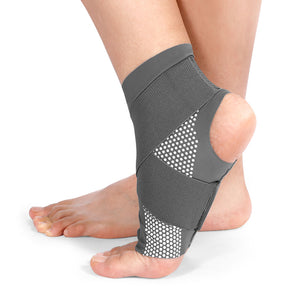
Arch And Ankle Support
- Black
- Grey
- Blue
- Pink
- Purple
- Black
- Orange
- Green
- Pink
- Black
- Red
- Blue
- Orange
Can Lack of Arch Support Cause Ankle Pain?
Yes, a lack of arch support can absolutely cause ankle pain.
Your feet are the foundation of your entire body. When that foundation is compromised by a lack of proper arch support, a chain reaction of biomechanical issues travels upward, with the ankle joint being the first to absorb the unnatural stress. Whether you are dealing with naturally flat feet, aging, or prolonged standing on hard surfaces, understanding how compromised arches affect your ankles is crucial to finding long-lasting relief.
The Downsides of a Lack of Arch Support
When the arches of your feet flatten or fail to absorb the shock of daily movement, your foot biomechanics are severely altered. This structural collapse directly impacts the surrounding joints, leading to a variety of painful ankle conditions.
Overpronation and Supination Issues
The most common consequence of poor arch support is overpronation. During a normal gait cycle, your foot naturally rolls inward slightly to absorb shock. However, without adequate arch support, the foot rolls inward excessively, causing the arch to completely collapse against the floor. This severe inward tilt forces the ankle joint to follow suit, placing immense, repetitive strain on the ligaments located on the inner side of the ankle, specifically the deltoid ligament.
Conversely, poor foot mechanics can also trigger supination (underpronation), where the foot rolls too far outward. This places a dangerous amount of stress on the lateral ligaments on the outside of the ankle. Both overpronation and supination stretch the ligaments beyond their natural capacity, leading to chronic ankle instability, frequent sprains, and persistent lateral or medial ankle pain.
Muscle Fatigue, Tendon Strain, and Compensation
Your body is highly adaptable and will automatically try to correct structural imbalances. Because the arches are not providing natural lift, the muscles and tendons in the foot and ankle must work overtime to compensate. Muscles that are essential for supporting the arches—such as the tibialis posterior and the flexor hallucis longus—are kept in a state of constant, rigorous engagement.
This relentless workload quickly leads to deep muscle fatigue. When these supporting muscles become exhausted, they can no longer stabilize the ankle joint properly. This condition, often referred to as Posterior Tibial Tendon Dysfunction (PTTD), leaves the ankle highly vulnerable to severe misalignments, sharp tendon pain, and chronic aching after walking or running.
Impact on Joint Surfaces and Cartilage
The arch of the foot is designed to act as a natural spring, dispersing the impact of your body weight as your heel strikes the ground. Without this vital shock absorption, abnormal kinetic forces shoot straight up into the ankle joint.
Over time, this unnatural pressure alters how the bones within the ankle interact, leading to excessive friction on the joint surfaces. The cartilage that normally cushions these bones begins to wear away at an accelerated rate. This increased wear and tear is a primary contributor to early-onset ankle osteoarthritis, a degenerative condition characterized by morning stiffness, swelling, deep joint pain, and significantly reduced ankle mobility.
Effective Prevention and Treatment Strategies
Fortunately, arch-related ankle pain is highly manageable. By actively taking steps to improve foot alignment and enhance structural support, you can alleviate current ankle discomfort and prevent future joint deterioration.
Regular Foot and Ankle Exercises
Physical conditioning plays a massive role in combating the effects of flat feet and fallen arches. Performing specific, targeted foot exercises can dramatically strengthen the intrinsic muscles that support your foot's natural curvature.
- Toe Curls: Also known as towel scrunches, this involves placing a towel flat on the floor and using your toes to grip and pull the fabric toward you. This builds strength in the flexor tendons.
- Arch Lifts (Short Foot Exercise): This involves keeping your heel and the ball of your foot planted on the ground while actively contracting your foot muscles to elevate the arch.
- Calf Stretches: Tight calf muscles can restrict ankle mobility and pull on the plantar fascia, worsening arch collapse. Regular stretching relieves this tension.
Strengthening these targeted muscle groups helps them better support your body weight, reducing negative impact on the ankle joint and minimizing daily pain.
Using Ankle Braces with Arch Support
For individuals suffering from chronic discomfort, utilizing specialized orthopedic wearables can provide immediate and lasting relief. Integrating an ankle brace for fallen arches into your daily routine is highly beneficial.
These advanced supports go beyond standard compression; they offer vital stability to the ankle joint while simultaneously lifting and reinforcing the arches of the foot. This dual-support mechanism helps correct foot misalignment issues that trigger ankle pain immediately. By actively maintaining the proper shape and elevation of the arch, the brace ensures that your body weight is distributed evenly across the entire foot and ankle complex. This completely mitigates the risk of severe overpronation or supination, drastically reducing the associated stress on your delicate ankle ligaments.
A lack of arch support causes ankle pain through a complex mix of abnormal weight distribution, altered gait biomechanics, and extreme muscle strain. By understanding this physical connection and implementing proactive solutions like targeted exercises and structural bracing, you can successfully restore your body's foundation and enjoy a life free from ankle pain.